Recently, the British newspaper “Sunday Times” published a report on a secret meeting between Russian President Vladimir Putin and leaders of the Afghan movement “Taliban”, where the two sides discussed about Russia providing assistance to the movement. The newspaper reported that there are sources that spoke about an unspoken meeting held between Putin and the leader of the “Taliban” movement at a dinner banquet at a military base in Tajikistan in late September.
For its part, the Kremlin denied the reports, describing them as “pure allegations,” but the observer of the details of the current international scene may not be surprised at the happening of that. What is happening in the large chess area in the world, starting from Syria and ending with Ukraine and Afghanistan is only conflicts between the poles of the global system for re-demarcation of the zones of influence, and so everyone competes and everyone plays and throws his weight and all his papers in order to extract more real or virtual, or even future influence.
Therefore, it may seem logical that Russia is seeking to re-enter Afghanistan, which it considers a traditional zone of influence and a strategic back garden to it, even if this return takes place with different tools and targets, and across the gate of the old enemy, which played an influential role in the collapse and the disintegration of the former Soviet Union since its invasion to Afghanistan in 1979, which most researchers consider as the beginning of the end of the old Soviet influence!
“Interests are reconciled,” as the political rule says, and there are no permanent interests, nor ongoing hostilities, and therefore, cooperation scenarios between the Afghani movement “Taliban” and Russia become possible, and even strategic thinking pushes the Russian side at them strongly for several reasons and considerations. First revenge, and the desire to return the “slap” to the United States, which has played the most important role in financing the Afghan jihadists during the Soviet invasion of Afghanistan, and is now at the heart of the event and in the same field of operations and seeks to emerge from the Afghan quagmire with the least possible strategic and human losses. And certainly there are strategic parties and opponents that will not let the opportunity pass without making use of it, led by Russia. And the second reason is that one of the motives of the Russian military intervention in the Syrian crisis lies in finding an objective equivalent willing to barter in the Ukrainian crisis, and to respond to the pressures and sanctions exerted by the United States and NATO against Russia in Ukraine, therefore the search for a deal with “Taliban” may represent a thinking of this kind, especially that the alleged meeting between Putin and the leader of “Taliban” has preceded the Russian military intervention in Syria, most likely, which took place at the end of last September.
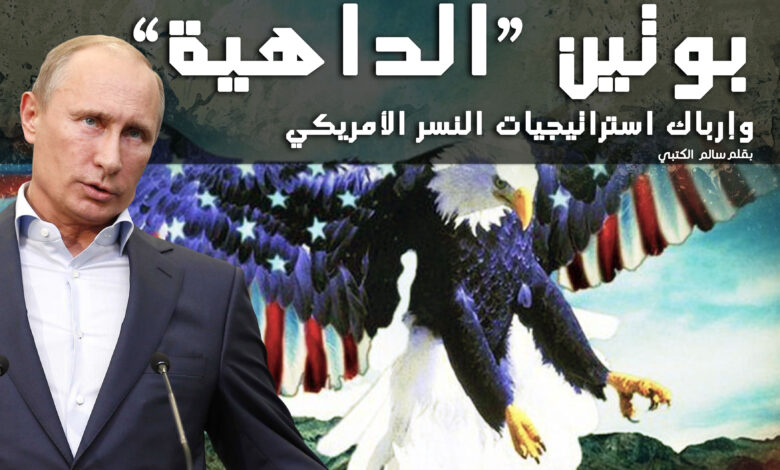
What I’m interested in in these developments is that the Russian variant is strongly haunting the American Eagle, which tried to tighten its grip on the new world order in light of the emergence of strong new competitors in the forefront of which are China and Putin’s Russia, and in light of the expansion of the competition area so that it is no longer exclusively on the military field, but extended to include the economy, trade and other areas of competition and polar conflict.
Putin’s Russia no longer accepts its geopolitical situation and strongly seeks to “produce” testable cosmic variables, and to redefine the global geopolitical environment through direct and indirect intervention in many of the world’s open files of conflict. The Russian intervention in the Syrian crisis for example, has caused confusion in the US pole calculations and placed it in a very awkward position, especially as this intervention was beyond the scope of possibilities for American strategies planners, but Putin did it and risked interfering in a complex war and a crisis that is experiencing rapid transformations. What has caused more confusion to the calculations of the only superpower in the world is that the Russian military intervention in the Syrian crisis has produced new variants including modifying the balance of military power between the parties to the conflict. And what doubles the importance of this result is that it was achieved through the Air Force, which the NATO is betting on a lot in resolving any future conflicts with his strategic opponents and enemies.
The Russian intervention in the Syrian crisis has also produced an alliance of a new kind, which remained for a long time on paper or confined in the political and economic sphere, but it has evolved into a real military alliance involving Russia, Iran and the Syrian regime of President Bashar al-Assad, and this coalition worked in the field with a single command in several regions of Syria, reflecting shifts in the concept of Russian-Iranian alliance, at least, and its scope as well as the limits of its employment in the future.
I believe that the rapid changes in the region will affect the US foreign policy somehow, and will push planners of this policy to rethink the question of focusing on the use of “soft power” as a key tool to ensure the control and influence of the US on the world, especially that the current and potential strategic opponents rely on “hard power ” on the journey for the search for new areas of influence, which could make the American Eagle return to an old-new circle, relying on US military power, or adopting a new combination of the two powers, “soft” and “hard,” or the so-called smart power, but awarding the hard power the upper hand in the new combination of American power.