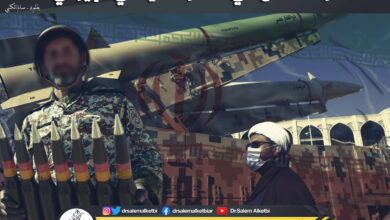
The recent visit by US President Donald Trump to Saudi Arabia resulted in the implicit announcement of the return of the American role in the Middle East, contrary to what prevailed during the past two years, where the Obama administration completely abandoned the issues of the region, and allowed a broad Russian-Iranian expansion, threatening the strategic interests of the GCC countries.
Unlike his predecessor, the US president did not mention in his speech to the American Islamic Summit, held recently in Riyadh, human rights or democracy. President Trump’s speech differed from his predecessor Obama in other respects. Obama’s speech was lengthy, with a total of 5400 words. He addressed the issues of freedom, human rights and women. He also dealt with several issues, the most important of which was the Palestinian cause. His speech was inclined to academic and political theory. President Trump’s speech was more focused on the issues of terrorism and Iran through a speech of about 2,600 words. It includes a clear and direct vision that expresses the new American administration’s creed. He presented a clear and precise vision in which he said each party should assume its obligations in a precise and unambiguous way. President Trump’s speech was also more focused on the idea of partnership and seeking to convince the Muslim world of the need to eradicate extremist ideology.
In his address to the leaders of the Muslim world, President Trump also said that the fight against extremism is not a battle between religions. “This is a battle between good and evil” he said. One of the most important points of President Trump’s visit, in general, is changing the prevailing stereotype of Trump’s vision of the relationship with Islam, focusing on the conflict between good and evil rather than conflict between religions, or with Islam in particular.
President Trump’s talk about the need to confront the Houthis’ danger and to stop Iranian support for them is in the interest of the Saudi-led Arab coalition, supporting its position in Yemen and putting a great deal of pressure on the Houthi insurgency and the ousted President Ali Abdullah Saleh’s militias. There is no room to play on the international split over what is happening in Yemen.
There are other gains made through this visit and the remarkable organization of the American Islamic Summit. The US-Islamic summit recognized Saudi Arabian leadership of the Muslim World (especially the Sunni parts) and capability to help the US achieve its strategic objectives.
President Trump sought to reframe American-Islamic relations as partnership instead of hostility and confrontation. This reform of discourse is an attempt to change his stereotypical image at home and abroad and promote himself as a champion of peace and harmony between civilizations and religions, without abandoning his favourite slogan: “America First”.
It is clear that the Riyadh summit provided a new dimension for the American administration, which is a better understanding of the Muslim world. This was stressed by the US Secretary of State, saying that they have a better understanding now of the Islamic religion through their presence there in the country of the Two Holy Mosques, hoping that Muslims societies know that the American people have the same concerns they have.
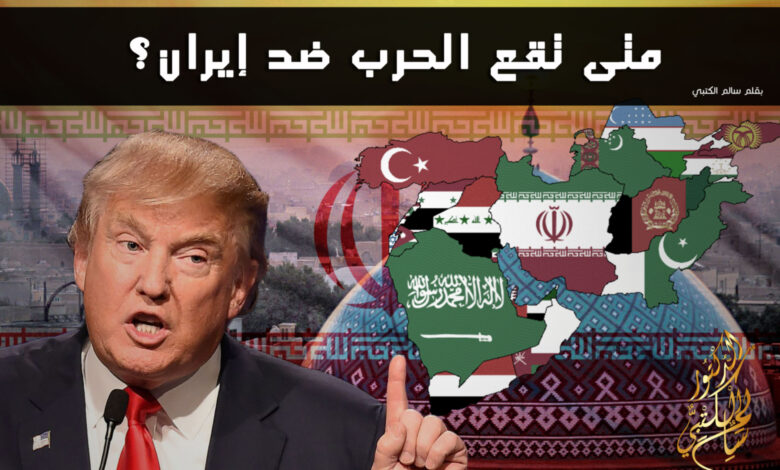
On the backdrop of the new anti-Iran international alliance, many wonder: is there going to be a military confrontation with Iran? When is the war against Iran starting?
Trump’s speech at the Riyadh summit helps us understand his orientations and main focus since he took office, indicating that the scenario of military confrontation between the United States and Iran is excluded and that Washington has a tendency to act in two main tracks.
The first is to help Gulf allies protect their national security and address strategic threats. The second is the American tendency to return to the principle of isolationism and containment of the sources of threat. This is a similar way to the traditional containment strategy which prevailed in US-Iranian relations for many years. The development of this strategy to become more effective and influential is achieved by pushing Muslim countries to isolate Iran and have it change its political conduct and stop intervening in the affairs of other countries.
In this context, US Secretary of State Tillerson was clear when he called on Iran to stop its ongoing activities to destabilize the region and its support for militias in neighbouring countries. He expressed the hope that the Iranian leadership will return to the negotiations table, stressing the need for the international community to adopt firm and effective positions while refusing Iran’s policies and support of terrorism through tougher economic sanctions and policies against Iranian foreign military presence.
Saudi Arabia does not seem to be inclined to open a military confrontation with Iran. The Kingdom adopts an ambitious development vision designed by the young Emir and Crown Prince Mohammed bin Salman. It is not clear that it is considering initiating a military conflict with the mullahs. Saudi Arabia knows the mullahs’ regime feeds on military conflicts to stay away from ‘legitimation crises’ distracting its people from internal failures with external crises.
The arms deals signed by Saudi Arabia are not a sign of readiness for an offensive. They are mainly and likely to strengthen and fortify the Saudi defence capabilities in the face of Iranian threats. The same applies to the rest of the GCC countries as they seek to strengthen their self-defence capabilities and protect their peoples from the Iranian growing expansion.
Iran should understand that the GCC is more interested in development than in confrontation with Iran, but that does not mean leaving free hand for the mullahs to pursue their sectarian expansionist plans.