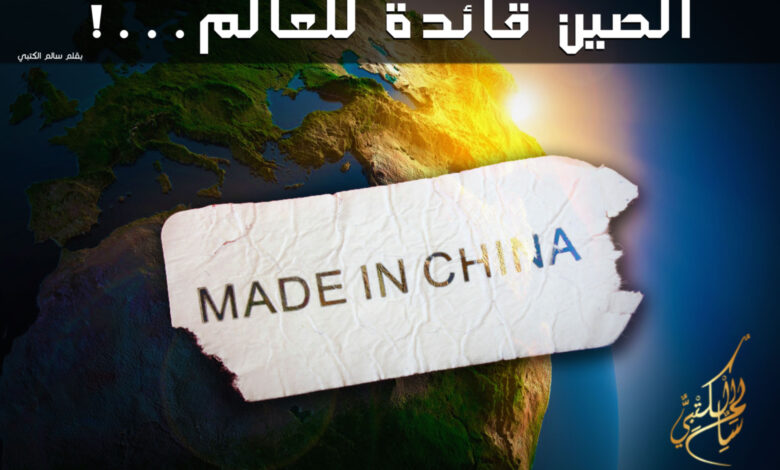
A statement that is not normal in international relations did not draw the attention of the majority of observers and specialists, but it must not pass unnoticed. Amidst the hype of high global debates on the strategic implications of the Donald Trump presidency, senior Chinese official Zhang Jun, head of the world economic forum in the Chinese Foreign Ministry, declared that China does not seek to lead the world, but they may be forced to adopt this role if others decline.
This statement is the first Chinese position in history about the possibility of leading the world, and this position came as a reaction to US President’s ‘America First’ position.
In an interview with Zhang Jun, President of the World Economic Forum in the Chinese Foreign Ministry, he said China has no intention to seek world leadership and that it is not rushing to play a global leadership role in the world, but leaders in the race backed away, leaving the place for China. This philosophical idea can lead us to the same conclusion, which is that China is moving toward leadership of the world whether it likes it or because others gave up, referring to the US.
Recently, there were several indicators from China about its outlook for the world. Most recently in an interview with Chinese President Xi Jinping at the World Economic Forum in Davos, he considered his country as ”leader of the globalized world,” saying that it is a world where problems are solved only through international cooperation. The Chinese president also hinted during this conversation to his country’s desire to play a greater international role, rejecting the idea of isolationism, and urged the new US president to abandon it.
Certainly, the emergence of the idea of the Chinese leadership to the world, regardless of the circumstances, necessarily means that there is a serious willingness in China for such a move. The sensitivity of China’s leadership is well known to international relations experts. Recognizing it means that there is an advanced strategic thinking on how to implement it as the Chinese official stressed that “If China wants to play this leadership role it will assume its responsibilities”, which means that there is already a study of the consequences and the limits of the international responsibility for the global system leadership. China is not an adventurer or reckless country, but has a huge stockpile of historical experiences as well as sensitivities, and it is not easy to say that it would bear the responsibility of leading without enough strategic awareness of the potential consequences of its leadership.
In principle, it is not surprising to talk about the Chinese leadership to the world. Experts are aware that it was a matter of time with strong links to China’s willingness to lead which has deep roots in Chinese history.
China was busy over the past decades to build its own capacity and not rush to reach for leadership, and was until recently keen to consider itself among developing economies, and does not want to be pushed to lead in a timing that is not appropriate, but when China says it is “prepared” it means that it exceeded the caution stage and elevated to the strategic readiness to assume the position.
China is also the world’s second largest economy, and is aware that Trump is moving towards reducing outsourcing and increase commercial and industrial protectionism, but is confident that there are limited opportunities for the success of these attempts after China introduced all the world’s economies into an addiction to cheap goods and cheap labor and other economic and commercial accounts that make it difficult to compete with China.
It seems that China is grimacing, albeit slightly, in the face of President Trump policies, as trump adopts a confrontational policy to a large extent towards China, especially after he broke what looked like a “taboo” for Beijing as he opened a telephone hotline and made a call with the President of Taiwan, the first since the relations deteriorated in 1979.
Although the White House has tried to mitigate the impact of this call, saying it is not considered a sign of change in the American political position of the “unified China,” which considered Taiwan a part of China. Vice President-elect, Mike Pence, described that as “a storm in a teacup (…) I say to our peers in China that this was a moment of courtesy”, but China always takes the Taiwan case seriously as it is aware that the new businessman president knows how to act according to the logic of profit and loss, thus measuring his steps while being aware of the consequences. There is no room for compliments in the first breakthrough moments of his presidency.
The recognition of China’s stance toward Taiwan is not the cornerstone of Sino-US relations, but is also the main basis for policy and diplomacy for China in its relations with the world, hence Trump has broken a Chinese taboo.
It is a heated diplomacy game between Trump and China which is the United States’ largest creditor and trading partner. The matter depends on how to keep the White House on a point of equilibrium that had existed since 1979 between the two major powers, but the evidence confirms that China is seriously considering taking the lead of the world order in the event of an American isolationist approach.
The disintegration of the system of globalization is not as easy as some might imagine, but if we realized that China is positioning itself as the world leader, we must prepare for the Chinese century, unless the new master of the White House does not pursue the isolationist policy.