First of all, I would like to strongly close the door to any attempts of quoting out of context by explicitly confirming my rejection of any infringement or violation of religious sanctity and symbols of faith, since I believe that freedom of opinion and expression does not mean disorder and must abide to the principles of social stability. It is my personal conviction. Some might agree with it and some might not. What we have in common is our dialogue and conversation in the arena of opinion and thought exchange.
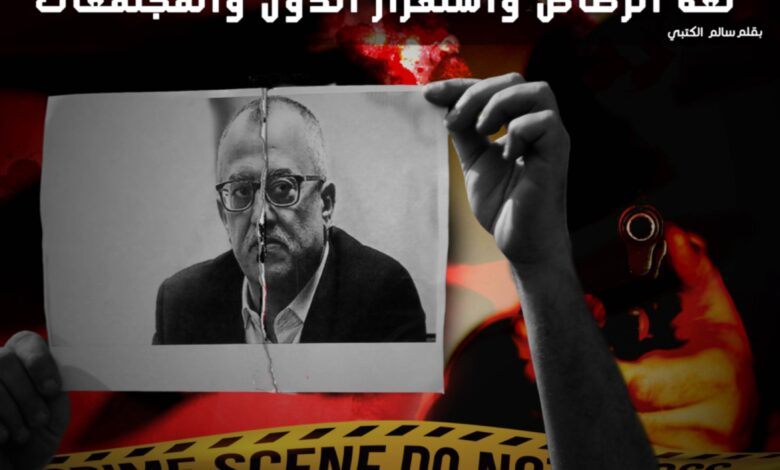
Then, I would like to move to a delicate and complex subject: the assassination of Jordanian writer and journalist Nahed Hatter. I see that this crime is a wake-up call about many issues. First, the extremist ideology is no longer necessarily the specialty of groups or organizations; ‘lone wolves’, who sympathize and work according to the agenda of organizations/groups without advance planning and coordination, adhere to it to.
Second, the efforts made so far to expose and counter the extremist ideology are not efficient enough to deal with the holders of this ideology, in terms of legal, security, cultural and religious mechanisms. The third point is the absence of sense of responsibility on the side of some opinion makers, who ignore the parameters of social context, and take the opposite direction under the pretext of breaking down barriers and taboos and opening new spaces for ‘freedoms’.
States, governments and security services cannot be held responsible for such crimes alone. The challenge of societal principles represents a heavy burden on those concerned with security and societal stability. They work in accordance with the delicate equations based on creating a balance between freedoms on the one hand and the system of moral and religious principles adopted by the society on the other hand. The breach of the principles system by some members of the community on a freedom of expression basis leads to confusion on the side of the authorities.
However, we cannot, under any circumstances, accept the idea of disorder that extremist/terrorist elements are trying to disseminate through persecution of people with different views. We need to declare explicitly that the ignorant barbarism of terrorist individuals, groups and organizations is threatening the foundations of states and societies since it denies the idea of the State.
In the second half of the 20th century, a radical terrorist group known as Takfir wal Hijra (excommunication and exodus) emerged. The group started from the idea of excommunication of the community in which they live, and isolation into private communities that hold specific ideas so extreme and outlandish. Other groups such as Jemaah Islamiyah also appeared. These groups reproduced the ideas contained in the books of renowned theorists of the Muslim Brotherhood, such as Sayyid Qutb. The spread of the ideology of these groups yielded unforgettable crimes, such as the assassination attempt of the World writer Naguib Mahfouz by a ‘hitman’ who had not read a line from his literary works. Enlightened theologians and scholars have also been victims to the crimes of extremists.
The way out of these heinous crimes and practices is certainly to consecrate the culture of respect for sanctity and religions, and to emphasize the boundary between freedom of opinion and expression on one side, and the respect for holy sites and religious symbols on the other. It also starts with implementing legal and security measures against crimes of incitement to violence and murder, intellectual, physical and moral terrorism. Only strict laws with clear penalties can ensure the achievement of security and stability of societies.
Facing the waves of violence and terrorism is a shared responsibility of institutions, countries and cultural elites. In any way, we cannot give in to the practices of obscurantism, particularly spreading fear among intellectuals and other members of society. This responsibility entails strengthening the foundations of social stability by rejecting ‘gun violence’, hate speech, asserting religious respect, and preventing terrorism from using certain pretexts to trouble our societies.