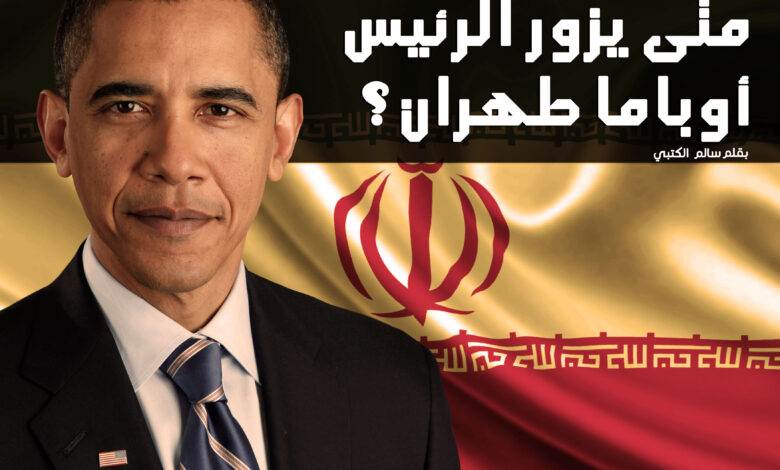
Yesterday, the US Government has announced that President Barack Obama will make a historical visit to Cuba in the few coming weeks. This visit is be historical because it come after fifty years of mutual hostility. So, is not it very legitimate to ask the following question: When will President Obama visit Tehran?
I am pretty aware that many do not see this scenario come true in the first glance, to the extent that some would convict me of being politically naïve or, at the best, unaware of the clear differences between the Cuban and the Iranian issues. However, I still believe that asking this question is very logical, taking into consideration the speeding regional and international developments and the overexcitement of President Barack Obama to make history as the first American president to make breakthroughs in some of the long standing issues in US foreign policy. This expected visit is to be the first of an American president at office since the Cuban revolution in 1959.
In fact, the US conflicts with Iran and Cuba not only had different backgrounds, but were solved differently. Washington has officially restored its ties with “Havana” in July 2015 after reopening its Embassy in August of the same year. On the contrary, US relation with Iran is still far from reaching this stage of normalization. However, there are many points in common between the two conflicts that should not be overlooked. John Kerry, the first US Secretary of State to visit Cuba since the sixties to lead US Embassy reopening ceremony, has a special relationship with his Iranian counterpart Mohammad Javad Zarif described as “mutual understanding by media in the US.
After having been listed the US list of terror sponsors, Cuba is now out of this list by virtue of a White House decision. Obviously, Iran would like to erase its name from that list as quick as possible. In fact, achieving this goal is something very possible taking into consideration the latest developments.
Another common point between the American-Cuban relations and the American-Iranian relations has to do with the nature of political leadership in both countries. Cuban president Raúl Castro and Iranian President Hassan Rouhani started their terms with more openness and readiness to negotiate their disputes with the US. The only difference between the two countries is Iran’s Supreme Leader, Ayatollah Ali Khamenei who controls everything in Iran and who can give Rouhani the green light to get even closer to the US or keep it at this level to not cause any internal opposition. The difference between the Iranian and Cuban situations in undeniable. When it comes to Iran, we cannot ignore the implication of Jewish Lobby, which enjoys a great deal of influence over the American industry and economy in general, and the calculations of President Obama who tries to make balance between several issues that he describes as “deep disputes” with Iran, especially its behaviors that threatens “regional stability” and US allies, GCC member states and Israel. Barack Obama, who wants to make history as the first American President to reach a settlement with Iran and Cuba, believes that not “talking to Iran for decades has not served US interests” and sees that “the nuclear deal with Iran has made the world safer”. He also argues that “through communicating with Iran directly”, America “become capable to solve other issues”. Consequently, President Obama is careful to encourage the Iranian openness. Recently, he sent encouraging messages the Iranian leadership by saying that “Iran has a historical opportunity to build new relations in the world for the benefit of its people” and the Iranian people by saying “Today, we have a great chance in decades to build a new common future between our two countries”. Honestly, I believe that comparing Iran to Cuba and expecting an official visit of President Barack Obama can be more logical and imaginable if we go back into history to have a look on US diplomatic history. President Henry Kissinger’s secret “Eastern Marco Palolo Journey” in 1971 to Beijing with whom Washington no diplomatic relationships. Few months later, President Richard Nixon paid an official historical visit to this country with whom there had been no diplomatic relations still.
It is a mistake to believe that hostility between the US and Iran is the reason why they have reach an advanced level of normalization until now. The Chino-American hostility has pushed the US to try to keep China outside the UN, which was a grave strategic mistake as admitted by President Dwight D. Eisenhower. Moreover, President Richard Nixon has been very hostile to China as no one of the current American politicians can be to Iran. When he was elected as US president in 1968, observers believed that Chino-American relations would improve in the few coming years, at least. However, the interest of his country to make use of the Chinese to make an end to Vietnam nightmare were enough for him to change his opinion to quite the opposite overnight. It was exciting that these two countries had in common the interest to counterpart the Soviet Union, and it is even more exciting that President Richard Nixon forget about all his country’s fears over Taiwan which has signed a defense treaty in 1954 and economic interests worth billions and the huge sympathy of the American people with Taiwan. So, the level of diplomatic relations is not truly reflected in the level of diplomatic representation and exchange of ambassadors and it is not a precondition for an American president to visit a country with whom the US has no diplomatic relation, the visit of Richard Nixon to China had taken place eighteen months before the opening of the US Embassy in Beijing. Actually, there was no exchange of ambassadors during Richard Nixon’s term, all they have in 1973 are two Liaison Offices.
This American openness towards China resulted in the end of the Soviet Union, so is Barack Obama trying to booby-trap Iranian-Russian relations, open a new page with Iran to kill the Russian dream and become the second American President to visit a Country which has no official diplomatic relationships?
International relations are full of experiences, examples and paradoxes too. Consequently, we can imagine any scenario regardless of how much possible it is, including the scenario of president Obama visiting “Tehran”. The likelihood of this visit taking place depends largely on the position of Iranian religious leaders and how much they are ready pragmatically speaking to “embrace” the “Great Satan” after “shaking hands” with him following the penning of the nuclear deal and lift of sanctions. The issue is not merely Iran; but rather, the mainly the complex and variable network of coalitions in the Arabian Gulf and the Middle East. Consequently, we should keep vigilant and expect anything to come on the scene no matter how unlikely it is.