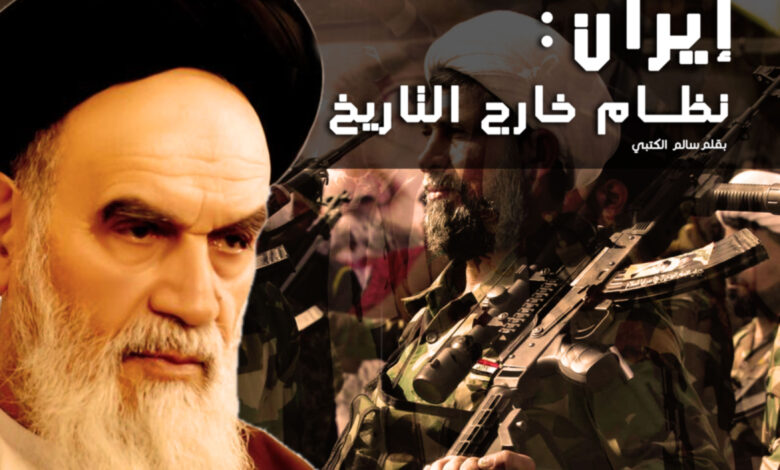
There is no doubt that the political and security bullying and the violation of international laws and norms the Iranian regime is doing in the Gulf represents a unique situation in the history of international relations. The Iranian regime jumps over the constants of the existing global system, which is based on recognizing the concept of national sovereignty of States and reinforcing the principle of “national State” since the Treaty of Westphalia in 1648. And then comes this obnoxious theocratic regime to undermine these constants and to sow corruption in the region, by intervening in the affairs of neighboring States and seeking to dismantle and topple regimes, imposing its political / religious theory based on what is known as velayat-e faqih over other States whose people, whether Sunni or Shiite, do not recognize this theory that expresses the thought of the mullahs in Qom.
Not only that, but this system instigated Shiite citizens in other Gulf States against their countries and regimes, and these interventions produced symbols of terrorism, violence and incitement against the State, including the so-called Baker Al-Nimr, who was executed by Saudi Arabia recently with other terrorists of the Sunni sect under a court ruling that has gone through all the normal litigation stages under the judicial and legal system prevailing in the Kingdom of Saudi Arabia.
There is no doubt that the implementation of the provisions and the law is a sovereign right of States regardless of the sectarian loyalties and ethnic affiliations of citizens, and regardless of the position of any person or State about the death penalty as such, since international laws indicate that the implementation of judicial decisions is one of the pillars of a State sovereignty over its territory and an integral part of the social contract between systems and people to maintain security and stability and to safeguard State sovereignty against any violations of internal or external laws, and then the ugly sectarian Iranian reaction on this provision becomes a kind of blatant interference in the internal affairs of the kingdom, and what is even uglier is that this intervention did not stop at verbal and official threats uttered by the Iranian regime’s leaders and symbols against the kingdom, but went beyond that to include the barbarian attack on the Saudi embassy headquarters in Tehran, in a move contrary to the rules of international law that requires from all members of the United Nations States to protect diplomatic installations and consulates and their crews, and to respect their international obligations in this regard, which obligations are stipulated in the Vienna Conventions on the protection of diplomatic missions, signed in 1961, which is the current legal basis for the immunity that is available to representatives of States, and whose clauses are considered to be the cornerstone of modern international relations.
In the face of this official behavior of Iran, Saudi Arabia could only act in a decisive and resolute response to this aggression, especially since the arguments and evidence confirm that breaking into the Saudi Embassy and the assault against it were not to occur except with a green light from the symbols of the system that almost counts the breaths of its people and besieges its citizens in every part of the Iranian territory. Therefore, it is absurd that the leaders of Iran come with flimsy pretexts and absurd justifications and decisions to cover up their awful act.
There may not be an induction more than the one practiced by Iran’s Supreme Leader, Ali Khamenei himself. He is the one that led the incitement and sparked fires across his fiery tweets on the social networking site “Twitter”, where Khamenei said in his account in English, commenting on the image of Al-Nimr “Awakening cannot be suppressed”. His page also showed an image combining Saudi Arabia and the organization “Daash”, in a comparison that is not worthy of a religious nor a political leader who seeks relations based on mutual respect with neighboring countries, nor even a leader of a gang seeking to build channels of communication with others!! Especially that Khamenei’s position opened the way for a wave of threats issued by leaders of the militias of the Revolutionary Guard, which has become a regional bullying symbol that moves wherever the television General, Qassem Soleimani, and other leaders of this terrorist militia are present.
Saudi Arabia, in such a case, could only exercise one of its rights, guaranteed by international laws, and confirm its sovereignty over its territory and defend its right to apply law and order in the face of the overwhelming Iranian bullying. The decision to cut ties was only a natural and intuitive result to the Iranian behavior that went too far in denigrating the Kingdom and damaging its interests since Iran’s involvement in the stampede of pilgrims during the last Hajj season, and the victims it resulted in, who had no sin except that the mullahs of Qom wanted to distort the image of Saudi Arabia, to offend it and to question its ability to organize this religious season.
Do the mullahs want to seize the sovereignty of the Kingdom of Saudi Arabia and its territory as they do in the Iraqi territory, and as they pushed nearly a million Iranians to cross the Iranian border into Iraq without any identification papers, in a move that only aimed at modifying the demographic composition in the Sunni areas of Iraq and the involvement of elements of the Revolutionary Guards in the conflict areas in Syria and Iraq? This perception may be true, but the problem is that Tehran has not read very well the thought and philosophy of the Saudi political performance in the reign of King Salman bin Abdul Aziz, who is known for his firmness, toughness and strength in defending the truth and the dignity of his country and its sovereignty over its territory and in defending its citizens. Additionally, Tehran did not understand the successive political messages issued from Riyadh, and did not realize that Saudi diplomacy has been fed up with the absurd Iranian actions and that it no longer accepts any interference in the internal affairs of the Kingdom or other countries of the Gulf Cooperation Council or other Arab countries. I do not know if Tehran was so stupid that it was not able to understand these messages, or if the Persian vanity and arrogance have overwhelmed it and pushed it to commit such reckless acts.
Whatever the reason or rationale behind Iran’s aggressive behavior, Tehran must realize that regional bullying time has gone and finished and will not return, and that mutual respect and abiding by the international laws and norms and charters is the ruling basis to its relations with the GCC countries, otherwise, any other options or alternatives will result in dire consequences.