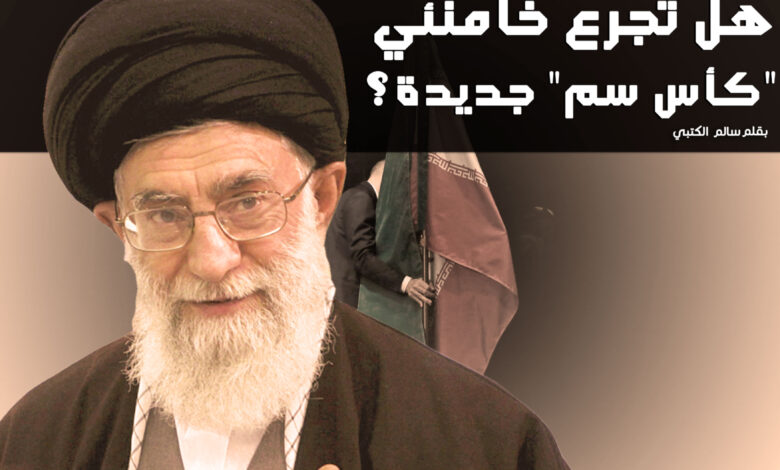
Some experts and analysts may think that Iran’s Supreme Leader Ali Khamenei had “drank the poisoned cup“ for the second time in the history of Iran by granting the green light to his negotiators to sign the nuclear deal in Vienna recently. This view misinterpreted what Khamenei said on the occasion of Eid al-Fitr, when he described the United States as an oppressing power and confirmed his country’s continued support to what he called “friendly countries and oppressed peoples in the region.” Some think Iran has made concessions for the agreement and this is relatively true, but any political agreement entails a priori concessions from both sides. Nonetheless Tehran is economically and militarily and strategically the winner, recognized as being a peaceful nuclear regional power; and thus any future military attack by Israel or by others would constitute a violation of international laws and norms. The agreement also grants commercial, military, and other economic and political gains to Iran. The West also has won strategically, and is on the verge of achieving greater economic profits, but Iran’s leaders have not drank the poison but exchanged cups of interests with the West.
The negotiations on Iran’s nuclear program over at least the past two years summarize the current scene in the Iran-United States relations. The White House is betting on this agreement for its strategic equation in the Middle East. There is an American deep desire to use the deal not in narrow regional issues but to influence the structure of the world order. Washington recognizes that building positive relations with Iran, with all its holdings of fossil energy sources (oil and gas) enhances the potential of the American diplomacy to contain the Chinese giant, putting international energy zones in the Gulf under Washington influence, which in turn would help the Asia First strategy adopted by the US.
Also, the ideological differences between Iran and the West do not make the idea of relying on Iran to police the region acceptable for various reasons, but there is a high probability for building interest-based relationships and strong economic partnerships between Tehran and the West as business deals with Iran were made as soon as the agreement was announced. Germany took the initiative and sent its deputy foreign minister to Tehran to talk about an estimated ten billion for trade, with increase of seven billion dollars annually, after the visit of some Australian officials. It is likely that Washington is trying to find a balanced strategic formula for its relations with various Gulf countries and to utilize Iranian influence to resolve crises in the region and to maintain functional relations with the Gulf Arab parties to ensure economic, strategic and military partnership and relations. Tehran, with implicit consent by the US, is expected to be the key player in several Arab issues. The Iranian role in these issues would be subject to the ability of Iran to find shared interests with Washington and understand the new US political language. China has done so in the last two decades as it shifted from ideological hostility to strategic partnership with Washington. Iran has studied the Chinese experience in the management of relations with the United States well. Tehran at this stage has two models, one of North Korea that has signed a nuclear deal with the West and then broke it and returned to hostility, and the China model, which succeeded in carefully approaching the superpower and has achieved tremendous strategy and economic successes at this level.
It is necessary to deal cautiously with the Iranian hard-line discourse toward the United States in the post-nuclear agreement stage. It is not logical to expect Iranian hard-line conservatives to surrender, especially in light of the fact that conservatives like the Iranian Revolutionary Guard commanders, were the biggest losers in the deal and the economic disembargo as they were taking advantage of the continuing blockade and sanctions over the past years. The Iranian regime itself has gained a great deal of internal and external legitimacy on the ruins of contrived wars and conflicts and confrontations and crises. Furthermore, the hard-line speech itself did not lose its political function because Tehran is a long way off the application of the terms of the agreement which involves bargains and reciprocal pressures. Anti-Americanism and hostility to the Great Satan, as described for many years in the Iranian political discourse, is not yet a thing of the past, but it is used to put pressure on the West to ensure flexibility in the implementation of the terms of the complex agreement, as Tehran fears losing the political credibility of the regime in the eyes of supporters and followers at home and abroad, and so is gradually undoing the tone of hostility. The more political and strategic gains achieved, the more space there is for trust in the eyes of friends and for promotion of the agreement as a victory that provided these gains. A gradual qualitative shift is expected in the historical political discourse of the Iranian regime over time!
Khamenei spoke on Eid al-Fitr about the lack of change in his country’s policy toward the United States. The Agreement itself, however, simply means turning the Iranian policy of hostility to an understanding so as not say partnership or alliance. Entente is closest to application at the current stage and the two sides do not need more than interests to proceed.
Khamenei spoke of lack of a change in his country’s support for what he described as the oppressed, but the interests of the Arabs were not on the agenda of the nuclear deal negotiations, but some might have expected the American negotiators to take into account the interests of the Arabs in the raging crisis in the Yemen, Iraq and Syria, overestimating the goodwill of others.
Finally, it may be too early to think about the drastic shifts in regional security equations based on the results of the nuclear agreement, but in all cases, these transformations are on the doors. The agreement represents the beginning of a new phase in the regional scene. The most serious problem is that the Arabs are playing the role of observer and do not have clear strategic alternatives to deal with the rapid developments of the events that were expected more than two years ago.