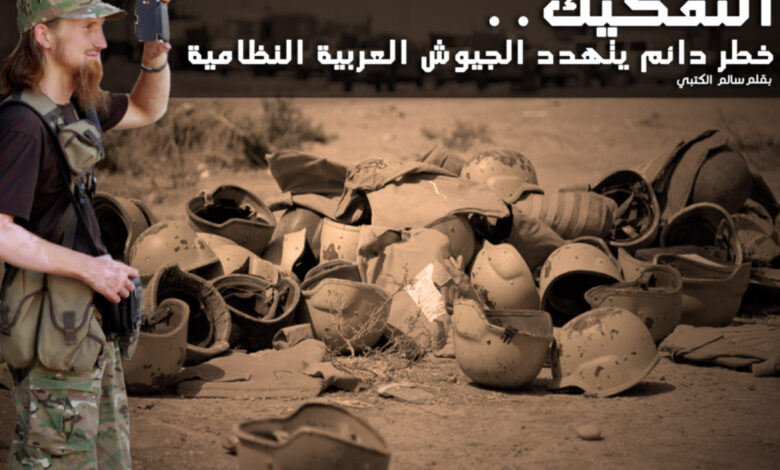
The problem of wars in the era of asymmetric threats is not related to the size or capabilities of armies but to their ability to cope with unfamiliar threats.
After the collapse and dismantlement of the Iraqi army following the US invasion in March 2003, it looks like there were plans to target the Egyptian army by regional or international parties seeking to pounce on the rest of the Arab countries.
Dissemination of regional chaos represents an essential strategy for many regional and international powers. The tools and tactics used to achieve this vital goal are multiple and variable, including using Daesh and the Muslim Brotherhood. What Ansar Bayt al-Maqdis, a Daesh branch, is trying to accomplish in Egypt’s Sinai is to control a part of the land from which to start a continuous operation to drain the Egyptian military force.
Egyptian experts contend that the size of the Sinai operations forces represents only a small percentage of the total of the Egyptian army, which is, at about 1 percent – estimates President Abdel Fattah al-Sisi. This is true because the majority of the military forces is involved in securing the Egyptian border with Libya and Sudan. Moreover, the proportion of military equipment in use in Sinai represents only a small percentage too of the total arsenal. Warfare in the era of asymmetric threats is not about the size of armies, armament, capabilities or levels of military and operational superiority, but mostly their capacity to cope with unconventional threats. Such threats originate from organizations and groups that are able to move, maneuver and escape easily. Small-scale organizations challenge the armies that are used to ground wars and major confrontations with other armies with identifiable and destructible military strategies. Conventional armaments were designed to counter specific strategies and plans by armies and with respect to decades of military experiences during wars.
Fourth and fifth wars generations somewhat depend on military confrontations and capabilities, yet the most dangerous strategies used in those wars mix media tools (traditional and new media) with economic, psychological and political tactics. Consequently, some armies, even the most advanced in terms of human and technical resources like the US army, do not eradicate terrorist organizations from terrains and deserts where they hide. The survival of the smaller groups may seem as a sign of power and outperforming, but in fact the ground confrontations limit the traditional operational capacity of armies, requiring training to adapt with new fighting conditions.
Organizations and groups differ from armies in structure and standards of victory or defeat.
While a standard of victory for groups is the ability to survive, the story looks different for armies. The latter have to achieve goals that can be discerned only if the enemy is an army. Given their massive power, armies can be criticized for not being able to eradicate smaller groups or causing civilian deaths, despite the fact that militias and groups rely on hit-and-run tactics, human shields and subsequently accusing regular armies of attacking civilians.
Targeting the Egyptian army may appear linked to the organization antagonistic to Egypt’s current political system, but generally speaking, attacking the Egyptian army is a strategically vital goal for some regional and international powers, regardless of the policies and political creed of President Sissi and the internal situation in Egypt. We cannot always yield the point that Israel and US interests lie in maintaining a secure and stabile Egypt, or that Israel cannot tolerate Daesh or Hamas or Al-Qaeda on its border with Egypt. The question to ask here is about the best option for the security of Israel; is it the collapse of the Egyptian army and the slide into chaos and turmoil for Egypt, or is it the surviving, resilient and mature Egyptian army?
The answer to this question is easy. Israel enjoys strategic security since the Iraqi army left the scene, turned into a small army with limited capacity and difficulties to deal with terrorist organizations on its own, let alone go to wars with States.
Obviously, the answer is that the Arab armies should be taken out of the picture. They should be preoccupied with untold conflicts with local gangs to the point of exhaustion and demoralization of soldiers, paving the way for redrawing the map of the Middle East. To achieve the objective, the functions of such tools as the Muslim Brotherhood, Al-Qaeda and Daesh come to the scene. The latter has started to expand, proclaiming itself as a superpower able to fight more than one war at a time, a trend that seems to be getting implicit support or tolerance from like-minded groups. The organization provides free services to the enemies of Arabs and Islam, so it is hard to believe that its leaders of the pseudo-Islamic group work in isolation from the forces hostile to the Arabs and Muslims, especially given their historical collaboration with and servitude to colonialism.