Amid an unprecedented wave of strategic challenges, whether represented in terrorist organizations or rogue groups that operate for the benefit of expansive regional parties, seeking to expand in Arab countries crucial to the national security of the Arab world and the Gulf, as is the case for brotherly Yemen, amid these regional complexities, the convoy of development, security, safety and stability is moving in the United Arab Emirates under a wise and rational leadership, and an awareness of a loyal people unified around its leadership, and recognizing the value of living in a unified home.
In the forty-fifth anniversary of the founding of the Federation of the United Arab Emirates, we first evoke the spirit of the founding fathers, led by the late His Highness Sheikh Zayed bin Sultan Al Nahyan, may God rest his soul, a spirit that characterizes the UAE’s developmental experience and distinguishes it from other regional and international experiences. We also recall with admiration and appreciation the struggle that transformed the desert sands into a young nation that matches the most developed nations in its infrastructure and strategic planning and government and development performance.
One of the secrets of the UAE model’s strength lies in the spirit of challenge that accompanied this model since its inception. The challenges of planning, construction and development represented the most difficult dossiers in the first years of the Union, and were mostly “survival challenges,” whether in building the nascent state institutions or human construction, as well as the challenges of crystallizing the national identity of the federal State formed from several emirates close geographically, culturally, humanly and linguistically etc. But these Emirates were for the first time in their history, experiencing living under the flag of the federal state. This required strengthening the federal institutions and their role and the unification of the armed forces, and other steps that deepened the spirit of the Union and accelerated the fusion of national identity and produced after these years of effort and hard work the concept of the “unified home”, a phrase that His Highness Sheikh Mohammed bin Zayed Al Nahyan, Crown Prince of Abu Dhabi and Deputy Supreme commander of the armed forces, may God protect him, used to sum up the national alignment and the popular cohesion and rallying behind the wise leadership.
Extrapolating the history of the Arabian Gulf region, and the United Arab Emirates since its founding in the second of December 1971, refers to the fact that challenges are a key part of the strategic environment in which the State of the Union was launched and has grown and evolved. It succeeded in meeting these regional conditions and difficult challenges since the war of the sixth of October 1973, which broke out while the State of the Union’s age was less than two years. However, this historic Arab moment was a solid foundation for the principles of nationalism, which continues to be a focus of diplomacy and foreign policy of the United Arab Emirates until now. His Highness Sheikh Zayed bin Sultan Al Nahyan, may God rest his soul, took a heroic stance, not afraid of possible strategic implications of his position when he ordered stopping oil exports to states supporting Israel, saying “Arab oil is not dearer than Arab blood”. So he set the foundations for joint Arab positions, and put the overarching framework to Arab national security, which is all integrated, as stressed repeatedly by His Highness Sheikh Mohammed bin Zayed Al Nahyan, Crown Prince of Abu Dhabi and Deputy Supreme commander of the armed forces, expressing his founding father’s values and UAE’s firmness on its established principles and values.
The regional challenges that confronted the march of the State of the Union did not stop. The Iranian revolution took place in 1979, which resulted in the emergence of a theocratic system raising the slogan of “exporting the revolution” to the regional surroundings. Then came the Soviet invasion of Afghanistan in the same year, then the disruption suffered by Arab relations against the backdrop of the signing of the Egyptian-Israeli peace treaty, then the Iran-Iraq war, then the Iraqi invasion of Kuwait in August 1990, which is roughly the strategically most dangerous event in the history of the Arabian Gulf region, Then the war of liberation in 1991, leading up to the invasion of Iraq in March 2003 and the subsequent strategic earth-shattering consequences still experienced by the region so far.
What I mean is that challenges are not absent from the strategic and security environment of the Emirates. This is what happened when unrest erupted in 2011, and major Arab states witnessed an internal upheaval. Arab states that have a direct impact on the national security of the Emirates such as Bahrain and Yemen, were subject to existential dangers, and several other Arab countries have suffered from institutional collapses and internal disorders that dropped the concept of the state itself of the Dictionary of these countries, thus opening the door to the interventions of the regional powers which are awaiting the opportunity to settle historical scores, and to achieve their expansionist dreams and ambitions. These forces drew their plans to pounce on what is left of the Arab national security system through the encirclement of the GCC by an ideological belt threatening its security and stability, and hired local proxies such as the Houthi group in Yemen and Hezbollah in Lebanon’s and other criminal organizations that spread in many Arab countries which suffer from chaos and internal turmoil.
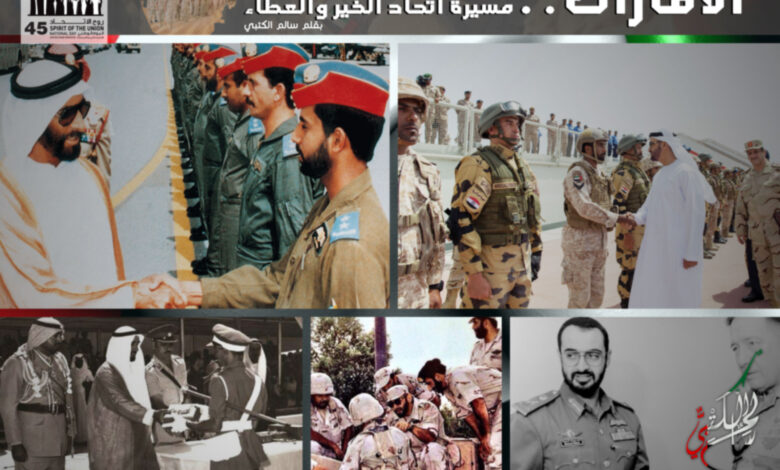
When the UAE celebrates its forty-fifth National Day, it also celebrates the achievements of its brave armed forces, the fort to the security and stability of the Emirates, and turns the page on a year of enormous strategic challenges, addressed by the wise leadership effectively to restore to the Arab national security its prestige and basic foundations, which is that the security of each Arab country is an integral part of the UAE’s national security.
In the forty-fifth National Day, the Emirates continues its empowerment march along the path of excellence and success, and our wise leadership demonstrates its keenness to provide the elements of a decent life to all the loyal people of the UAE, which in turn proves its deep loyalty and sense of belonging to our wise leadership and good land. In this glorious day also, we remember our martyrs and we shake hands with our children and our men, the heroes of the valiant armed forces stationed in the fields of pride and heroism in brotherly Yemen. They set an example and role model in nationalism and belonging, and raise the flag of the Emirates high in the arena of honor and glory and triumph, and defend truth and justice and the authentic values of the UAE against the criminal transgressor, and the brutal enemy that has no honor and does not respect the integrity of homelands.