It is clear that the problem of the United States is not in the conflicts in the Middle East but also in the formulation of the results of these conflicts and how they relate to American interests.
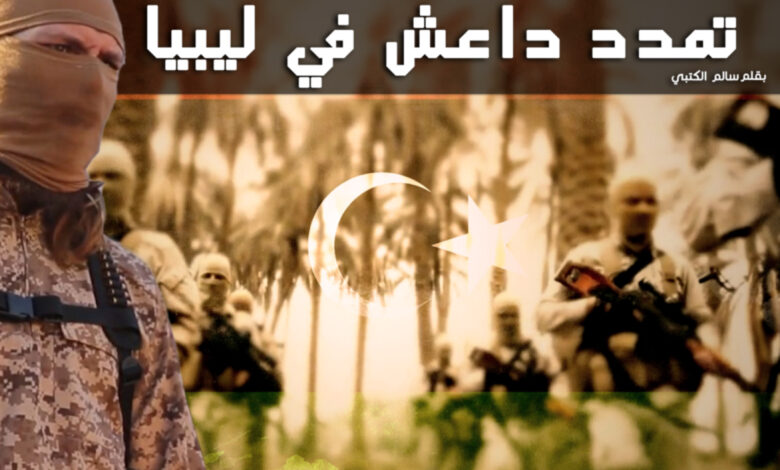
Amid the bustle of the military conflict in Iraq, Syria and Yemen, a precursor of Libya was reported to say that Daesh controls areas, infrastructure and cities and is rapidly expanding. This deserves a careful pause by the international community so that the world does not end up recognizing a new “State” in Libya.
Media reports talk about the control of Daesh of an important power station along the coastal road extending west of its stronghold of Sirte towards Misrata, the commercial center and mainstay of the alliance of extremist militia which controls the capital Tripoli. This comes almost two weeks after the takeover by Daesh of the airport on the outskirts of Sirte, as well as the water station used by Misrata militias in the past as a base. This means that Daesh uses the strategy of control of the infrastructure facilities and structures that it used in Iraq as controlling services was a serious blow to the government. Electricity can be lost in large areas in central and western Libya.
Despite the media coverage of the news of Daesh in various regions of the world, what the organization does in Libya seems to be outside the circle of interest and a forgotten battle for the international community, despite the mediation efforts undertaken by several Arab countries between the warring Libyan parties.
Interestingly, some Western media reports are talking about the fact that the Libya “case” reflects the possession by Daesh of an aspiring surplus power, which is helping the organization influence other areas in Libya. The organization sees Libya as a gold mine capable to finance its plans and projects of expansion in the Levant, Iraq and other regions of the Islamic world.
Other reports also suggest that Daesh considers Libya as a virgin land, feeding the basic need for human resources from Arab and foreign countries. Libya has become a favorite destination for the veterans who participated in the Syrian war, Iraqis and Tunisians extremists, as well as the fact that the Libyan scene is ready to transform into a training and governance area of control in the newly acquired land, according to media reports.
Published statistics indicate that Daesh has about two thousand fighters in Sirte and about 700 fighters in the coastal city of Sabrata, which is just 41 miles away from the capital, Tripoli. In such a short time, they succeeded in transforming Libya into a large and safe training camp under the silence of the West and the inability to address this cancerous organization, whether in Libya or in other countries it is present. Suspiciously, extremist militias leave their controlled zones and escape when they face Daesh, undermining all claims by these militias about defending the principles of legitimacy and other heresies.
What is most dangerous is that Daesh expanded in Libya using a hostile approach to religious minorities, opening sectarian conflicts in new areas of the world. It is clear that the US administration meant what it said about the fact that the war against Daesh may take many years, and that others misunderstood this, thinking it is a poor strategic appreciation of the danger. But now it is certainly not a matter of bad estimation but an American strong desire to keep this organization alive, at least, over the next decade.
It is also clear that the problem of the United States is not in the Middle East conflicts, which the White House does not worry about at all, but in the results of these conflicts on the US interests.
Daesh expansion in Libya is a catastrophe affecting the national security of several Arab countries. Libya provides the organization with strong economic resources to expand towards other regions and possibly other countries. When Daesh will take hold of Libyan oil revenues, it may allow it to bear the burdens of the areas under its control in Iraq and Syria, and send money to the headquarters of its “State”. afterwards, it will be able to lure more extremists in joining in Syria or Libya, which is an enormous risk taking into account the human resources it can access there. This could open the gates of recruitment through extremist and terrorist organizations in North Africa, or the possibility of exploiting thousands of people fleeing from misery and poverty in Africa through the boats of illegal immigration to Europe coming from Libyan shores. This could provide a high probability for recruiting huge numbers and sending them to fight in neighboring countries or even to Europe to seek other “conquests”.
Due to its geostrategic importance, Libya in particular represents a turning point in the life cycle of Daesh and its leaders. It is also an economic treasure and its vast territory makes military operations against Daesh more difficult, especially that a large part of the Libyan territory is controlled by extremist militias that share the same ideology and aspirations as Daesh.
Will the international community wake up and be quick to address the risk of Daesh in Libya or will it repeat the mistakes of Iraq and Syria and leave the organization until a formal declaration of the establishment of “the State of the caliphate” in Libya?