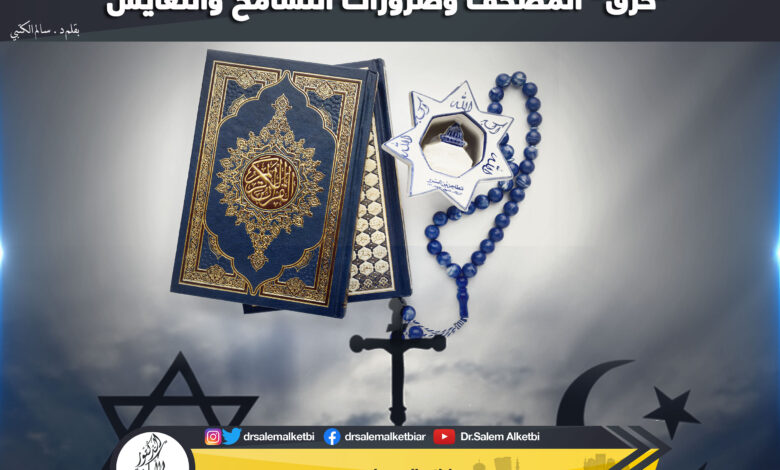
Following the UN Security Council’s recent approval of a groundbreaking resolution concerning tolerance, peace, and global security, with the active participation of the UAE and the UK, the world was taken aback by the incident of burning the Sacred Qur’an in Sweden.
In reality, these two occurrences are intertwined when it comes to their subject matter. The second event wouldn’t have taken place had there been a proper grasp of the principles of tolerance and coexistence, along with a “loose” and perhaps misguided understanding of freedom of speech, its boundaries and regulations. This is precisely what the international resolution cautioned against, recognizing that hateful language and radicalism can breed further extremism, violence, escalation, and an upsurge in global conflicts.
This resolution is crucial not just for combating hate speech, instigation, and extremism, but also for driving the translation of the convictions held by states, governments, and other partners in social responsibility into the values of tolerance and living together, and transforming them into public practices and binding regulations applicable to all within their territories.
Hence, one aspect of the significance of this resolution lies in reaffirming the worldwide commitment to upholding the principles of tolerance and coexistence. It sheds light on their intimate link to global security and peace, as well as stability and sustainable progress since they are interrelated conditions and factors that cannot be divorced from one another. Genuine progress is unattainable without stability, and stability is unattainable without achieving security and peace.
Resolution 2686 stands as the inaugural UN resolution to acknowledge that racism, xenophobia, racial discrimination, and gender discrimination are pivotal factors that contribute to the eruption, intensification, and recurrence of conflicts. It explicitly and unequivocally calls for the outright condemnation of these detrimental practices.
The resolution aims to foster collaborations among all societal actors to counter violence and hate speech. It implores responsible stakeholders within communities, encompassing religious and social leaders, media entities, social media platforms, and influential opinion makers, to fulfill their role in openly denouncing hate speech as it emerges and fostering the development and dissemination of exemplary approaches that foster a climate of tolerance and harmonious coexistence.
The incident involving the burning of a copy of the Sacred Qur’an in Sweden is an enduring occurrence that refuses to fade into obscurity, as its ramifications and repercussions resurface with each new perpetrator.
It is undeniably an “disrespectful act of provocation” that mirrors manifestations of racism and xenophobia. Here, we cite a statement from the EU, not a statement from the foreign ministry of an Arab or Islamic country. The EU denounced the incident and expressed remorse for its occurrence during the global Muslim festivities of Eid Al Adha.
Without a doubt, confronting extremism, extremists, prejudice, and zealots calls for resolute action by individuals who recognize the peril these practices pose to social cohesion and national interests. Such practices should not be regarded as expressions of freedom of speech. The recurrence of this situation, particularly in Sweden, demands introspection from the concerned country, before others. The Swedish authorities must not interpret freedom of opinion and expression in a manner that contradicts the beliefs of other people, including Western societies that share a common foundational set of values.
The predicament at hand is that nations allowing such extremist practices are flinging wide the door to the global propagation of prejudice. They are effectively bestowing extremists with either an unrestricted gift or a potent “breath of fresh air,” fostering the resurgence of violence and terrorism through the dissemination of hate speech and counter-hate speech.
We firmly believe that no responsible nations on a global scale endorse this trend or aspire to the proliferation of violence and terrorism, including recruitment and radicalization, particularly within European societies that have suffered from numerous abhorrent acts of terrorism in recent years.
Therefore, the predicament resides in the misjudgment of authorities or relevant entities in certain European countries when it comes to discerning the boundaries of freedom of expression, its regulations, and the ramifications of interpreting constitutional texts in isolation from their contexts and the evolving temporal landscape.
They harbor an unjustified apprehension of establishing boundaries, regarding them as deeply ingrained societal fixtures, oblivious to the delicate equilibrium between accountability and recklessness. A choice that may appear commendable from the vantage point of these authorities can unleash malevolence upon the entire world. This is evidenced by the widespread global condemnations of the act of burning a copy of the Sacred Quran, as well as the opportunistic exploitation and manipulation of this incident for achieving political aims unrelated to the defense of the Islamic faith or any other cause.
The truth of the matter lies in the initial resistance exhibited by the Swedish police against permitting the burning of a Quran copy, followed by their subsequent compliance with an appeals court ruling that overturned the initial refusal. This sequence of events attests to the security authorities’ cognizance of the repercussions entailed in sanctioning such practices.
Nonetheless, the court, fixated on a purely legal standpoint, failed to acknowledge the political ramifications of its judgment, both internally and externally. It merely weighed the accompanying security concerns of these demonstrations against the constitutional entitlement to freedom of assembly and protest, as if seeking to safeguard or guarantee this constitutional right, yet inadvertently falling into the snare meticulously set by those who orchestrated the exploitation of this “right,” even at the expense of the public interest.
Moreover, I prefer not to delve into the matter of the political manipulation of the incident, which I do not perceive as epitomizing a “Western standpoint” counter to the Russian stance regarding the reverence and esteem for Islam and Muslims, as exemplified by the image of President Putin embracing a copy of the Sacred Quran.
As Arab and Muslim people, we ought not to entangle ourselves in the ongoing confrontation between Russia and the West over an isolated incident that merely signifies the individual prejudice harbored by an extremist or a collective of extremists and fanatics, prevalent in both the East and the West. Rather, our collective endeavor should be focused on collaboratively unmasking their parochialism and curbing their sway.