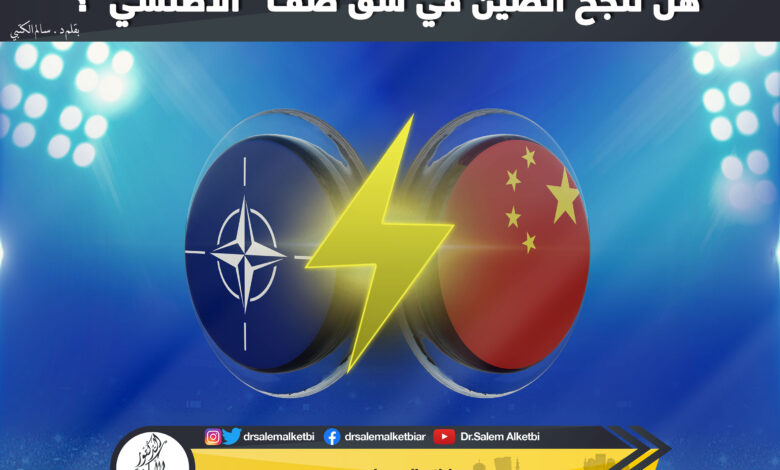
China is forging stronger ties with Europe, using economic interests, commercial cooperation, and investment to deepen the relationship. French President Emmanuel Macron has dubbed this Europe as the “third pole.” The question arises whether China is seeking to separate the EU from its ally, the US, or if it is a matter of mutual strategic interests.
Through its war in Ukraine, Russia provided NATO with an effective kiss of life, which strengthened the partnership and cooperation among its members. In contrast, China utilizes soft diplomacy to gradually win over prominent powers in the EU one by one. French President Emmanuel Macron’s recent visit to Beijing, following German Security Adviser Olaf Scholz’s visit a few months prior, raises concerns about the future of European relations with the two strategic rivals competing for leadership in the new global order: China and the US.
Macron emphasized the importance of Europe not becoming entangled in the conflict over Taiwan and instead becoming a “third pole” that is independent of China and the US. He described subordinating oneself to American policies as “the worst thing.”
Macron’s critics contend that he is disconnected from European reality and positions, and that the key to addressing his statements lies in identifying who currently safeguards European security. Is it France, Europe as a whole, or the US? These critics point to the difference between France’s contributions to aid Ukraine and those of the US to bolster their arguments.
In the US, the White House downplayed the repercussions of President Biden’s remarks on transatlantic relations, but Republican Senator Marco Rubio has a different take. Rubio maintains that if the French President speaks for all of Europe, the US should “focus on Taiwan and the threats China poses, and you guys handle Ukraine.”
China did not express disapproval of Russia’s war in Ukraine, nor did it recognize Russia’s annexation of the Crimean Peninsula in 2014 or the territories it captured during the war against Ukraine. As a result, China is accused of indirectly supporting Russia in the war by the US.
Nevertheless, China does not view increased trade with Russia as a form of political support. For the EU, China is a crucial trading partner, especially considering that the US is China’s largest trading partner among countries.
Beijing also considers the EU a significant market for the Chinese economy. The volume of trade between China and the EU amounted to approximately $912 billion in 2022, a 23% increase from the previous year.
China closely monitors NATO’s position and believes that enhancing economic, trade, and investment ties can be a powerful tool to influence the alliance’s stance towards it. The leadership of the US-led NATO faces diplomatic challenges from influential economic blocs such as BRICS and the Shanghai Cooperation Organization (SCO).
However, there is a possibility that the NATO leadership may be successful in keeping Europe neutral in its conflict with the US over Taiwan, especially as more Europeans are convinced not to follow the US into a Cold War confrontation with China. This may increase due to Russia’s loss and the related economic fallout from the Ukraine crisis, which has led to rising public anger in most European countries.
The differences in European countries’ stances towards China create a dilemma for the EU. Some countries, like the Netherlands, are aligned with the US’s view on China, while others, such as France, have a different approach. Nonetheless, China remains the largest supplier to the EU and the third-largest importer from EU countries in 2022. This attitude towards China is not only based on economic interests, but also on skepticism towards US policies.
It is still too early to conclude that China may cause a rift between the US and its European allies. The transatlantic relationship is not solely based on the idea of American protection of European security. The US relies heavily on its European partners for support, particularly when it comes to issues related to its influence and dominance in the global system, including the Taiwan question.
Despite the lack of a cohesive European foreign policy, individual countries are developing their own stances on China. However, the current moment is not necessarily indicative of the future, as all European countries are feeling the impact of the Ukraine conflict and recognize the importance of American leadership in this situation.