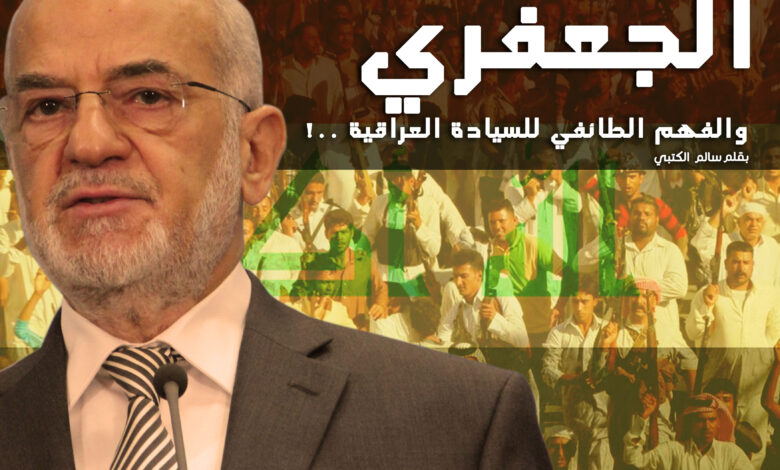
I do not think that there is something that could prevent Ibrahim al-Jaafari, Iraq’s Foreign Minister, from seeing things correctly in his country and the region, except a narrow sectarian perspective of events and an obnoxious sectarian interpretation to them. The man is a sectarian politician par excellence, he is even a model of sectarian political practice in its worst forms and manifestations.
There is no doubt that Jaafari’s obnoxious sectarianism, shown in the meetings of Arab Foreign Ministers recently in Cairo, is not the first incident of its kind in this regard. Over the last months, he has been known for striking views that put him undisputedly in fierce competition with Mohammad Javad Zarif over Iranian diplomatic representation, and if the latter did not have a great negotiating expertise and tremendous political maneuvering ability in the face of his Western counterparts, he would not have stood in the face of Jaafari’s competition by virtue of the latter’s proficiency in maneuvering, though his share in that is nowhere near the Iranian minister’s.
Of late, al-Jaafari filled the world with noise and fuss, claiming that he is seeking to mediate between Saudi Arabia and Iran, following the crisis that broke out against the backdrop of the burning of Saudi diplomatic premises in Iran, but the man came to a strange political behavior when he visited Tehran and did not complete the alleged mediation rounds by visiting Riyadh, he only visited Omani capital, Muscat, making remarks that only aimed at attracting the limelight, and did not make any serious effort befitting one who is supposed to be leading the diplomacy of a State in the size of brotherly Iraq.
For the sake of objectivity, al-Jaafari is a man who is good at speech and maneuvering, but he also deserves well the title of the most unsuccessful Iraqi politician, as he took over as prime minister of this ancient country in one of its most sensitive historical epochs, and only succeeded in deepening the wounds of this brotherly country, and turned the period in which he was Prime Minister into one of the most bloody and melancholy eras in the history of this ancient country.
History will remember al-Jaafari as the one who put Iraq on the threshold of the sectarian path, and the shrine bombing in Samarra in 2006, is one of the consequences of the sectarian strife triggered by al-Jaafari, whose miserable efforts culminated in the opening of the doors to the Mehdi Army militia to penetrate the security and the military services in Iraq, and the following disastrous sectarian cleansing practices it undertook under the guise of the Iraqi State and its flag, claiming to maintain the State’s existence, sovereignty and identity.
I do not pretend making a scoop when I attribute to al- Jaafari an unprecedented success in the implementation of the Iranian plan in Iraq, The man who spent the years of the Iran-Iraq war, the first Gulf War as it is called, in the arms of Iran, can not violate the whims of the mullahs in the retaliation of honorable Iraqis and the burning of ancient Iraq, and the burying of any ability of Iraq to stay and be resilient. His role is also known in the invasion of Iraq, and does not need a major research effort; although he was trying to suggest that the Iraqi army had nothing to do with the practices of Saddam Hussein, he keenly sought, following the invasion, the dissolution of this army and the demobilization of its soldiers when he was the first president of the interim Governing Council in Iraq in 2003.
Everyone realizes that al-Jaafari has never been far from Iraqi policy management, he derives his legitimacy from his strong relationship with the mullahs of Qom, who are keen on his staying in the spotlight for their confidence in his dedication and loyalty to the Iranian regime. So it was not surprising that al-Jaafari said that those who accuse “Hezbollah” of being a terrorist organization are terrorists. He said literally, “the popular mobilization forces and Hezbollah have maintained the dignity of the Arabs, and those who accuse them of terrorism are the terrorists themselves.” These words do not deserve a response nor the effort of looking for the linguistic meanings necessary to express this level of extravagance and political apathy, Al-Jaafari is the first to know the real roots of terrorism in the region, and he knows exactly the driving hands of this terrorism from behind the scenes, whether these hands are on the land of brotherly Iraq or inside the Iranian territory.
Al-Jaafari wants to become a national Shiite hero, not a national Iraqi hero. He has chosen sectarianism since his first steps in the Iraqi political space, as I pointed out above, so it was not strange that he felt happy to be received by Iraqi Shiites in the Baghdad airport after his triumphant return from Cairo and his participation in the meetings of Arab Foreign Ministers, as if the man had returned after having freed Iraqi territory occupied by the “Daash” and the popular mobilization militias , the organization that was brought from various Islamic countries through Iranian money and aid.
I feel wonder about those sectarians, celebrating Jaafari’s insolence, which caused the withdrawal of the Saudi diplomatic delegation, and forgetting about the risks facing their country because of the failed policies of Jaafari and other Iraqi politicians. And even odder is that Jaafari believes himself and addresses those who received him saying “Defending the popular mobilization forces in both the Arab League and all the forums in the world where I gave speeches is only part of my duty toward a group that courageously dedicated itself and its life, and represented a real shield that protects Iraq from the scourge of the enemies and their hatred.”
He continues with his falsehoods saying “Let the governments that ignore our heroes know that were it not for the popular mobilization forces in Iraq, “Daash” crowds would have spread to their homes, shops, workplaces and capitals, and to wherever they are, and they’ll realize that even after a while.” Well, Mr. Jaafari .Was it not incumbent upon you to save brotherly Iraq first from the clutches of “Daash” before boasting that you prevented the danger of this malignant organization from reaching others’ homes, shops, workplaces and capitals.
Also in his statements to the Kuwaiti newspaper “Al Ra’y”, al-Jaafari said that Iraq “has resisted despite the challenges, and it represents a great integrated model”. I personally do not know of any “great” and integrated model this man who is unconscious of real events speaks about. In the near yesterday Michael Hayden, an American official who was closely related to the decision-making circles of the US, declared that Iraq had ended and was no longer on the map of the region, so which model does Jaafari speak about and to whom does he want to lie?
But it seems that I rushed to express amazement about what Jaafari said, and if I had waited a little bit, I would have understood what he meant by model He subsequently alluded, a few lines afterwards, to his attachment to the relations of Iraq with Tehran, and said Iran is “entering our territory with an Iraqi Visa, according to our will and under our supervision,” meaning that handing Iraq over to the Iran is the “model” supported by al-Jaafari and the rest of the Iraqi Shiite politicians, and they have no reservation on that. The man, in fact, does not represent Iraq nor the Iraqi diplomacy as much as he is the spokesman of the Shiite current. Everyone remembers that Jaafari’s first visit to Tehran, after taking over as Iraq’s Foreign Minister, was to participate in a religious conference that discussed extremism in the presence of theologians, not political officials, indeed, the timing of the visit coincided with the absence of Iranian Foreign Minister Mohammad Javad Zarif from the country during that period.
I feel pity for the capital of Al Rasheed because of this obnoxious sectarian group, and I pity the most the fact that the likes of al-Jaafari are representatives of this ancient country in a historic moment in which Iraq needs true Iraqis not representatives of the Supreme Leader and agents of the leaders of the Iranian Revolutionary Guards.