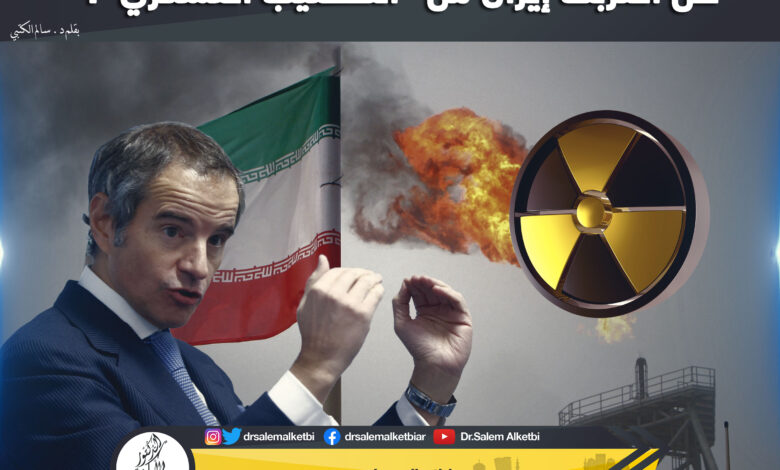
In the Iranian nuclear issue, we must separate two important things so that we can understand the dimensions of what is going on in this complex matter. The first is the possession of the knowledge and production capacity necessary to enrich uranium to 90% purity, the level needed to build a nuclear bomb. Here, too, a distinction must be made between the levels of capability and implementation.
For example, the prima facie evidence confirms, at the very least, that Iran has had the technical ability as well as the necessary equipment for many years. But it chose to postpone moving to this level of uranium industrialization for reasons and considerations that we believe to be primarily political in nature.
The second is the political decision necessary to move to the implementation level, that is, to move knowledge and enrichment capabilities into the operational phase by building a bomb or conducting a nuclear test.
It seems to us that the whole discussion is still focused on the first part, since the second political decision remains a card of maneuvering and its implementation is a matter of time.
A recent report reveals that inspectors from the International Atomic Energy Agency (IAEA) discovered uranium enriched to 84% purity at one of Iran’s authorized nuclear facilities. This finding is significant as it indicates that Iran is only 6% away from achieving the necessary enrichment stage to construct a nuclear weapon – a threshold that experts believe is not a technical hurdle.
The revelation highlights the urgency for the international community to take action as Iran now officially possesses uranium enriched to the level required for a nuclear weapon, according to international experts. The IAEA’s latest report raises questions concerning the timing of Iran’s decision to allow the inspectors to reveal this level of enrichment. It is widely believed that inspectors only see what Iran allows them to see. What is the extent of Iran’s enrichment activities that remain hidden if there are clear official indications that they have exceeded the prohibited enrichment ceiling?
Notably, a spokesperson for Iran’s Atomic Energy Agency dismissed the credibility of the IAEA inspectors’ report, calling it a lie. This entire situation appears to be part of a carefully orchestrated Iranian strategy of selectively leaking information, denying it, and then exploiting it for political maneuvers and a game of mutual pressure and threats with Western nations.
Earlier this year, IAEA Director General Raphael Grossi confirmed that Iran had amassed enough enriched uranium to construct nuclear weapons. Meanwhile, Tehran claimed last December that its uranium enrichment capacity had reached an “unprecedented” level and stated that it had no intention to build a nuclear bomb. Therefore, the recent revelation of Iran’s progress towards nuclear weapon capability does not come as a surprise.
What is more interesting is the timing of Iran’s decision to make this information public. It is probable that Iran intentionally leaked this information to make it official at a time when it realizes its nuclear dossier is stuck, with negotiations for the renewal of the nuclear agreement failing or stalled, and international sanctions remaining in place with the likelihood of additional sanctions in the coming months.
The Iranian regime may be considering escalating pressure on Western capitals to increase the stakes on Iranian threats in a calculated game, recognizing that it is difficult for the US to decide on war or even a preventive military strike against Iran during such a sensitive and precarious period in international relations. Consequently, many believe that Iran’s recent actions are part of a carefully planned strategy.
The recent revelation of Iran’s uranium enrichment has sparked a game of political maneuvering. According to IAEA Director General Raphael Grossi, Iran has amassed enough enriched uranium to build nuclear weapons, while Tehran claims that it has no intention to build such weapons. However, the time at which this information was leaked is particularly noteworthy, as Iran is currently facing negotiations for the renewal of the nuclear agreement and suffering from international sanctions.
Observers are now speculating that Iran may be deliberately escalating tensions to increase pressure on Western capitals. It is unclear whether this tactic will achieve the desired Iranian goal or lead to a more charged response from the West. The hidden aspect of Iran’s nuclear program remains a concern, as the regime has shown a deep expertise in hiding its nuclear efforts over the years.
The behavior of the Iranian regime is under scrutiny, as they continue to intervene and impose influence and hegemony as trump cards to guarantee important room to maneuver without being subjected to a military strike. Israel, in particular, feels an existential threat from Iran’s growing military capabilities and has a different strategic calculus than its American ally. At some point, Israel may have to protect itself and settle for a green light from Washington without engaging in any possible military operation. It is clear that realistic expectations and visions for the next phase are needed to navigate this complex situation.