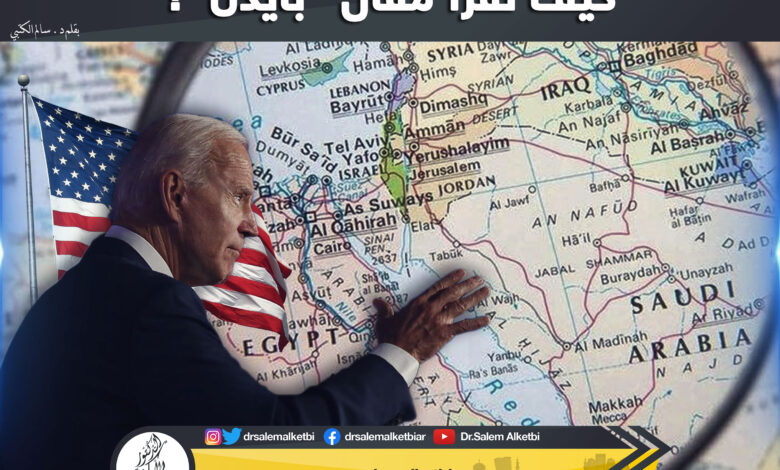
There is much to analyze in a recent article by President Joe Biden published in the Washington Post, and one should try to read it in light of current regional and international circumstances and changes. The timing of the article, which anticipated Biden’s Middle East tour, reflected his goals to market his view to American public opinion and political elites first and foremost.
We are not interested in the controversy surrounding the author of the article, whether it is President Biden himself or others. In such cases, the rule is that the “content” reflects the author’s beliefs, regardless of any other context.
Nor do I mind that the article does not explicitly admit a number of US failures in dealing with problems in our region, particularly in managing relations with Saudi Arabia, the US’s historic strategic partner. Such an admission simply cannot be expected, because it implies an acknowledgement of miscalculations, misjudgments, and policy failures.
This would be a double disaster, especially in the case of President Biden, given his vast experience in the region, its problems and sensitivities, and given that such an acknowledgement would partially affect the popularity of a president who is losing steam and who faces very important midterm congressional renewal elections in which he could lose his party backing, complicating the remainder of his term.
President Biden was not expected to say he was wrong in his stance on Saudi Arabia. The visit to Riyadh, the recognition of Saudi Arabia’s status, importance, and role in the US foreign policy calculus, and the withdrawal from all White House positions are an implicit admission of the mistake and a desire to undo it. This is common practice in international relations.
Neither waits for the other to directly admit the mistake before correcting course. In short, the point is that the article is a stepping stone down the road of climbing down from his erratic positions toward Riyadh.
So it seems natural that Biden’s article talks about not wanting to give up his previous positions, wanting to spread American values, etc., understandable in the context of politics, diplomacy, and practice on the ground.
This was evident in the article’s eagerness to connect the immediate interests of the American voter with talk of energy, trade, supply chains, and the White House visit to Riyadh, the language closest to understanding the American street, with the rising tide of inflation.
Certainly, the article is not free of attempts to play with words, especially when it comes to pointing out that its goal from the beginning was “to reorient — but not rupture — relations” with Saudi Arabia; it was not about either term. It was about “isolating” the Kingdom, whether with the goal of cutting off relations, or maintaining the minimum, which seems more conceivable.
But such attempts are also a must; Biden wanted to justify his new position and market it in such a way that he would not be embarrassed when answering journalists’ questions on the tour. The article provided them ready-made answers by referring to his content and avoiding all other answers that might bring further trouble and criticism to the White House.
The impact of the more than 100 journalists who accompanied the President on this trip should not be overlooked.
In his article, President Biden attempted to embellish the Middle East by talking about a different, safer, and more stable Middle East than his administration inherited, linking his pursuit of stability in the region to the fight against terrorism and domestic security in the US to avoid new wars affecting American families.
These are all legitimate campaign statements, even if they do not correspond to reality in all details. President Biden’s article was certainly a proactive media prelude to his visit to Saudi Arabia and his attempt to put the alliance with Riyadh on a more realistic footing. That is what really happened.
These are all things that are credited to Saudi leaders and reflect the kingdom’s place in the calculus of US policymakers, whether they admit it or not. Reality accurately reflects new balances of power and the Kingdom’s place in them.
The US path to regaining its status and maintaining its position in the world order, whether under Biden or others, must go through the Gulf region and Saudi Arabia in particular. President Biden’s greatest mistake is that his extensive experience in US politics has led him to fail to understand the influence of his country’s historic allies such as Saudi Arabia and the UAE.
Nor did he understand the dynamics of change sweeping their foreign policy, the implications for US interests, and how to deal with the new strategic reality. An early understanding and careful strategic assessment of all these issues could have avoided many mistakes and left the US in a stronger position to deal with international crises.
President Biden’s policies are complicated primarily by the fact that he often blames the previous administration of President Trump for the deterioration of US relations with its Gulf partners. This is one of the deceptions that hides President Biden’s bias in favor of President Barack Obama, with whom he worked as Vice President for eight years.
This is not about defending partisan politics for Democrats, or even policies that Biden himself helped create and implement. This is about defending Obama because he is convinced of his policy direction and vision, which Biden continues to adhere to and try to implement, with all the disasters it has caused not only for the countries of the region, but also for the US.
But he himself has also not survived the consequences of this policy, which has weakened his position in dealing with major international crises and put him in many critical situations since he took office a year and a half ago.