The Arab League has passed many difficult tests in recent years. Opinions differ on how it interacts with problems, its approach to issues and crises, its policies regarding regional and international developments, and its ability to evolve with the circumstances, demands and variables of the times to strengthen its institutional role and deflect its critics.
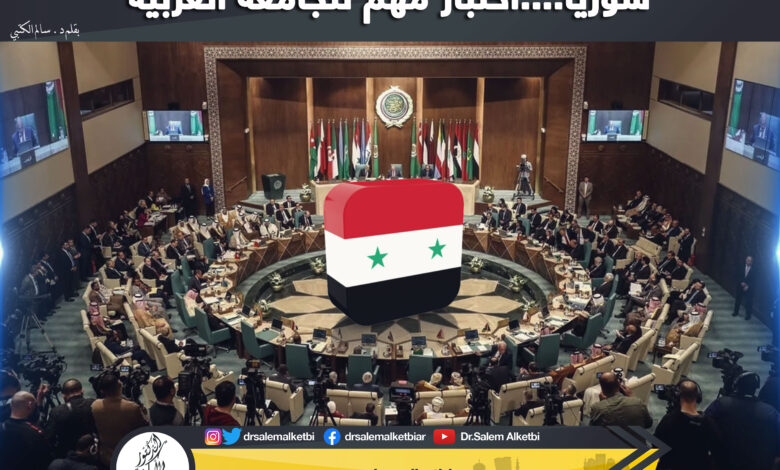
Many of them speak out of concern and have valid opinions. Others have old visions that we will not discuss here. Given the above, the issue of Syria’s return to the Arab League seems to be an important test of the Arab League’s ability to at least institutionally heal the current Arab reality in all its details, as everyone knows, and to regain at least part of its role in Arab joint action.
I am convinced that the League is a mirror of the troubled Arab reality, an institution that reflects the conditions of its members and that its will is organically linked to the will of those members.
But I am surprised that sufficient institutional efforts have not been made to bring Syria back into the Arab fold, not only in the interest of Syria, the country and its people, but also in the interest of the common Arab collective action and in the interest of the League itself.
“In the coming months, efforts will be made to secure Syria’s participation in the Arab summit to be held in Algiers in early November 2022,” said Arab League Secretary General Ahmed Aboul Gheit recently. “Syria’s participation in the Arab summit, when it happens, will be based on a broad Arab consensus,” he said.
This is a statement whose wording seems to have been carefully chosen with great verbal precision and accuracy so as not to leave League officials in diplomatic confusion. This seems to be the reason why the statement was issued in a way that was at least politically incomprehensible. Personally, it never occurred to me that this was an attempt to involve Syria in the upcoming Arab summit.
Perhaps it was meant that the League was making efforts in that direction. But the reluctance or ambiguity of the explicit announcement of such intentions gives rise to many signals that are not in the interest of the League and its administrators. In general, Syria, regardless of the content or purpose of the statement, deserves to publicly declare its support for a return to the Arab League.
The Syrian people deserve everyone to defend their country’s cause clearly after all the costs they have paid, regardless of what has happened in the past or who is responsible. The Arab nation also deserves that Arab League officials declare that they are making efforts to accelerate the return of a great country to the League system.
Given the stated position of Arab states, the position of Arab League officials is understandable. Caution in accepting Syria’s return to the League may also be warranted. But I believe that the League has a more important role to play than simply coordinating the positions of its members or being cautious about explicit or implicit support for Syria’s return.
I do not mean here that the League should engage with one side or the other that rejects Syria’s return, even those that link return to conditions they deem necessary. That is their right and that is their view. But I believe that regional and international circumstances and changes have created a new climate and environment that has contributed to the revision of many regional dynamics.
It is clear that Syria is at the centre of the regional recalculations and reconfigurations. This should be an appropriate starting point for discussion and resolution. The regional reconfiguration has been going on for several months and gave way to a remarkable consensus and mutual understanding for the benefit of the people and interests of all countries in the region.
The entire Middle East region is witnessing a new structure of intergovernmental relations. I think this is very positive. But leaving Syria out of this new system of relations is a curious circumstance that limits the desired consequences for regional security and stability.
According to Syrian Foreign Minister Faisal Al Mekdad, Syria’s relations with 14 Arab capitals have returned to normal.
In an earlier statement, he confirmed the return of 14 Arab embassies to Damascus and called on other Arab capitals to reconsider their positions in light of the shifting strategic regional and international environment and before and after all the interests of the Syrian people, especially after their issue has fallen among the priorities of the international community since the beginning of the Ukraine crisis.