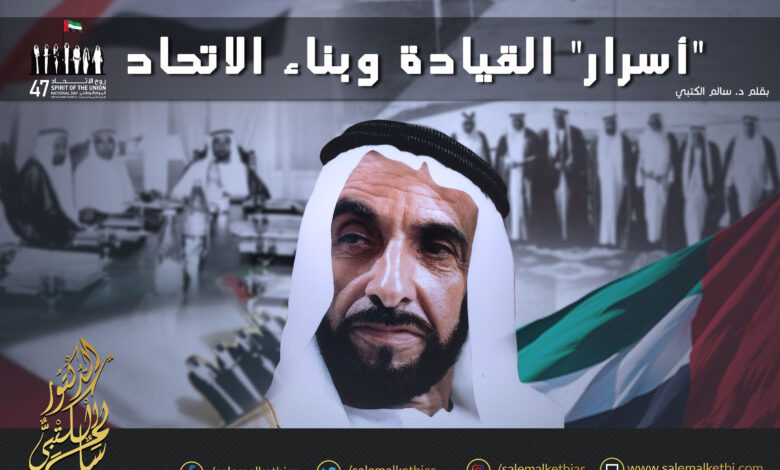
The federal experience of the UAE is a rich material for research. Western scholars who lived in this historical phase are interestingly well-documented.
Also worthy of reading is Arab literature about the personality of the founding leader, the late Sheikh Zayed. Many published books and studies plunge into a deep analysis of personality, circumstances and the context of such unique an experience in contemporary Arab history.
Among these studies is the book “Origins of Cultural Leadership: A Study in Sheikh Zayed’s Thought” by Dr. Nabil Ragheb. The author addresses the characteristics of the leadership of the founding leader, including its origins. He considers that the leader who makes history begins political life early, learning and understanding past and present experiences. Such a type of leadership, even in its early beginnings, does not deal with the political experiences of others as sacrosanct, but as contributions that need constant revisions; as opposed to tactical leaders who exploit transient opportunities.
Nation builders are the kind of leaders who make history and pursue civilizing projects, not wars and conflicts. The leadership of Sheikh Zayed turned the principle of “Unity makes strength” into a reality in the UAE and the Gulf region. Once the Union State was established, he led a cultural renaissance spanning from education, health and development to military force to protect and maintain security and stability.
Sheikh Zayed once said, “The Union is my wish and the ultimate goal of the people of the Union.” He knew how to read history and look forward to the future. Perhaps it was through simple instinct that he understood that the future is for big blocks, not small dispersed entities. This ambition ultimately laid the foundations of the UAE’s 21st century renaissance.
Every statement the founding leader made was well received in literature about him. The positive reaction is probably due to the inherent love that linked Sheikh Zayed and his people. He would interact directly with citizens. Nabil Ragheb wrote, “Sheikh Zayed believed that the media can be a true expression of mutual love between the leader and his people. In the absence of love, the media becomes a hollow drum and that is why Sheikh Zayed’s actions and achievements in all areas exceed his words and statements.”
People would be to keen to listen to what Sheikh Zayed was going to say. The founding leader was not known for oration or eloquence, but for work and achievements—being like a real father to his nation. He would implement what he believed in and saw as right for the benefit of his people. The words of the founding leader were simple, concise and to the point.
The founding leader was modest and his political discourse was frank. That was decades before accountability became a fully-fledged principle of political leadership in the twenty-first century.
The speeches of Sheikh Zayed stressed the need to instill honesty in the collective consciousness of people, to spread love, a direct product of honesty, among them. He has said, “friends owe frankness to each other if they are willing to love one another.”
These were lessons from the Union and the leadership genius of the late Sheikh Zayed bin Sultan Al Nahyan, and sure there are more to come.