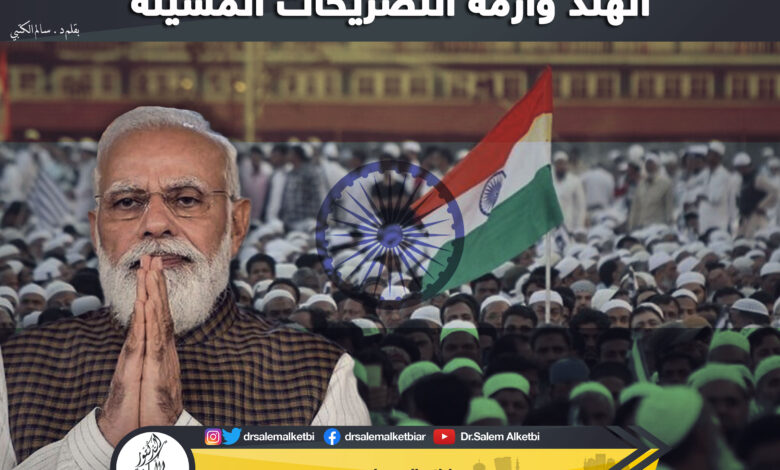
Undoubtedly, the recent events in India’s relations with Arab and Islamic countries related to insulting remarks about the Prophet (PBUH) made by officials of the ruling party (Bharatiya Janata Party) are a litmus test for these relations in their official dimension. But the main test, in my opinion, is for grassroots relations.
India maintains a good image in the Arab and Muslim collective consciousness since the days of non-alignment, as well as closeness, communication and cooperation at the level of trade, economy, politics and labor. Now, remarks by the spokesman of India’s Bharatiya Janata Party (BJP) have been widely decried and rejected by Arabs and Muslims.
India’s ruling party suspended its spokesman and fired another official after a wave of anger over hurtful remarks that some Indian analysts believe were related to internal sectarian tensions. These spurned remarks not only damaged the image and reputation, but also further soured relations between different segments of Indian society.
Muslim-Hindu relations need no further cause for tension and complexity. Worth noting about this issue is that the GCC countries have taken the lead by adopting a formal and angry stance on the Arab and Islamic levels. This means a lot, both for their foreign policy and for the regional balance of power.
Of course, the anger of the Gulf and Arab countries, rightful in principle, does not mean that the official reaction will veer into an economic or political boycott of India advocated by a few radicals. There are a number of reasons and considerations, most importantly the depth of historical and popular relations between India and the Arab and Islamic world.
The second reason is the extent of strategic interests exchanged between the two sides. The Gulf countries are home to millions of Indian workers (Muslims, Hindus and other communities) who are an important source of income for the Indian economy and millions of Indian families back home.
India is a major large importer of oil exports from the Gulf, a huge trade exchange of about $100 billion per year, with other strategic considerations that run counter to the idea of dragging relations with a major regional power like India into antagonism or divergence that affects the interests of both sides.
The ruling BJP party issued an official statement in which it “strongly denounces insult of any religious personalities of any religion.” The party also stressed that it rejects any ideology that insults or denigrates any sect or religion.
Regardless of whether the Party’s orientations and policies are internal matters that should not be discussed from the outside, the Party has taken an important measure to contain the external anger that erupted after these remarks by suspending the official who made the remarks and removing the Party’s media officer from his post. It is a relatively positive stance.
But it falls short of the ceiling demanded by some states, which had hoped for an apology from India for these offensive remarks. Moreover, given the sensitivity of the Islamic public to this issue, the consequence of similar insults in other parts of the world, and the possibility that they will be repeated in the future, the impact of such remarks is not exactly proportionate.
In my view, the official, not partisan, Indian position relates to the extent to which the party’s response can contain the Arab and Islamic waves of anger.
In other words, New Delhi has opted for a phased approach to deal with this anger, based on a party stance, in anticipation of what will follow according to a graduated policy, and in an effort to contain the crisis with little or no political cost. The statements of some of those referred to by Indian officials as “marginal elements” do not reflect the views of the Indian government.
This is true at a formal or surface level. But the Indian government could have quickly assuaged the anger by taking an official position rejecting such serious abuses in absolute or general terms, especially since they have profound consequences that deepen the scars in India’s sectarian and social fabric.
From a purely analytical point of view, far from any emotional or religious bias, as a Muslim who resents such repudiated statements, whatever their motives and justifications, I am of the opinion that the BJP’s management of this crisis was overshadowed by the party’s ideological orientations and not by India’s higher strategic interests, which dictated party leaders to act from the onset of the crisis to calm the uproar and pre-empt any expected trouble at home and abroad.
The leadership of India’s ruling party probably decided to wait, to delay taking a stand, and perhaps to try to reconcile its partisan leanings with the country’s strategic interests.
However, the Arab and Islamic reactions seem to have surprised the Indian politicians who did not realize that there is a difference between the Arabs’ desire not to interfere in the internal affairs of India and the relations between their communities and undermining the status of the Prophet, as this cannot be considered as part of the internal religious polarization of the country.
The wisdom, not alien to India with its rich history, would have been for Indian leaders to take the initiative to settle this controversy, to create an atmosphere of tolerance and coexistence at home and abroad, and to provide important moral support to friends who are trying to sow the seeds of coexistence and tolerance at the global level, especially the UAE, which in 2018 built the first Hindu temple in Abu Dhabi, a qualitative step with profound significance.
India’s relations with the Gulf countries, especially the UAE, are also experiencing a major upswing. There are commonalities in views on international crises and problems such as the Ukraine crisis and others.
The conclusion is that the crisis related to the insulting remarks about the Prophet (PBUH) could have been contained and controlled from the beginning to preserve the foreign policy gains of the BJP and thwart any chance for hardline voices and currents to fan the flames of discord and open the door for political football, not to mention the impact on India’s reputation.