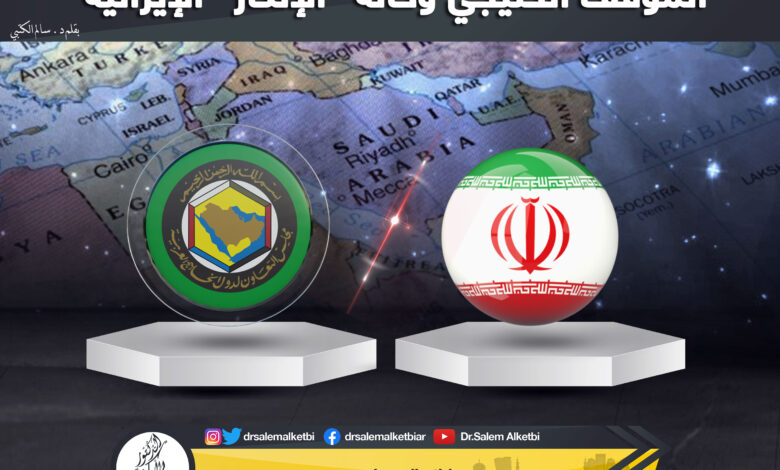
It seems strange to me why the Iranian side is angry just because the GCC countries talk about their interests and demands for security and regional stability? The latest position expressed in a statement issued at the end of the 152nd Gulf Ministerial Council meeting in Riyadh reveals the Iranian regime’s growing sensitivity toward neighboring countries.
It calls on Iran to respect the principles based on the UN Charter and international law governing relations between states, including the principles of good neighborliness, respect for state sovereignty, non-interference in internal affairs, peaceful resolution of differences, non-use of force or threat of force, rejection of terrorism and sectarianism.
Ironically, despite all the Iranian regime’s claims about the importance of dialogue in resolving regional tensions and mutual understanding between neighboring countries, sensitivities run high. Certainly the GCC countries have a right to be concerned about Iran’s position, especially given that this behavior has continued and intensified from 1979 to the present.
Moreover, the regime in Tehran’s desire for expansion, excessive fomenting of crises, and attempts to drag neighboring countries into trouble and involve them in crises that distract them from continuing the development process-all aspects of this regime’s behavior, underlie people’s sense of constant comparison with the development taking place in neighboring countries.
Why is Tehran angry at the GCC countries’ request to deal seriously with Iran’s challenge to the countries of the region, not only the nuclear issue, but also the militia arms and the threat of missiles? Aren’t Iranian missiles and drones a threat to everyone in our region, or are we being asked to buy claims that they are being developed in Houthi mountain hideouts?
In fact, the GCC has not demanded an international escalation or stance against Iran, for example. It called for calm, cooperation and adherence to international laws.
It also called for participation in any negotiations on the Iranian issue as a regional issue, as in the case of North Korea, participating in its six-party talks with interested neighboring countries (South Korea, Japan and the three major powers, China, Russia and the US).
“Our dialogue and communication with Iran should be based on a unified Gulf position. We call for calm, cooperation, international legitimacy and good neighborliness so that we can work together to achieve our development plans in a stable regional environment that promotes partnership and supports economic diversity programs,” said Saudi Foreign Minister Prince Faisal bin Farhan.
“Negotiations on the Iranian nuclear issue and any future negotiations with Iran should include addressing its destabilizing behavior in the region, sponsorship of terrorism and sectarian militias, missile program, security of international shipping and oil facilities, and the need for GCC countries to participate in these negotiations and all regional and international discussions and meetings related to this issue,” he added.
All of this generally reflects the real demands and guarantees of regional security and stability, whether it meets Tehran’s wishes or not. That is the reality and those are its demands.
“Making such routine statements contradicts the principles of good neighborliness and has no special function other than creating regional crises and nullifying the diplomatic efforts and steps of the Islamic Republic with neighboring countries, including some friendly and partner countries of the GCC,” replied Iranian Foreign Ministry spokesman Saeed Khatibzadeh.
As if Iran’s actions in Yemen and other Arab countries and its incitement to commit terrorist acts with the rockets it sends to the Houthi terrorist group fall under the principles of “good neighborliness,” while diplomatic actions and the expression of demands in civilized language are outside those principles.
The Iranian speaker seems to be putting the cart before the horse by talking about arming the Gulf armies, ignoring the fact that his country is the main and only reason for the current situation, which no one would see if the Iranian neighbor behaved like a normal state.
He talks about the symptom ignoring the disease. He ignores the reason for the military expenditures of the Gulf states, which are certainly not designed to protect the gains of thier people from fictitious threats from another world.
Even when the GCC nations try to pay no heed to this threat, the Iranian regime keeps reminding of its danger, whether in its proxies or in provoking tensions and dragging the GCC into any verbal escalation with the US or others. Khatibzadeh’s statements are a manifestation of Iranian arrogance. “The nuclear agreement clearly defines the countries that adhere to it,” he said.
This may sound like truth. But who says his country adheres to it at all? Then who says it’s even a living agreement?
The GCC countries are talking about any “future negotiations,” not an agreement that is now in a state of brain death, whether because of Iran’s violation or the US withdrawal. Talking about the three occupied Emirati islands (Greater Tunb, Lesser Tunb and Abu Musa) is another display of arrogance.
The Iranian speaker claims that they are “an integral and eternal part” of Iranian territory and rejects “any claim” to these islands, noting that “repeating these interventionist positions is totally unacceptable in any case. It would in no way affect existing legal and historical realities.”
This unacceptable and blatantly arrogant attitude in response to a legitimate demand for the sovereignty of a neighboring state over the occupied part of its territory exposes the intentions of a regime that constantly repeats statements of good faith and dialogue with neighboring states, without realizing for a moment that such issues cannot be discussed amid such aggressiveness and disregard for international law.
The bottom line is that the way out of the dilemma of chronic tensions in the Gulf region will begin and end when the behavior of the Iranian regime changes. It is the one who can defuse them all by changing its behavior, stopping its expansionist, destabilizing interventions.