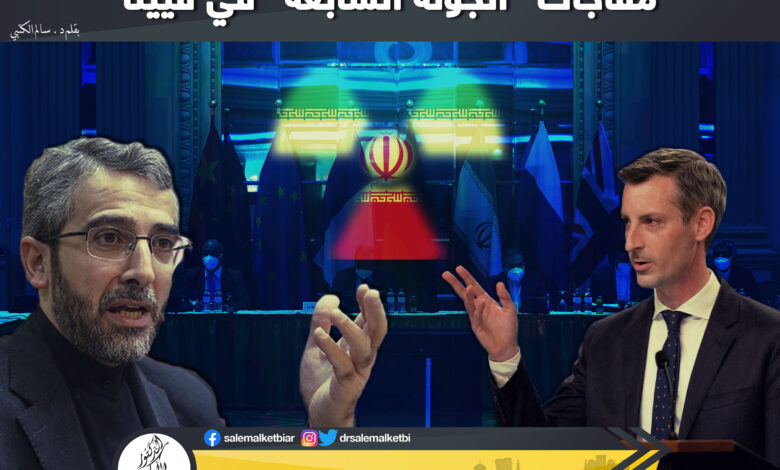
After much hesitation, the Iranian mullah regime has finally agreed to participate in negotiations to be held in Vienna on November 29 with representatives of the 4+1 (China, Russia, Germany, France, and the UK) with the direct participation of the US.
Iranian chief negotiator Ali Bagheri Kani said his country has agreed to “start negotiations on lifting the unjust and inhumane sanctions.” US State Department spokesman Ned Price said an agreement could be reached quickly if Iranian representatives are “serious.” The announcement is not surprising given the rapidly evolving crisis over Iran’s nuclear program over the past two weeks.
The tone of political discourse in the US has changed recently. An Israeli-American dynamic has emerged regarding Plan B or the alternative plan to end the Iranian nuclear threat if efforts to revive the nuclear agreement signed in 2015 fail. Iranian positions and statements then emerged. This suggests that the relative change in the tone of US political discourse played a role in changing the Iranian position and persuading it to accept a return to negotiations.
However, Iranian Foreign Ministry spokesman Saeed Khatibzadeh noted that threats are no longer an option for dealing with Iran. “US options have proven unsuccessful in the past in the region,” Khatibzadeh said. “America has experienced the catastrophic defeats caused by testing its options, and the world has seen the consequences of these egregious defeats,” he said.
Khatibzadeh echoed a statement by US Secretary of State Tony Blinken that the US would put all options on the table. Khatibzadeh’s remarks came after the announcement that the trip to Vienna was approved later this month. The connection between the relative change in tone in US discourse on the one hand and the Iranian position on the other seems clear.
President Biden is focused on building a strong consensus with France, Germany, and the UK that the mullahs must return to compliance with the nuclear agreement, a foundation that supports any US move to pressure the Iranian regime.
I mentioned earlier that the Biden administration has so far favored the diplomatic option in dealing with the Iran nuclear agreement, but the mullahs’ maneuvers have put the White House in a difficult strategic position. President Biden has demonstrated an inability to choose alternative strategic options that preserve America’s standing and its ability to protect its closest ally, Israel.
This has led to a rapid convergence of US and Israeli positions. The US can no longer pretend to rely solely on diplomacy to counter the Iranian nuclear threat. The mullahs’ agreement to resume the Vienna negotiations is different this time.
The hardliners in Ibrahim Raisi’s government lack the political and negotiating skills of the previous negotiating team led by Javad Zarif. So, the current team hides behind the language of the hardliners. It is intent on winning the media battle rather than winning the negotiations.
This group’s negotiating ability seems limited. But it could still win in one case: if the US bows to Iranian conditions. This is unlikely, though possible in that the White House appears to be aiming for a tangible political victory after a series of foreign policy failures. But let’s not be fooled by the mullah regime’s rhetoric.
The mullah regime’s rhetoric is intended for domestic consumption to achieve propaganda success among the regime’s supporters. Most members of this team do not have the experience of their predecessors. Therefore, they constantly strive to appear tough regardless of their actual calculations, views, and positions they take at the negotiating table.
I also believe that the current Israeli government’s vision of how difficult it is to reach an agreement to revive the nuclear agreement in its current form has a reasonable chance of being realized. For one, Iran’s nuclear capabilities have come a long way since 2015. As the International Atomic Energy Agency (IAEA) says, the “genie” is about to come out of the bottle.
For another, the mullahs are demanding a full lifting of US sanctions before agreeing to pull out of the nuclear deal. Given the changing positions, circumstances, and negotiating environment between Iran and the US, European mediators’ efforts could focus on bringing both sides back into the nuclear agreement simultaneously, one step here and one step there.
In this way, each side saves face in the negotiations in a win-win format, assuming Iran has “good intentions,” as the US side hopes.