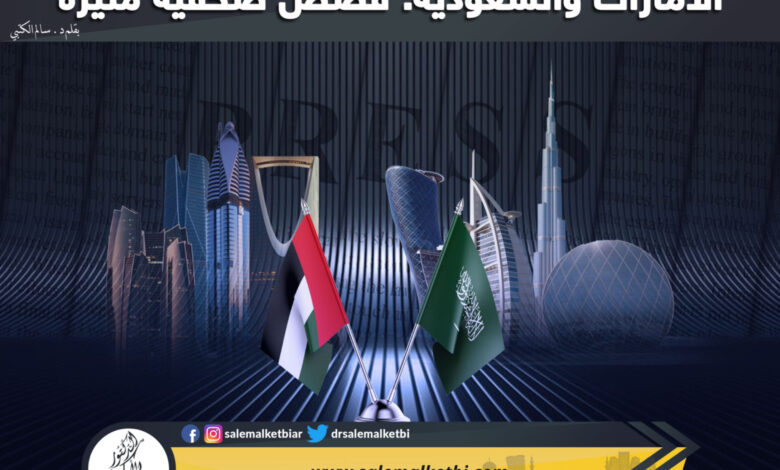
Over the past few days, I have been following many sensational news articles reporting “differences,” “tensions,” and a “silent crisis” in the relationship between the UAE and Saudi Arabia. These stories are hard for any Gulf observer to ignore, even if they are not accurate and do not show the reality of the relationship between the two sister countries.
In particular, these stories raise several points of discussion. These are mainly points of convergence and divergence of views between the countries, regardless of their levels of strategic convergence.
Contemporary international relations no longer boil down to the traditional catchphrase that has long adorned the official statements of high-level meetings between Arab or Gulf states. “Total convergence of the views of the two countries.” This so-called convergence no longer exists by virtue of the complexity and overlapping strategic interests of states.
The perfect fit between these interests is simply pie in the sky. I don’t think it has even been achieved in the past, or at least 100%, as the word “perfect” suggests.
The rich experiences of Emirati and Saudi diplomats show that they have shed some of the old ways and are dealing with the facts more openly. This is not just because it has become inconvenient to hide the facts and keep differences, however small, under wraps.
Also, diplomacy works through mechanisms that suit its time. It does not catastrophize the discussion of differences of opinion as something that undermines a strong and sustainable bilateral relationship.
Even more so if such a relationship is based on well-thought-out ties, interests, and strategic partnership agreements that clearly outweigh any potential impact of a fleeting difference of opinion. Of course, I also do not mean to imply that there is a disagreement in the UAE-Saudi relationship.
My position as an observer does not allow me to confirm or deny speculation. Moreover, the focus on reports of this disagreement by some well-known media and currents reveals persistent attempts to throw fuel on the fire and seek to ignite discord between two fellow nations whose alliance has served as a lifeline in our Arab region’s crises in recent years.
In politics, breaking down alliances between those who put out the fire in an explosive region is one of the goals of the firebrands and seditionists.
While some media outlets have gone so far as to claim a divergence of strategic interests between the UAE and our fellow Kingdom of Saudi Arabia (against the backdrop of differing views on issues such as oil production, Yemen, normalization with Israel, and even how to deal with the coronavirus pandemic), an objective examination of what is going on leaves no room for interpretation.
For example, an issue such as lists of countries to visit during a pandemic outbreak undergoes rapid and natural changes by virtue of each country’s awareness of health conditions within and beyond its borders. These are technical decisions that have nothing to do with politics, at least in our region.
The latter does not have polar conflicts between great powers, such as between China and the US. It is clear that the “spark” that triggered many media outlets promoting a disagreement between the two countries is the difference of opinion on the OPEC agreement on production quotas of member states.
This position has been an opportunity to build a fish story around the two countries’ position in Yemen, and the relationship with Iran, under the pretext that the UAE is taking a more open attitude towards Iran, although official evidence points to Riyadh and Tehran’s official recognition of the existence of talks between them.
In fact, it is difficult to address each of the issues that some place in the sphere of “disagreement” between Riyadh and Abu Dhabi in such harebrained discussions based not on information but on pure sensationalism. Certainly, Emirati and Saudi diplomats have gained a great deal of flexibility and dynamism in recent years.
They can maintain the intimacy of fraternal relations and the existing strategic partnership regardless of any transient tactical variables that, in the eyes of some, will inevitably spoil the atmosphere of relations. In other words, the relations between the two countries do not experience any forward or backward movement due to a fleeting situation or moves here or there.
There is a prior agreement on the strategic frameworks governing the relations of the two fellow countries, on par with the circumstances and the volatility of politics. The fact is also that with the enormous ambition of economic development of the UAE and Saudi Arabia, interests are likely to meet and also clash. Everything can be overcome through discussions.
However, some misinterpret these positions and confuse political, economic, military, and other aspects. In all fairness, recent history attests to the fact that differences, especially along economic lines, can sometimes arise between Riyadh and Abu Dhabi. But no rift between the two countries.
It is understood that the interests of the two countries and the two fellow nations are superior to any difference of opinion. All the more so since the blood of martyrs melded on the land of fellow Yemen to defend the security, stability and interests of all GCC people.
In recent years, the ties between the two countries and peoples have evolved firmly, sustainably and steadily, regardless of what others may see as a phase of division and discord. The Emirati remains Saudi and the Saudi Emirati. A truly sacred bond. A bulwark that transcends traditional calculations in bilateral relations.