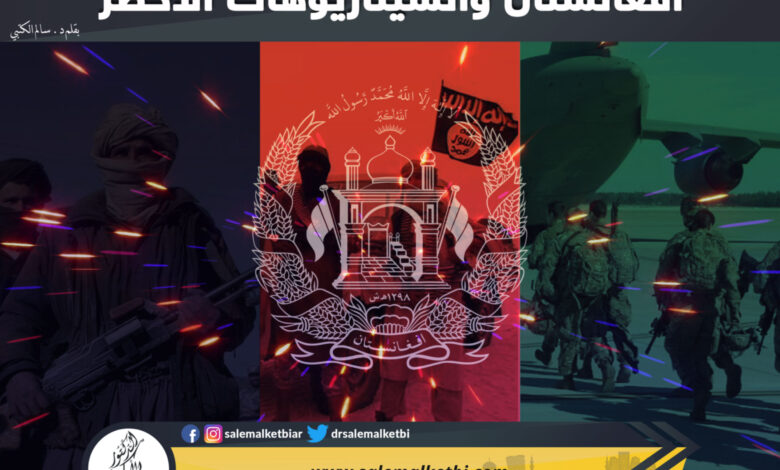
Experts and observers have raised several rightful questions since the official announcement of the upcoming completion of the withdrawal of US troops from Afghanistan. Some fear that the country will once again become a stronghold for Al Qaeda or any other terrorist organization.
Others believe the withdrawal offers a “free gift” to the Iranian mullahs to expand their regional influence and pressure in the face of any possible Western moves. A third party fears a two-decade setback, and that Afghanistan will be back in the hands of the Taliban.
A fourth believes that a new Afghan civil war due to the security vacuum in the wake of US forces withdrawal spells the return of extremist and terrorist organizations to life, for them to muster from their diaspora, regain strength, and take the country as a theater for their activities under the name of jihad.
These and other assumptions are likely as events and conditions on the ground evolve in a country that has been plagued by conflict, chaos, and fragmentation for nearly five decades.
With this in mind, the Iranian mullah regime has been quick to host the talks between Taliban representatives and the Afghan government and to mediate between the two sides. Interestingly, there was no American reaction to the Iranian move. The latter carries serious strategic implications.
The most important of these is Iran’s strong intervention in Afghan affairs and the further configuration of the Afghan political map in the post-US withdrawal to ensure Iran’s strategic interests. Some believe that the expansion of Iranian influence in Afghanistan will mirror the Iraqi situation.
In other words, there will be pro-Iranian sectarian militias in Afghanistan. But it appears that the mullahs will not replicate the Iraqi scenario in Afghanistan for several reasons.
The first is to avoid a clash with the Taliban and their willingness to build a generally anti-US, anti-Western Iranian-Taliban coalition in Afghanistan, as well as the possibility that the mullahs will use their close ties to Al Qaeda leaders, who once took refuge in Iran, to revive the group’s activity and reposition it in Afghanistan to target Western countries and interests.
The Taliban likely plan to regain power in the country. Some Western intelligence reports indicate that the group is strengthening its positions on the ground, in order to recognize it as a major force capable of governing the country. That means Afghanistan’s return to the pre-9/11 phase.
The Afghan worst-case scenario is on the horizon. Report after report shows the growing influence of the Taliban in Afghan cities and territories as they await the final drawdown of the US.
The resurrection of Mullah Omar in Afghanistan, 20 years later, has several negative connotations. These include the failure of the US to achieve the goals it sought when its forces invaded Afghanistan. Here, it is not a matter of eradicating Al Qaeda or not, but the extent to which there is the same environment that has already provided a suitable breeding ground for extremism and terrorism.
There is a high probability of a new civil war in the country. This is the warning of Russian Foreign Minister Sergei Lavrov. The latter expressed Moscow’s concern about the rise of Daesh in northern Afghanistan.
“IS is actively acquiring territories – mostly in Northern Afghanistan, right on the borders of countries that are our allies, amid the irresponsible behavior of some officials in Kabul and amid the hasty withdrawal of NATO, who is unable to report the achievement of at least some goals.”
That prompts some to say that the US and NATO are planning to sow chaos in areas close to their main strategic adversaries — China and Russia. The completion of the US withdrawal from Afghanistan coincided with the expansion of Taliban influence in the country.
That influence is expected to grow with the completion of the US withdrawal by the anniversary of the Sept. 11, 2001, attacks, ending a 20-year war that killed 2,442 US troops, more than 3,800 US private security contractors, and 1,144 troops from other coalition countries. Some 117,000 Afghan civilians and soldiers lost their lives.
Approximately 20,660 US troops have been wounded in combat operations. Brown University estimated US casualties at $2.26 trillion. From 2001 to 2019, the Pentagon estimated military spending in Afghanistan at $778 billion.
In addition, $44 billion was spent by the US State Department, USAID, and other agencies on reconstruction projects there. However, these figures do not take into account the extent of US military spending in Pakistan. It is used as a base for military operations related to Afghanistan. There is also logistical support for the war in that country.
So, estimates certainly differ here given the multiplicity of expenditures and sources of funding and support. Other official US data show that US spending on reconstruction in Afghanistan since 2002 to date is approximately $143 billion.
Importantly, a US Congressional report released in October 2020, which included an estimate from the oversight body overseeing reconstruction efforts in Afghanistan, stated that approximately $19 billion was lost between May 2009 and December 31, 2019 due to waste, fraud, and abuse.
All of this shows the heavy losses to the US taxpayer as a result of this military campaign. This one seems to be about to end without major success. Several scenarios await post-US Afghanistan. All bleak, they haunt the security and intelligence officials of the major powers.
But the worst-case scenario for Afghanistan remains that the global collective sits back and watches what happens on the country’s soil without moving to anticipate events and dangers.