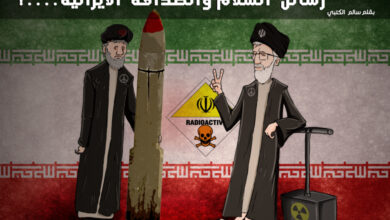
There is a great difference between the conduct of states and the practices of organizations and militias, which are characterized by many uncertainties and miscalculations, regardless of the precision or capabilities of an organization or militia such as the Iranian Revolutionary Guard.
Organizations and militias remain made-up entities, characterized by a great deal of chance, indiscipline and sometimes chaos, despite the apparent appearance of things on the surface.
Nonetheless, states and regular armies have their own inherited rules and traditions that govern institutional action and precisely determine the power to make military and strategic decisions, which are particularly sensitive.
There is no doubt that the fallout from the current problem that the Iranian mullahs’ regime has attracted by the shooting down of a Ukrainian airliner could outweigh the consequences of the crisis caused by the death of General Qassem Soleimani.
Where the mullahs have to foot the bill for limiting the role of the Iranian military and building parallel militias that have the upper hand in diagnosing the regime’s interests and defending it against what the regime’s generals and leaders consider threats.
Efforts have been made by the mullahs to take advantage of the assassination of General Qassem Soleimani following a US missile attack on him and his IRG and Iraqi Popular Mobilization comrades near Baghdad airport, to use the event to create a fake case of popular rallying around the Iranian leadership, and to play on the rope of Persian nationalist sentiment and surround Soleimani’s body in various Iranian cities.
However, the explosion was quickly lifted and suppressed after the role of the Revolutionary Guard in the shooting down of a Ukrainian civilian plane was confirmed. Tehran admitted that it was an accident by mistake.
The Iranian people felt, as expected, what their leaders were trying to do. They immediately realized the seriousness of the mistakes caused by the miscalculations, hasty decisions, indiscipline and loss of control over the Revolutionary Guard Corps, which resulted in the downing of a civilian passenger plane, most of which was Iranian.
Mass demonstrations have broken out in Iranian cities, which may not have an immediate effect in bringing down the regime. But it is an important message, as is the deterrent message it has received from the American side.
There is a double siege both internally and externally that the mullahs, who have lost the compass of leadership and the sensitivity of crisis management in recent times, are undergoing.
On the one hand, there is the strong and cumulative effect of the harsh economic sanctions imposed by the Trump administration on Iran and, to a lesser extent, the surprising American targeting of General Qassim Soleimani. This decision has confused the Iranian leadership, precipitating a catastrophe in terms of decision-making.
I believe that the top of the Iranian power hierarchy, Supreme Leader Ali Khamenei, may not have been tested as hard as he was in the assassination of General Qassem Soleimani.
How confused everyone seemed, unable to implement the threats against him. The statements were mixed, not respecting the rules of the role-playing game that the mullahs had known for years.
The pressure the mullahs are facing at this time is enormous.
The US, for example, has not been content to apply decisive military deterrence against the mullahs with a single missile strike. It also gave up a lot of reservations and diplomacy when President Trump first announced that he stood by the Iranian people, and that the US was “following your protests closely,” referring to the popular protests that erupted in Iran after it acknowledged the shooting down of the Ukrainian plane.
“To the brave, long-suffering people of Iran: I’ve stood with you since the beginning of my Presidency, and my Administration will continue to stand with you,” President Trump tweeted. “We are following your protests closely, and are inspired by your courage,” he added. Obviously, the US is betting on the Iranian people’s ability to overthrow the dictatorship. President Trump’s entry suggests that there is fire under the ashes.
British Secretary of State for Foreign Affairs Dominic Raab, for his part, has accused the Iranian authorities of having arrested the British ambassador in Tehran for some time. Raab said, “The arrest of our Ambassador in Tehran without grounds or explanation is a flagrant violation of international law.” The mullahs’ confusion and inability to manage the crisis is evident after exposing their fear and weakness in making the decision to respond to the military response to Soleimani’s death and implementing their exaggerated threats.
The regime’s leaders were probably not serious, making threats that they were unable to carry out because they feared the severity of the US military response. They chose to appear weak rather than see the whole system collapse.
The mullahs’ regime is at a real crossroads and seems to be in dire need of its usual political pragmatism, realism and interest calculations. All paths seem to be closed compared to the one the mullahs have mapped out for themselves in recent years.
There is a state of regional and international rejection and anger over their expansionist role and the threats that have caused widespread chaos and unrest in the Middle East.
Nevertheless, the regime can save the rest of its prestige and stature by adopting a rational option. This would require reversing the plans for chaos and rolling back sectarian weapons, now that their architect and founder, Qasim Soleimani, has been killed. The event may be a decisive moment for recalculation and self-revision, abandoning arrogance and stubbornness, and defending the interests of the Iranian people who deserve a secure and stable life.
A courageous decision must be taken to change the path, redefine the strategy, adopt various decisions and policies to calm the regional atmosphere, open a new page with the neighbourhood, announce commitment to the principles of international law, and renounce everything that has caused a state of isolation The economic and political consequences of the unprecedented suffering of the Iranian people.
The mullahs may not be able to take courageous or bold decisions at such a delicate moment. The regime feeds on crises and has no real development project to present to the Iranian people. It fears the moment of confrontation with the people. But reason and logic say that the moment is undoubtedly coming.
The ball is in their court to escape the fate that we see fatally coming. The simplest excuse to the Iranian people for the mistakes of the mullahs is to have the courage to correct the path and correct the policies instead of continuing stubbornness and making the entire people pay the bill for the mistakes of the militia in the crash of the Ukrainian plane and the violation of the sovereignty of other countries.