There was good news about the institutionalization of efforts to promote coexistence and tolerance and to advance, on a global scale, the true values of religions, outside extremist, violent and terrorist ideas.
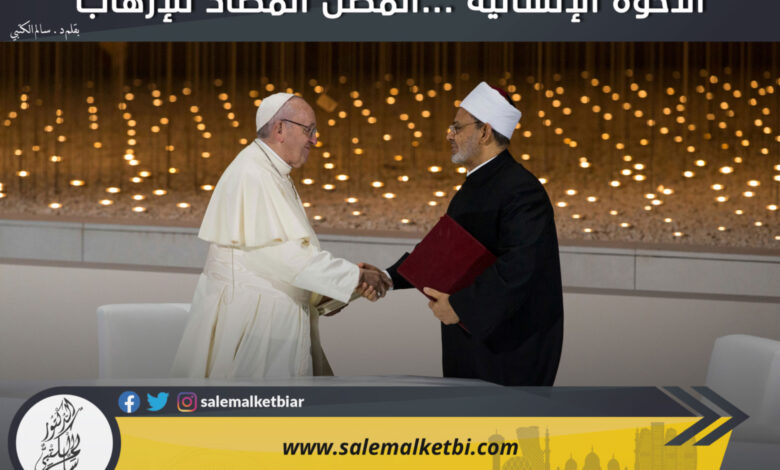
In February in Abu Dhabi, the Grand Imam of Al-Azhar, Dr. Ahmed Al-Tayeb, and His Holiness Pope Francis Pope, signed the Document on Human Fraternity under the patronage of His Highness Sheikh Mohammed bin Zayed Al Nahyan, Crown Prince of Abu Dhabi and Deputy Supreme Commander of the UAE Armed Forces.
The document provides for the establishment of clear values and principles such as freedom of belief, pluralism and recognition of differences in religion, colour, sex, race and language created by divine will and the abominable forms of terrorism are not the product of religion even if terrorists carry its flag.
Terrorism is the result of an accumulation of misconceptions about religious texts and policies that contribute to hunger, poverty, injustice, oppression and arrogance.
This historic document, which is receiving increasing global attention, was described by United Nations Secretary-General Antonio Guterres as a testimony of mutual respect.
The document is of great interest to both the Pope of the Catholic Church and the Sheikh of Al-Azhar. At a recent bilateral meeting, they discussed plans for cooperation between Al-Azhar and the Vatican for human fraternization.
“Great religious institutions have a great responsibility in spreading the principles of goodness and the values of love and peace,” said Pope Francis.
He added that “the document of historical human brotherhood carries within it a guide that leads humanity towards world peace and coexistence, a universal reference for all those who believe in humanity, and a call to men of conscience to renounce violence and extremism,” he said. “The document of human brotherhood was a distant dream. But with God’s will, it became a reality.”
For his part, Sheikh Al-Azhar, Ahmed Al-Tayeb, said that “this meeting is a concrete translation and a real call to followers of religions throughout the world to embrace human brotherhood and reject feelings of hatred. ” The encounter “strikes all the doors to bring world public opinion to spread the values of fraternity and coexistence.”
What humanity needs now is for this interest of the two largest institutions in the Muslim and Christian world to promote coexistence and moderation to be translated into legislation, laws and initiatives that reflect the values and principles of this historic document.
In fact, human fraternity requires institutional action that frames this approach and protects societies from any excess or deviation. In the United Arab Emirates, we have a law against discrimination and hatred that is an example of the legislative principles that ensure social coexistence and tolerance.
Certainly, security efforts have always played a key role in the fight against terrorism, extremism and radicalism. Similarly, religious discourse plays a key role in strengthening good mentalities and reducing extreme trends.
However, it is essential in the long term to translate society’s values and principles into strict and dissuasive laws that limit abuses and respond to any action detrimental to social stability. Such laws will immunize societies against any radical ideology that leads to terrorism.
Imam Ahmed al-Tayyib, head of the Muslim Council of Elders, and Pope Francis of the Vatican are ready to establish religious cooperation to fight extremism and violence. This is an excellent opportunity to give a strong impetus to global cooperation to introduce the principles of the humanitarian fraternity text and translate it into national laws and regulations that immunize communities against terrorism.
In no way can we ensure global security and stability unless we establish coexistence and tolerance between the components of the community mosaic in any country, regardless of their ethnic, religious and sectarian particularities.
If you look in the Middle East, you can see that one of the most serious causes of conflict and crisis in this vital region of the world is the weak culture of coexistence and acceptance of the other, even among the components of the same society. There are gaps that terrorist organizations exploit and sectarian and ethnic tensions that States also use.
The world needs an integrated system of solutions, alternatives and remedies to reduce the risk of violence and terrorism and to avoid global conflicts of a religious or sectarian nature in the future. We must defeat the plans of those who support the clash of civilizations, cultures and religions, who really just want to lead the world to misery.