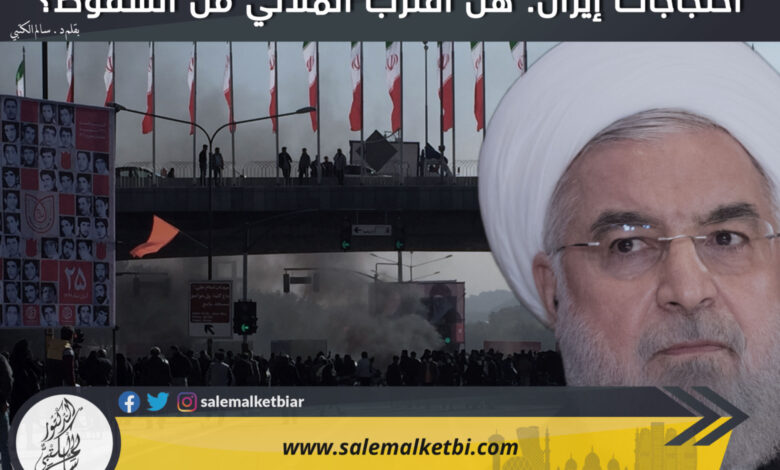
The news of the demonstrations in Iranian cities did not surprise observers of Iranian affairs. Although Iranian demonstrators have gathered to protest against the decision to raise the price of gasoline, this decision is certainly the straw that broke the camel’s back.
The mullahs’ regime’s security grip has weakened. In recent years, the regime has violently opposed all popular demonstrations through the Revolutionary Guard militias.
This militia represses, muzzles the Iranian people, and gives the world a false image of apparent stability that convinces no one that the mullahs have been able to face heavy US sanctions against Iran for its continued violations of international law.
Released last Friday, the decision to raise gas prices was described by an Iranian trade union leader as setting the lives of the poor on fire. The resolution provoked further protests that the Iranian scene was well prepared to welcome.
In a recent article, I mentioned that the demonstrations in Iraq and Lebanon could cross the border with Iran because of the weakening of the country’s defenses, the existence of sufficient ground for the spread of demonstrations, in an application of the domino theory.
If we look at the details of the decision to increase the price of Iranian gasoline, we can understand the suffering of the Iranian people and economy following the American sanctions in one of the main oil-producing countries in the world. The price of gasoline has been increased by 50% to 60 litres per month, and by 300% for those who exceed the monthly quota.
This decision was taken despite repeated denials by the Minister of Petroleum, Bijan Namdar Zanganeh, about an official propensity to cap or raise gasoline prices. But the decision, which President Rouhani described as favoring Iran’s poor, triggered a new wave of demonstrations in several Iranian cities.
It remains to be seen what direction the Iranian demonstrations will take. Could it cause the mullahs’ regime to collapse?
Here, several scenarios stand out.
The first is aggravation, escalation and the building on previous experiences in the popular conflict with the regime, and its effort to overthrow it, with the direct support of the United States from the first day of the demonstrations. In addition, the Iranian regime’s use of force could further fuel public anger.
However, it seems hard to predict a rapid end to the mullahs. The Revolutionary Guard militias will fight to defend the regime until the last minute, regardless of the human and material cost.
The Iranian theocratic regime leaves no opportunity for the army and security forces to join the demands of the Iranian peopple,as has happened in some Arab countries, and has therefore helped to accelerate the collapse of the regimes.
The likelihood of achieving this scenario therefore seems moderate, unless other factors strengthen the position of Iranian demonstrators, such as an increase in their number in a way that the regime’s militias cannot bear.
In addition, the regime is expected to resort to increased oppression and confrontation, regardless of the consequences. The lack of foreign media coverage and social media sites for the Iranian people only makes this situation worse. In similar situations, the media have played a major role in communicating the facts to the world and putting regimes under pressure from international positions.
In the second scenario, the mullahs’ regime will be able to contain the demonstrations by marrying security policies with truce decisions, even if it is forced to reverse the decision to raise fuel prices.
This decrease depends largely on the evolution of conditions on the ground in Iranian cities. But the mullahs could nevertheless cling to the decision until the last minute, unless this directly affects the fate of the regime. If the regime fears that maintaining this decision will lead to the collapse of the government, it will give it up right away.
The third scenario is for the demonstrations to continue during a period of stalemate between the demonstrators and the regime. But this scenario implies a dose of risk for the mullahs.
The continuation of demonstrations without a security settlement, as always, has the potential to raise the ceiling on the demands of demonstrators, who will gain more courage and ability to face the security situation.
As such, the regime may want to speed up the resolution of the street clash by exercising the highest levels of security, regardless of the cost, in order to avoid the worst case scenario for the regime.
Whatever the likely scenario in the coming months in Iran, some factors herald a greater risk that the Iranian regime will enter a spiral of danger. These include the increase in deaths and clashes between the population and internal security militias.