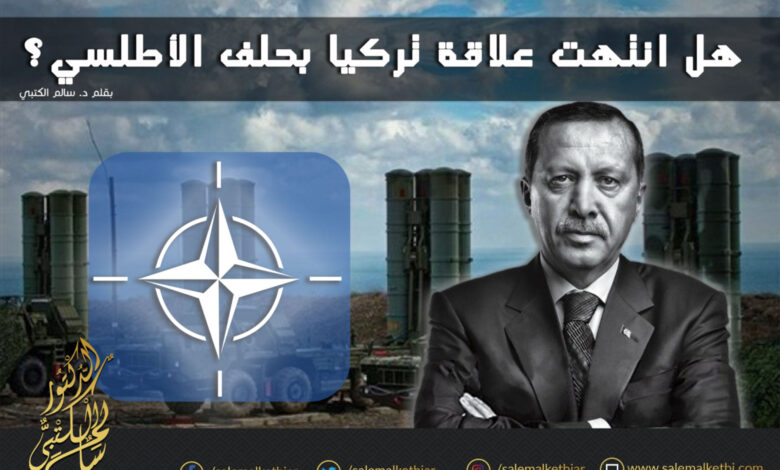
Turkey’s agreement to purchase the S400 missile system has raised concerns about its fallout for relations between Ankara and Washington. As the first and second instalments of the Russian advanced missile system have been received, the Turkish President has put his country in a tricky dispute with the US.
The Trump administration had no choice but to impose the sanctions it had brandished if Turkey went ahead with the agreement. But the major ramification of the deal is apparently going to be on Turkey’s relations with NATO.
This is not the first time President Erdogan collides with Trump’s America. But it might be the straw that breaks the camel’s back. This time, it is very sensitive for the United States.
Erdogan pushed it too far when he ignored the US requests not to buy the missile system in disregard of the impact of the issue on his country’s relations with NATO, where the US and Turkey are the two largest armies.
Has Turkey decided to give up NATO? Are we looking at a restructuring of the Alliance in the coming period by dint of the ongoing strategic changes? Do other NATO members accept Turkey’s use of both Russian missiles and NATO military techniques? A lot of questions are now being asked. But the Turkey situation is quite different.
This is not the first time that a NATO country has had Russian military technology in its armed forces. Greece, a NATO member, has purchased the same Russian missiles. But that did not upset the US who did not react as it did with Turkey.
Some see the US concern as linked to Israel’s security, with the Turkish regime’s hostile rhetoric towards it. But this assumption is simply wrong. Turkey’s relations with Israel were only disturbed by the demagogic rhetoric that President Erdogan has been feeding his popular base in the country and in the Arab and Muslim world. But the West knows that the discourse is empty of any real hostility towards Israel. There is no doubt that the strategic relations between Turkey and Israel have been put on hold. But ties never became tense, even in their worst moments in years such as with the Marmara incident.
What disturbs the Trump administration is that, through rapprochement with Russia, Turkey is seeking to restructure the balance of power. It is not a question of a missile agreement but of establishing a military partnership under which Turkey, until recently involved in the US most advanced F-35 fighter industry, would take part in the manufacture of S-400 missile systems.
Erdogan has chosen the worst time for the Turkish economy to sharpen his tone toward the United States, risking putting the economy on the cusp of deterioration and perhaps collapse if the United States tightens its expected sanctions. The move coincides with the worsening of Turkey’s crises in its regional environment. The Turkish regime has put the country in a state of chronic crisis with major Gulf states, Egypt, Iraq and Syria. Only the Qatari regime has a good relationship with it.
President Erdogan has put his country’s future relations with NATO in jeopardy. The Turkish Defence Minister said that the purchase of the S400 agreement does not represent a change in the country’s strategic position. But the relationship between Turkey and the Atlantic is at stake.
It is no longer longer possible to talk about a normal Turkish relationship with the rest of the alliance. It is true that NATO is going through an identity crisis. Since the end of the Cold War, the alliance has sought a real role, and has failed to take a major part in the fight against terrorism. But Turkey’s membership was an important strategic factor in its relations with Europe.