As the Iranian crisis unfolds and the mullahs’ regime stands defiant, some signs have recently emerged of how the Trump administration plans to move forward at this juncture.
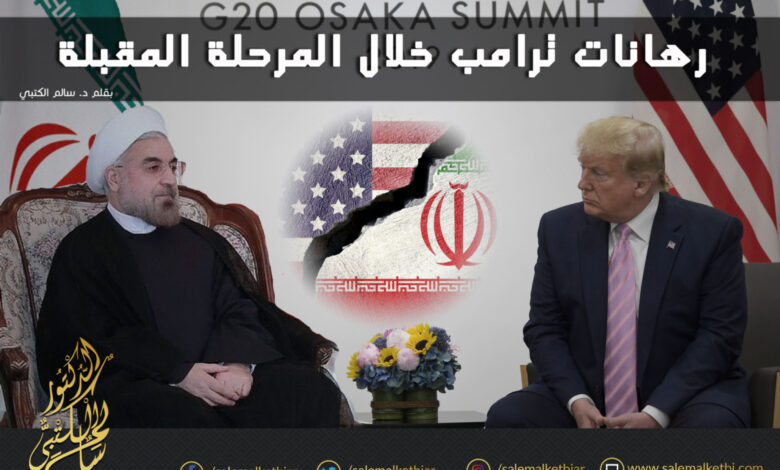
At the recent G20 summit in Osaka, Trump said “There’s no rush” about resolving tensions between the United States and Iran. “We have a lot of time[.] They can take their time. There’s absolutely no time pressure.” This statement is indeed indicative of President Trump’s strategy in managing the crisis with the Iranian mullahs.
The comments made can be interpreted as part of the patience strategy currently being pursued by the US administration. The bet is strong and decisive on the effectiveness of economic sanctions and their ability to “suffocate” the Iranian regime, as the White House has said. Under such an interpretation, the United States has limited its strategic options in the face of a hard-nosed and uncompromising Iran.
Another explanation can be drawn from this particular statement. President Trump has chosen not to launch a military strike against Iran for the time being and to continue to capitalize on the strategic tools he finds effective. Economic sanctions and cyber attacks are among the measures aimed at creating and mobilizing a limited international coalition to counter the Iranian regime’s menace. The President knows that after the early presidential elections, in which he hopes to win a second term, things will get much clearer.
By then he will have more room for manoeuvre and a greater ability to make a war decision. What’s more, he is convinced that at that time, simply knocking the drums of a war on the Iranian regime would be enough to deter it, given the different setting of the conflict; the White House would not have to care about the presidential election anymore.
In fact, the two interpretations do not contradict each other, but lead to the same conclusion: the US President is banking on the time factor. His consultations with the inner circle of the government concluded in temporarily refraining from a military attack on Iran.
President Trump himself has a deep personal desire to prove his own vision. In his view, if applied effectively and efficiently at the same level as the planning of active military action, sanctions could be a more powerful weapon than wars. He dreams of taming the mullahs without firing a single shot. If he succeeds, he will be one of the most rational American presidents in history. He would have accomplished his strategic goals through diplomatic tools away from the wars he has long criticized.
President Trump’s stakes are influenced, among other things, by the reactions and positions of the mullahs’ regime. The economic sanctions imposed by the White House on the mullahs’ regime are rapidly achieving their objectives. According to Iranian Foreign Minister Javad Zarif, his country’s current situation is more difficult than the long years of the 1980s’ war with Iraq. Iranian oil exports are a key variable in the Iranian regime’s decision-making. In the coming months, the economy may crumble, opening the door to a complete collapse of the regime.
So, we can expect the mullahs to lose their calm soon. The Iranian Revolutionary Guards will seek to provoke the United States, harass its allies and strategic interests and lead them into an aggressive war. On the mullahs’ side, war is the optimal option. Such a scenario will push the international community to intervene and put pressure on the United States in search of a political settlement that the mullahs hope will help to lift economic sanctions even before any negotiations begin.
War is the appropriate way out for the mullahs’ regime. What helps them to build this belief is that the regime’s interest has the highest priority, not that of the Iranian people. All told, the time factor remains an important parameter in the current crisis between Iran and the United States.
The mullahs feel the pressure of time because their regime is subject to American sanctions while President Trump wants to buy time and let the sanctions bear their full fruit. Thus, conflict is not only a strategic conflict, but also a struggle for time.