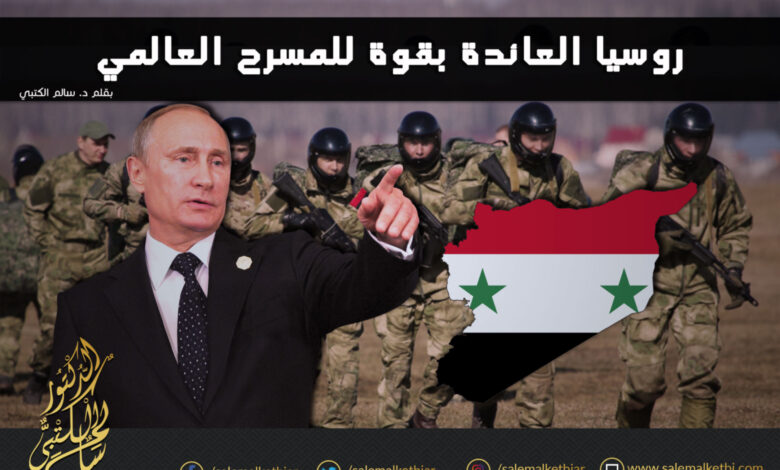
Russia has returned strongly to the Middle East through the Syrian gate. Now, through its position of support for the Libyan national army led by General Khalifa Haftar, it has made another move to re-establish its status as an global player on the regional scene.
One key factor behind Russia’s return is its growing military power in recent years. The Russian Minister of Defence, Sergey Shoygu, recently said that “six years ago, Russian forces were not in a position to engage in military operations in remote areas of Russia’s territory due to a lack of weapons and qualified personnel.”
The statement by the Russian Defence Minister to the Duma Defence Committee confirms the extent of Russia’s progress since 2012. The Minister of Defence said that the Russian army had received more than 1100 cruise missiles in six years.
He added that the measures taken in 2019 made it possible to increase the number of long-range high-precision guided missiles by more than 12 times and for high-precision cruise missiles by more than 30 times.
The massive upgrade in operational capabilities was reflected in the performance of the Russian military intervention in Syria since 2015.
The Russian Defence Minister has already confirmed the progress made in his remarks last December. He said that by 2018, the Russian army had reached an unprecedented level in terms of modern equipment and weapons, with more than 1,500 weapons and 80,000 pieces of equipment. The modernization index of the Russian army was 61.5%, he added.
Many Western countries have reacted to the level of development of Russian missiles. New advanced weapons, occasionally unveiled by President Vladimir Putin, could allow Russia to achieve qualitative military superiority over NATO.
The new Russian Tsircon missile is more lethal than expected, a German newspaper reported. It has a speed of 11,000 kilometres per hour. It would only take it five minutes to reach the Pentagon.
Most of the new Russian weapons seem to be aimed at surpassing the American military arsenal. The Russian navy recently announced that it had completed testing of a new anti-aircraft missile system known as Poliment-Redut. It has been described as being capable of “destroying” American Tomahawk missiles.
Russia’s weapons came into focus after Turkey maintained its commitment to the plan to purchase the Russian S-400 missile system, despite this effectively threatening its relations with the US and NATO.
The unprecedented number of threats to Turkey into dropping the plan is enough of an indication of the US anger. Even the spokesman for the Pentagon mentioned “necessary consequences” if Turkey insisted on buying the Russian system.
In fact, the plan marks a major shift in the nature of Turkey’s relations with NATO. Turkey, the second NATO military force, is not only plannning to use an outside defence system, but also one that is owned by a main strategic adversary of NATO.
NATO justified its anger at Turkey’s decision by fear of the disclosure of the its military and technical secrets to Russia. The United States had previously offered Turkey to buy Patriot in order to dissuade it from buying the Russian missile system. But all that can be done now is to impose as many sanctions as possible on Turkey.
The issue for the United States is not only about technical and military secrets, but also about the reputation and global marketing of American weapons and thae fact that a NATO ally is buying a rival’s weapon.
One of the strongest American pressure cards would be to call off the Lockheed Martin’s F-35 Stealth aircraft agreement with Turkey. The aircraft is supposed to be able to bypass the Russian missile system. Turkey received the first shipment under the deal in June. But the fighter aircraft are still in the United States being used to train Turkish pilots, a process that could take a year or two, according to the Pentagon.
The present dynamics in arms markets are not only linked to the military superiority of regional and international powers or strategic competition between allies and adversaries, but also closely tied to the arms producers’ shares in the global market.
According to SIPRI, the share of producing countries amounted to about $398 billion in 2017. The Stockholm-based Institute has estimated the United States’ share of global arms sales at about 57%, around $226 billion, including purchases made by the US Department of Defense, whereas the total sales of the ten largest Russian companies among the 100 largest global defence companies represented nearly 10% of global sales.
Almaz-Antey, the Russian manufacturer of air defence systems, including the S-400, had a turnover of $8.6 billion. The figures are still much lower than the sales of a large American company such as Lockheed Martin, the world’s largest arms dealer, with sales of about $50 billion in 2017.
It is true that Russian arms sales figures are still far from competing with their American counterparts. But the pace of development of Russian weapons can be a serious threat on the long run.
As Russia makes a strong comeback to the world theatre, it wants to transform its power into new spheres of influence. To do so, it makes use of advanced arms sales, which is one of the most important sources of global expansion and influence.