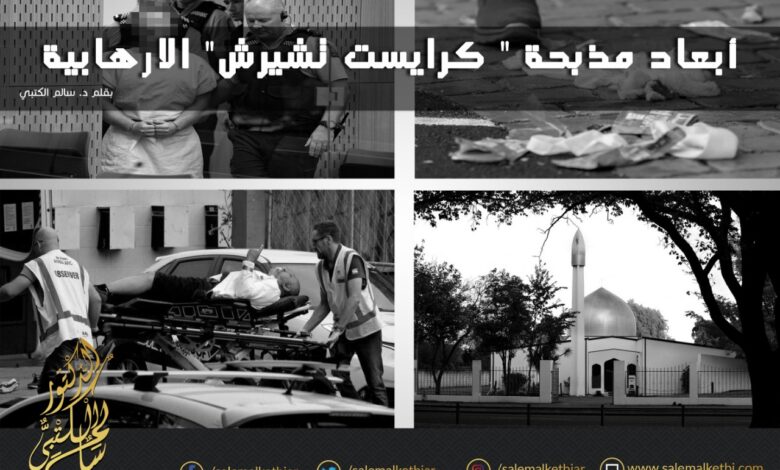
The horrendous terrorist crime that killed some 50 Muslims and wounded more than 40 in two mosques in Christchurch, New Zealand, last Friday, drew attention to many dangers. It should not be forgotten in a few days or weeks.
The analysis of this despicable terrorist crime raises several questions. First, the crime took place in a peaceful State that has no position linked to the so-called religious terrorism or far-right terrorism and Islamophobia.
New Zealand is a peaceful country with about 46,000 Muslims, or about 1% of the population, of about five million people, according to 2013 statistics. The city where the bloodbath took place is one of the most important Muslim population centers in the country. Most of them hail from Asian countries, New Zealand citizens converted to Islam and Middle Easterners.
New Zealand is also a model of a pluralistic country and tolerant society, with more than 200 ethnic groups living on its soil. Its people speak 160 languages.
Shortly after the terrorist massacre, New Zealand’s Prime Minister Jacinda Ardern visited the Canterbury refugee center in Christchurch, wearing the Islamic headscarf. The message she sent to her citizens and to the whole world was a strong one, New Zealand believes in values of pluralism and tolerance. At the press conference following the crime, the Prime Minister was clearly sad. She described it as one of the “darkest days.” At her visit, she expressed “sympathy and love for all Muslim societies.”
This tragedy shocked New Zealand, as well as one billion and eight hundred million Muslims worldwide.
The massacre demonstrated the implications of the extremely dangerous inflammatory rhetoric of the far-right anti-Muslim extremism.
Many countries are witnessing a growing anti-immigrant trend. Adding fuel to fire, political and party leaders play the xenophobia card to attract voters.
The terrorist committed his heinous crime “professionally,” broadcasting it live on Facebook. He published a long 74-page manifesto on the Internet. “I am just a regular white man, from a regular family, who decided to take a stand to ensure a future for my people,” it reads. The statement was published two days before the crime took place.
The social media content must be properly monitored and what is published must be treated with great seriousness.
It is true that security services have difficulty controlling all content published by social media users, but this massacre has revealed that content monitoring is more important for public security than illegitimate free speech.
Also, monitoring extreme right-wing websites is no less important than those by terrorist and extremist organizations that claim defending Islam.
The far right ideology became more complex than ever. In what he called “The Great Replacement,” the terrorist referred to the “increasing number of immigrants” as “occupants and invaders.” He then chose New Zealand as the location for his terrorist crime, to send a message to the “invaders” that they are not safe, even in the most remote corners of the globe, and said that there were no “innocents” among the “targets,” because anyone who “invades” others’ lands must suffer the consequences.
This terrorist’s ideology is no less ill-intentioned than that of Daesh and Al Qaeda. It lies in hatred, racism and intolerance. He wanted to kill more “invaders,” he added, to “avenge the hundreds of thousands” of Europeans “killed by invaders” throughout history.
The most alarming thing in his manifesto is that he said he was influenced by US President Donald Trump as a symbol of “white identity” and by Candace Owens, a pro-Trump politician.
This particular point will receive quite some attention in think tanks and research centers studying the impact of the rise of right-wing and nationalist politics on integration and stability in Western societies.