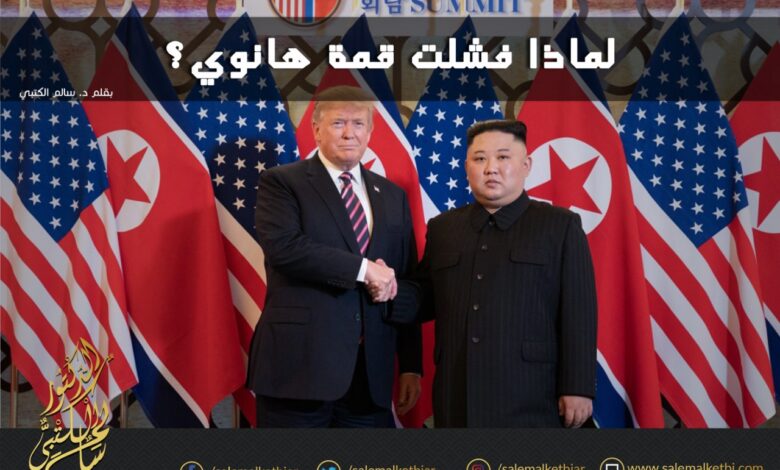
The results of the second recent summit between US President Donald Trump and his North Korean counterpart Kim Jong Un did not achieve a significant breakthrough. The summit in Hanoi, Vietnam’s capital, just six months after the first meeting in Singapore in June, had different results from what President Trump had talked about. He had spoken positively of his
“friend” Kim and predicted a “tremendous future” for North Korea if he would agree to abandon nuclear weapons.
Many in the Republican Party were waiting for the second summit to clarify the ambiguous statements about denuclearization on the Korean peninsula made by the two leaders in their first summit. Trump was hoping for diplomatic success that would divert media attention away from his internal problems such as Congress investigations.
The United States demands that North Korea completely abandon its nuclear arsenal. Pyongyang insists that the US lifts sanctions on North Korea and ends its military presence on the Korean peninsula. Kim personally asked President Trump at the Hanoi summit to lift all sanctions for partial nuclear disarmament, that is, the opposite of the US request to abandon nuclear weapons completely and then consider lifting international sanctions.
The Western media described the second summit as a failure, comparing the lack of results with the statements made by President Trump a few minutes before the meeting began. He said he expected the summit to be “a success,” while Kim Jong Un said he was confident that his summit with Trump would yield “positive results.”
But at the end of the meeting, President Trump said he had “a very productive” dialogue with the North Korean leader and later tweeted he a good dinner with Kim Jong-Un in Hanoi.
After the summit, President Trump could only confirm the failure. He said that the summit had ended without agreement. Washington rejected Pyongyang’s demands to lift the sanctions. “Sometimes, you have to walk,” Trump said at a press conference in Hanoi. He denied any plans for a third summit.
Trump said Kim was ready to dismantle the Yongbyon nuclear complex but wanted to lift all sanctions, which the United States was not prepared to do.
Kim’s position has not changed since the beginning. He links nuclear disarmament to lifting sanctions. But the second summit revealed that the White House was betting on things so unrealistic that the initial summit agenda, prepared by the US side, included a “signing ceremony for a joint agreement” and a working lunch for the two leaders.
The disagreement between the two leaders in Hanoi was evident following the official outcome of the meeting. The lack of consensus was clear from the first meeting, when the American side discussed North Korea’s agreement on unconditional nuclear disarmament without talking about any lifting of sanctions.
The US side apparently miscalculated the situation. Before the summit, President Trump said alongside the North Korean leader, that he had “great respect” for Kim and that their relationship was very strong. He reiterated that North Korea could become an economic power if the discussions went well.
The Hanoi summit certainly questioned Trump’s ability to make deals, but he gets credited with maintaining a privileged relationship with the North Korean leader whom he described as “quite a guy and quite a character” after the summit. He said they had a strong relationship.
The summit was the source of the frustration and disappointment that dominated American media reports after the summit. Some expected a political declaration to end the Korean War (1950-1953), which ended in a truce without a comprehensive peace treaty or a promise to close the Yongbyon nuclear reactor, a pillar of the North Korean nuclear program.
There are major differences of opinion and clear differences in attitudes. The second summit not only failed to reach an agreement, but ended two hours earlier. There was no reason to continue the discussions and it was difficult to bridge the gap between the two sides.
At the same time, it revealed Trump’s seriousness. He promised his supporters that he would immediately withdraw from the summit if the conditions he was seeking to forge a “deal” did not materialize. The North Korean leader believed he could embarrass Trump and put him under pressure to get his approval of the Pyongyang conditions rather than to see the summit collapse.
The Financial Times perceived the failure of the second summit as a negative outcome, but not a catastrophic one. It noted that the summit between Soviet leader Gorbachev and former US President Reagan reached an agreement on limiting the proliferation of weapons but the newspaper said Trump went to the summit unprepared, relying on his personality and his relationship with his counterpart without prior diplomatic planning on options and alternatives.
The White House ruled out options such as the proposal supported by South Korea, which is the partial disarmament of nuclear weapons in exchange for partial lifting of economic sanctions, although State Secretary Mike Pompeo said at a press conference after the summit that he was not expecting difficult negotiations with the North Korean delegation.
Despite the recent failure, Trump’s diplomacy managed to ease tensions on the Korean peninsula and his relations with Kim ended North Korea’s missile tests and opened an important door to dialogue in this hot region of the world. Trump said Kim promised him not to make any further nuclear or ballistic missile tests.