Throughout the history of the UAE, even before its establishment by the late Sheikh Zayed bin Sultan Al Nahyan and the founding fathers, on December 2, 1971, the human values of tolerance and coexistence have been an integral part in the social and cultural fabric of the Emirati society. Traditional communities, skilled in trade, fishing and diving since ancient times, are generally open, possess the ability to coexist, communicate with and accept others.
The transition of these communities to developed societies, through the industrial era and up to the knowledge revolution, has been easier than it was for other communities, not only because wealth and material resources were available, as in the case of the UAE, but also because such communities were inherently tolerant and accepting of others. This kind of societies turned out to become attractive destinations for skilled people from around the world in a few years.
The state of human harmony that people from over 200 nationalities experience today in the UAE actually goes way back in history. Historical documents show that Emirati cities in the 1970s and before the economic boom were already home to tens of thousands of expatriate workers.
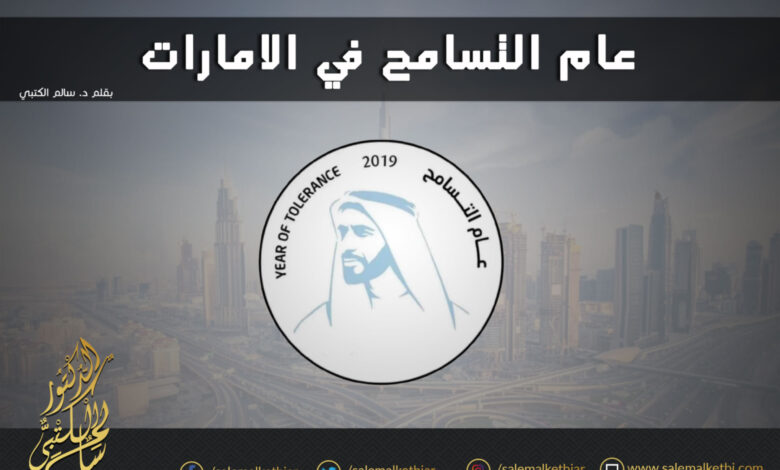
Since tolerance has always been a shared ideal in this country, the leadership sought to institutionalize it. In this spirit, after the UAE established the world’s first Ministry of Tolerance, His Highness Sheikh Khalifa bin Zayed Al Nahyan, President of the UAE, declared 2019 the UAE’s Year of Tolerance.
As tolerance is an established value in the country, the UAE is seeking to promote tolerance as a foreign policy, because without tolerance, there is no security or stability. Especially in the Middle East, societies need to institutionalize tolerance, for instance, through a Ministry of Tolerance or legislation against discrimination and hate speech.
The UAE’s experience, either in terms of development or tolerance, has become an inspiring model at the regional and global levels. It is not enough to fight radicalism, extremism and terrorism in our region and the world, but we must also promote the model that counteracts obscurantist and extremist ideologies.
The UAE’s policy of promoting coexistence, moderation, openness and tolerance made the country an attractive haven for many. In many polls conducted by different international institutions, the UAE has been the top destination for Arab youth for the seventh year in a row.
The countries that suffer ethnic and sectarian conflicts and chaos need serious efforts to overcome such challenges. They must adopt a system of values that support tolerance and coexistence so as to overcome the effects and psychological traumas of such conflicts.
The positive contagion of the UAE model reached millions of young people in our region and the world. Our wise leadership provides the support needed to help Arab countries overcome the present hard times, both morally and materially. The UAE model is spreading in societies where hatred, intolerance, violence and terrorism have been rampant for years.
Sharing experiences can come in several ways, including presenting the inspiring model. This model should not only be about development or coexistence, but also about the legislation that can guarantee tolerance in society.