The only possible point of agreement in any discussion of the criteria of victory and defeat in unconventional wars is that these norms are “elastic” and it seems very difficult to decide in this respect. Everyone has seen how the Lebanese terrorist group Hezbollah has been promoting its military victory against the Israeli army in the 2006 war despite the woes of the war, which Lebanon still suffers from. This is also true for the Hamas movement, which raises the slogan of victory despite the massive destruction in the Gaza Strip every time there is a clash with the Israeli army, which confirms the “relative” level of victory and of defeat in such unconventional wars.
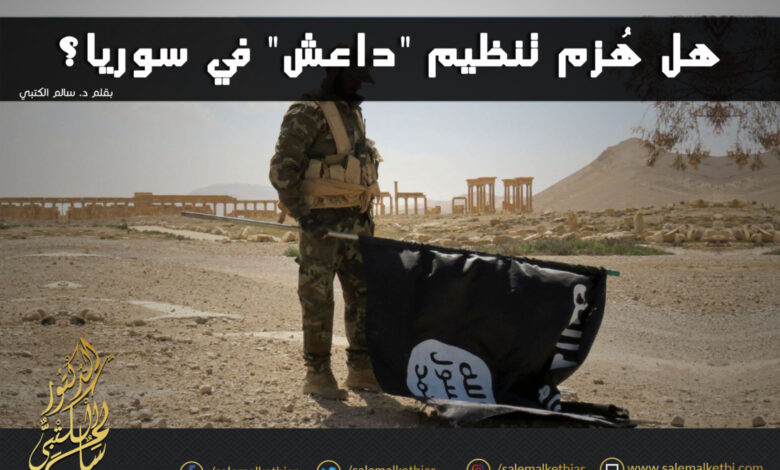
In the face of terrorist organizations in general, there are several main objectives, including the defeat of the organization militarily. This goal has already been achieved in Iraq and Syria, where the Daesh organization has received successive military strikes putting an end to the control of all areas that the organization controlled in both countries, and so it is understandable that President Trump announces the achievement of this goal.
The problem is that the defeat of these terrorist organizations may not mean their end, as confirmed by experiences in Afghanistan, Somalia and other conflict zones that have escalated.Terrorism in previous periods.
Terrorism looks like a “cancerous disease” in the human body: it takes a lot of time for the patient to follow up because the disease can easily come back, and the cancer cells can regenerate very well.
The most dangerous factor in terrorism is the idea, not the terrorist element itself. The idea is spreading in various ways. Terrorist leaders have understood the importance of spreading the idea and setting up virtual institutional structures of terrorist ideology through the Internet, which has become a platform for virtual recruitment and training for the manufacture of explosives and communication between networks and terrorist elements in all languages.
Experiences also indicate that the phenomenon of terrorism goes through waves of ebb and flow. In fact, Daesh represents the third generation of terrorist organizations. The first generation of organizations dates back to the 1980s and 1990s, small organizations from various Arab countries and quickly eliminated by the security forces, but their roots have remained and its theorists have transported the idea to other lands. The second generation was born in Afghanistan by its leader, al-Qaeda’s spiritual leader, Osama bin Laden, and relied on the fight against the distant enemy to found its terrorist activity. Bin Laden launched the September 11 attacks and other terrorist operations. After the death of bin Laden, Daesh was born by Abu Musab al-Zarqawi, succeeded by Abu Bakr al-Baghdadi, thus laying a new foundation based on the philosophy of “management of savagery” and fighting against what is described as the near enemy!
The elimination of terrorism and extremism requires not only a security and military response, but also a long and realistic strategy based on economic, political, intellectual, educational and media bases. It also requires enormous legislative and legal efforts to fight extremism and hatred of the other. It also requires the establishment of tolerance, coexistence, moderation and acceptance of the other, and these are efforts that are not seriously taken into account by many Arab and Islamic societies, as well as in Western societies, to be fair. There is ignorance about abuse of the Islamic religion, under the pretext of freedom of expression, there is a high prevalence of racism and exclusion on the basis of religion in many countries In the West, there is a failure of integration and coexistence policies, which explains the involvement of some of the second-generation Muslim immigrant children in the West in the ranks of Daesh in Syria and Iraq.
In the light of the foregoing, it can be said that the defeat of the daesh organization in Syria has been achieved, but this does not exclude the possibility of the return of the organization even gradually to carry out its activity, even to a lesser extent. . Great Britain believes that the defeat of Daesh is not complete and that there is a possibility for dormant cells to resurface, and the same point is shared by France that said through its defense minister Florence Parly “But Daesh is not wiped off the map, nor its roots, it must definitively be defeated militarily tothe last pockets of this terrorist organization” But objectivity also requires to say that Daesh was indeed defeated militarily in Syria, but the organization is not completely destroyed, and its structures are still there, and the fate of its leader Abu Baker al-Baghdadi is unknown. President Trump knows that the American voter does not care much about the existence of dormant cells in Syria, but is primarily concerned about the organization’s ability to threaten US interests and target Americans anywhere in the world. That’s why President Trump was very cautious in denying this possibility to satisfy American voters.
The issue requires a review of what happened in Syria and Iraq. The Daesh organization is the main threat to the countries of the region, and efforts must be made to eradicate it completely, and there is every reason to believe that its eradication can only be achieved through a series of serious cooperative moves to destroy the social environment incubator of terrorist ideology as much in Syria or Iraq or in any other Arab or Muslim country. Terrorism is an idea that must be fought and eradicated, and not just elements that must be eliminated. The truth of the matter is that neither the United States nor any Western country has a role to play in the war on ideas, it is the battle of the Arabs and Muslims, and they must absolutely fight it without hesitation. .