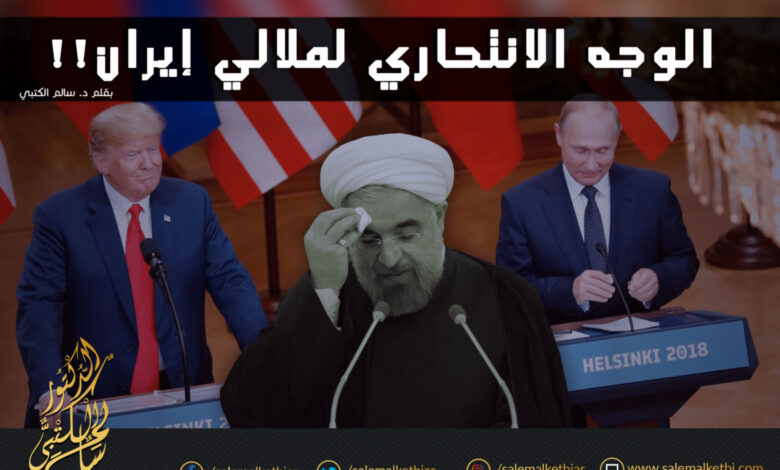
The Trump-Putin Helsinki summit did not reveal details of what the two leaders discussed concerning Iran’s role in the Middle East. This was expected. Public statements following the summit did not give any hint about the issue. In recent days, relations between Iran and the US entered a new stage. US officials said that the Trump administration launched an offensive of speeches and online communications meant to have Iran end its nuclear program and its support for militant groups.
Supported by Secretary of State Mike Pompeo and National Security Adviser John Bolton, the campaign is led by more than a dozen current and former officials. It aims to work in concert with the Trump campaign to clamp down on Iran economically by re-imposing severe sanctions.
The campaign operates in an informal setting. The White House and the State Department refused commenting on it. Iranian officials, as usual, have met the move with mockery and denied any expected impact.
On the other hand, the Iranian President Hassan Rouhani threatened to close the Strait of Hormuz and prevent the Gulf oil exports if Iran was in danger. He said during his tour to Europe: “The Americans have claimed they want to completely stop Iran’s oil exports. They don’t understand the meaning of this statement, because it has no meaning for Iranian oil not to be exported, while the region’s oil is exported.” The statements were praised by the Iranian Revolutionary Guards. General Qassem Soleimani expressed his desire to kiss the hand of the President for making such a statements that reflected Rouhani’s true face. Following these statements, Iran’s Supreme Leader Ali Khamenei entered the line of threats. He supported the idea of blocking oil exports from neighboring countries through Hormuz Strait if Iran’s oil exports were halted.
Khamenei’s talk was not addressed to the public. He tackled the topic while meeting Iranian diplomats and ambassadors. He said that the policy of preventing shipments of oil through the Strait of Hormuz was meaningful and reflected Iran’s approach if Washington continued to impose restrictions on Iranian oil exports. He added that the Foreign Ministry has a duty to follow the president’s position seriously.
These statements reflect a process of instructing Iran’s ambassadors to send the message of threat to the capitals where they work.
There are many strategic analyses on Iran’s strategic options to deal with Trump’s plan to pressure Iran and stop oil exports. These options include the closure of the Strait of Hormuz. This alternative is feasible and easy. The issue is not related to Iran’s military capabilities due to the narrow strait and the sensitivity of this area. But this is mainly an Iranian political decision. It is perhaps the first time that the Iranian leadership has gone out to signal the closure of the strait. Dozens of threats were launched during previous crises but they remained at the hands of the IRGC’s extremist Gens.
Khamenei’s remarks also confirm that Rouhani spoke out a radical strategy that was agreed upon by the cabinet of the Iranian regime, a suicidal strategy par excellence.
This time, the threat came from the top of the political power in Iran. The mullahs are aware that stopping oil exports means the end of the Iranian regime, opening the way to a popular revolution that may oust this regime in a few days.
The mullahs’ options in dealing with the US’ pressures are already suicidal. They exacerbate the edge of the abyss policy and go further in the practice of bickering. Tehran is aware that Trump is highly professional in this. He said “at a certain point they’re going to call me and say ‘let’s make a deal'”. He has repeatedly stressed that he is a well-known president for making deals. He is therefore good at the rules of the game. But the mullahs’ regime always resorts to suicidal options.
Khamenei and his circle do not realize that they are putting the fate of their regime to global targeting, not just the US. His threats aim at having the oil importing countries from the Gulf region to push the White House to stop its pressure on Tehran. This is an unreachable objective given the current global tensions between the major powers, whether due to customs duties or because of the difficulties to adapting to Trump’s policy. However, no major country will accept this stupid threat. Everyone knows that there is difficulty in putting pressure on the White House. The mullahs’ regime will pay a high price because it ignored the developments that occurred in international relations under the Trump administration.