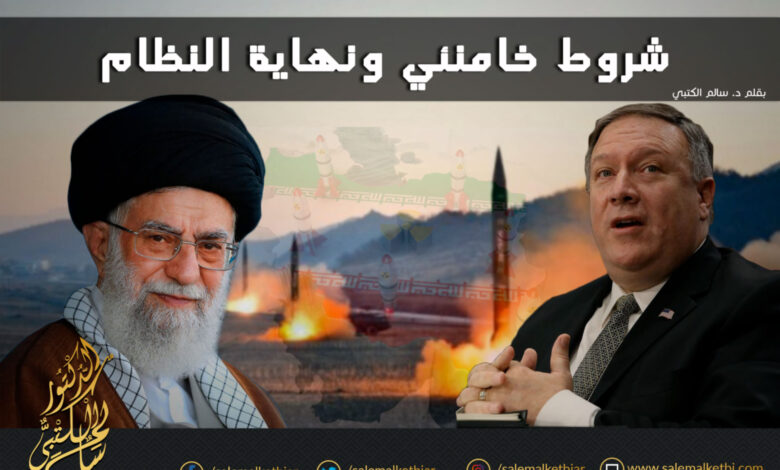
As a response to the 12 conditions recently announced by US Secretary of State Mike Pompeo, Iranian leader Ali Khamenei set seven demands to keep the nuclear deal. The US has recently pulled out from the agreement.
Khamenei’s most important demands are:
- European banks should safeguard trade with Iran.
- European powers should protect Iranian oil sales from the US sanctions and continue buying Iranian crude.
- European powers should pledge not to seek new negotiations on Iran’s ballistic missile program and its activities in the Middle East.
Surprisingly, Khamenei called on Europe to condemn the US withdrawal from the nuclear agreement.
These demands have no political basis nor are they a ground for any rational negotiation. Khamenei made it clear that Iran does not trust the three European countries (France, Germany and Britain). He also said that Europe should “fully guarantee” Iran’s oil sales. “In case Americans can damage our oil sales… Europeans should make up for that and buy Iranian oil,” He added.
Khamenei should have asked himself self-evident questions before setting these demands: Why would Europe make these fundamental concessions to Iran? And what would Europe get in return?
Instead of thinking of rational ways out of this impasse, the mullahs’ regime deepens its crisis by engaging a dispute with the EU. The EU has lost so much because of its support for the nuclear deal and its sharp disagreement with the Trump administration.
The mullahs are aware of the dispute between the US and Europe over the nuclear deal. Iran does not motivate the EU to hold on to its position and distance itself from the US. The mullahs’ regime is trying to impose illogical demands on Europe.
Khamenei promotes the idea of defeating the US and he seems sure about it. He propagates the idea to tickle the feelings of the hardliners in his regime. The mullahs’ regime supporters often launch indiscriminate threats against the US.
It seems that Iran is following North Korea’s steps, fully copying President Kim Jong-un’s statements. Tehran considers launching threats as the best way to extract concessions from the US. Iran has forgotten that Pyongyang was unable to withstand the recent international pressures. North Korea had to turn to South Korea in search of a lifeline to save its regime from collapse.
Khamenei did not give his politicians the opportunity to have a dialogue with Europe. He intervened radically to set demands. The Supreme Leader is aware that Europe won’t meet his conditions. What will Europe get in return if it ensures the continuation of financial flows resulting from the Iranian oil sales? Khamenei did not ask China to make these commitments, as it is the main buyer of Iran’s oil exports.
Javad Zarif, Iranian Foreign Minister, said the EU must support the nuclear deal not only for its commitment to working with Iran but also to prove its ability to counter the US influence. The NATO allies do not think this way and Europe does not seek to counter American influence. The US Secretary of State said that they will find a way to cooperate with the European partners concerning Iran.
Pompeo said there is almost complete overlap in our values and interests in this regard. There is no disagreement about the Iranian missile program, about its malicious behaviour and assassinations, he added. He also stressed that everyone agrees that there is a problem and there is a need to find a way to address it.
The Financial Times reported that the collapse of the Iranian oil sales will increase pressure on the mullahs and make them accept US conditions. Khomeini had already drunk the cup of poison. He reluctantly agreed to conditions to end the Iran-Iraq war and save his regime. It is very likely that Khamenei could drink a new cup of poison following the footsteps of his mentor. He is likely to accept the US’ conditions and dictates to save the mullahs’ regime from collapse.