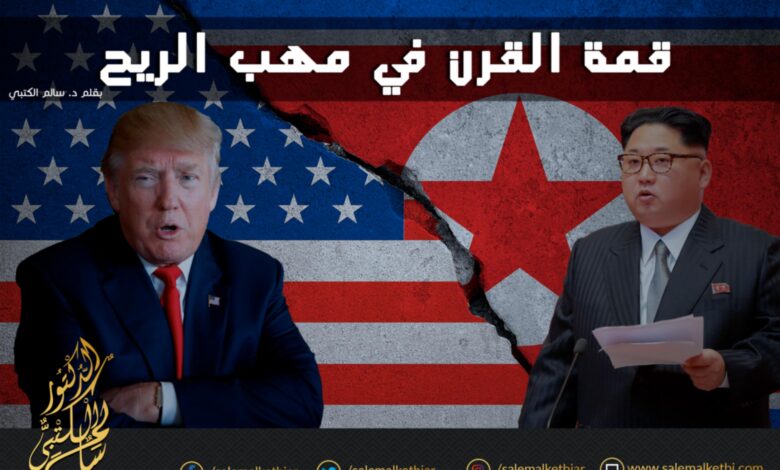
The world is optimistically awaiting the outcome of the upcoming summit between Trump and his North Korean counterpart on 12 June. But the evidence emphasizes the need to be cautious in anticipating the outcome of this summit.
Official statements were recently issued in Pyongyang questioning that the summit could result in a radical solution in the Korean Peninsula. North Korea postponed talks with the South. The move has been taken because of the joint military exercises between South Korea and the US. Pyongyang made this decision and even noted that North Korea might withdraw from the Trump summit as well.
Expectations always tend to exaggerate the conclusions that follow any development in the relations between the two sides. After the inter-Korean summit, some thought that the page of historical conflict has been turned forever. This is inaccurate because this summit and its promises did not lead to any change but repeated similar expectations and promises. And then everything had to be dispelled by the events and the predominance of Pyongyang’s strategic orientations. The North Korean regime’s policies are implemented in order to embellish the image and gain some international sympathy. Pyongyang often tends to give up promises as a pressure card that usually precedes any negotiations with other parties.
The Trump administration’s new approaches are disturbing the North Korean regime. The new US Secretary of State, Mike Pompeo, and the National Security Adviser, John Bolton, have recently appeared in briefings. They talked about the need for North Korea to completely dismantle its nuclear weapons in accordance with verifiable and monitoring mechanisms. Observers named the mechanisms as the Libyan model. Bolton said North Korea was in a vulnerable position over Trump’s “maximum pressure” policy of diplomatic and economic isolation. Bolton himself had hinted in earlier statements at the denuclearization of Gaddafi’s regime as a possible precedent for the North Korean situation.
These remarks got Kim angry. A North Korean official spoke of disgust at Bolton. Western observers tended to compare the North Korean and Libyan cases. Pyongyang had officially declared that it did not need nuclear facilities because it possesses a nuclear bomb. The North Korean case is very different from what was in the era of Gaddafi in 2004.
There is a clear divergence between Washington and Pyongyang over the goal of the upcoming Singapore summit. Trump said that the purpose of the talks simply means that North Korea will get rid of its nuclear weapons. Trump meant unilateral disarmament of the North Korean side. North Korea considers nuclear disarmament to mean, among other things, that the US abandons its nuclear weapons in the Korean Peninsula.
After the inter-Korean summit, the impressions that spread globally after the talk of peace and a new era of relations during the month of April have recently vanished. Kim’s point of departure has almost become lost amid the threats of withdrawal from the Singapore summit.
There is a need to adjust concepts and terminology before talking about a lasting peace in the Korean Peninsula. North Korea talks about an immediate halt in nuclear and missile testing after building its nuclear weapons. But the US talks about an irreversible denuclearization of North Korea.
Trump is fully aware of Kim’s intentions and policy. The US president sets a very high ceiling for his demands. He is well aware that Pyongyang needs to revive its economy after the impact of the tight economic sanctions on the country. It is no surprise that the US said that any investment in North Korea is conditional on the country’s commitment to the full disarmament of its nuclear weapons.
Trump’s strategy is based on facts, including that North Korea’s exports have slumped 30 percent in 2017. Exports, especially to China, Pyongyang’s largest trading partner, have declined by 35 percent. This has cut off a large amount of the regime’s revenues, creating enormous pressure on Pyongyang. North Korea fears further economic deterioration. The fate of the North Korean regime is at risk.
It is a very difficult and complicated summit – preceded by a diplomatic tug of war. The world will see more statements, mutual threats and verbal escalations during the remaining time to the summit.