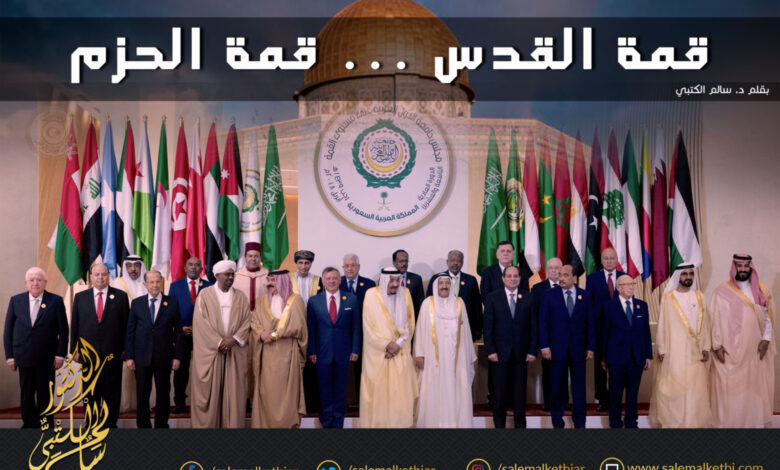
The Arab League summit in the Saudi city of Dhahran was exceptional in addressing serious Arab issues. The summit was not set up for attracting media attention.
The speech of Saudi King Salman, during the opening of the Arab summit, drew Arab leaders’ attention to some special and important Arab files. His speech has put the record straight about SA’s stance on the Palestinian cause. The summit was named the Jerusalem Summit so as to reflect the centrality of the Palestinian cause in the Arab world. The meeting called for a resolution where Palestinians should be given their legitimate rights in their territory with East Jerusalem as its capital.
The Jerusalem Summit came as a response to deny the allegations that have been promoted by a social media campaign to defame SA’s position on Palestine.
The final statement made SA’s position clear. Arab leaders pledged to provide the necessary support for the Palestinian cause. The ranking of Arab political priorities was very clever. It pulled the rug from satellite channels that would do nothing for the sake of Jerusalem but blame Arabs for not taking the cause seriously. The focus on Jerusalem is crucial to avoid Arab-Arab conflicts and fortify joint Arab action. And this would deprive regional expansionist powers of the opportunity to exploit religion to implement their plans.
The Saudi leadership was successful to unify Arab states over the Palestinian cause. The Arab world had faced a state of turmoil since the 2011 events. Extremist organizations took advantage of the state of instability in various Arab countries. They used various files, especially the Palestinian cause, as a pretext for covering their betrayal of the Arab countries.
The final communiqué of the summit allocated seven clauses to discussing the details and regional and international interrelationships of the Palestinian cause. The first clause reaffirmed “the centrality of the question of Palestine to the entire Arab nation and the Arab identity of occupied East Jerusalem, the capital of the State of Palestine.” This clause was clear, precise and historical.
“The summit, led by the decisive King Salman, avoided using circumlocution over political positions. It was firm and to the point. The meeting put the joint Arab action back to its path. Arab leaders met on common concerns and agreed on bringing together the Arab world. The summit confessed that the Arab nation has gone through dangerous detours. “We reaffirm the importance of promoting joint Arab action based on a clear methodology and solid foundations that protect our nation from the dangers that threaten it, safeguard security and stability, and secure a bright and promising future that will bring hope and prosperity to future generations,” the final communiqué read. The summit was not limited to analyzing critical Arab issues and how to deal with them. It went far to set plans to have a better future for the Arab nation.
The preface of the statement said that the youth generations of the Arab nation have witnessed past and present experiences and can be “united and determined to build a better tomorrow that contributes to the realization of the hopes and aspirations of our peoples”.
The summit addressed the Iranian threat in the region. The final communiqué called on the international community to sanction Iran and its militias and prevent Tehran from supporting terrorist groups and supplying the Houthi terrorist organizations with ballistic missiles. The Iran-backed Houthi militias launched Iranian-made ballistic missiles from Yemen to Saudi Arabia. The statement said Tehran should comply with the UN resolution No (2216) that prevents the supply of arms to the Houthis. The Arab leaders expressed their rejection of the interference in the internal affairs of the Arab countries and condemned the aggressive attempts aimed at destabilizing the security, instigating sectarian strife and fueling sectarian conflicts.
The communiqué of the Jerusalem Summit was stamped by a tone of rationality and diplomacy that respected international law and conventions. It stressed on “the importance of building normal relations based on mutual respect and positive cooperation with neighboring Arab countries to ensure security, peace, stability and development.” This paragraph reflected an Arab position that is respected by the world. But the other side, specifically Iran, has nothing to do with political discourse and uses an outdated one.
The Jerusalem Summit is a milestone in the history of joint Arab action. It is the beginning of a positive shift towards the restoration of the regional political initiative and action for the benefit of the Arab world.