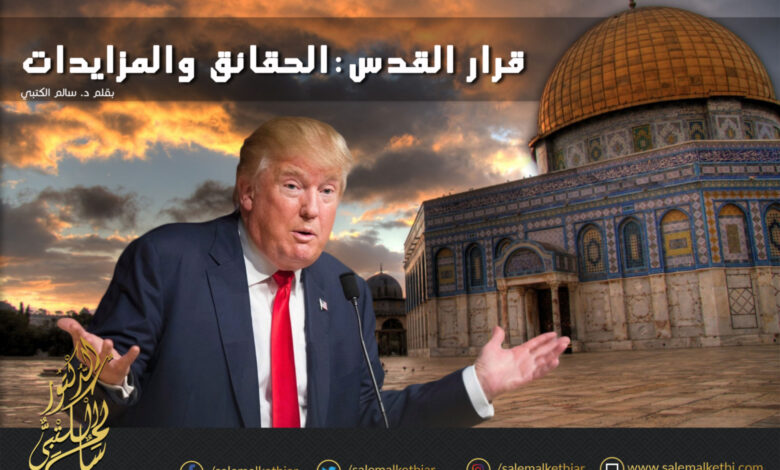
President Trump’s decision to recognize Jerusalem as the capital of Israel is certainly a turning point in the Palestinian cause. Palestinians and the Arab and Muslim world will not ignore this, objectively, strategic mistake of the US State Department.
Any strategic decision of this magnitude should serve the interests of the United States in the first place, and Israel next. But this decision is basically in the interest of Israel and almost no important interest to the US. The President’s decision led to a new deep crisis that adds to the complex crises in the Middle East, which is not in the interest of the United States, a superpower with a diminishing role in controlling conflict zones in the region; no influential role in the Syrian crisis, Libya, and now, after taking the side of the Israelis, losing the status of the mediator of the peace process in the Middle East.
Washington’s decades-long policy toward the status of Jerusalem changed completely. All American presidents, from former President Truman, who recognized Israel as a State in 1948, and subsequent presidents, all failed to recognize Israel’s sovereignty over Jerusalem. That is because the cases like Jerusalem, borders and refugees, should be resolved in a final negotiated settlement between Israel and the Palestinians. However, this decision gave Israel full control over the entire city of Jerusalem (East and West), without any negotiating process, wasting decades of US diplomatic efforts.
The Jerusalem move shows a lack of strategic vision towards peace and of the apprehension of the details of a complex issue. After the cart was put before the horse, determining the whole status of Jerusalem as the capital of Israel, there is no longer any incentive for Israel to negotiate seriously for peace. The Israelis got what they wanted without negotiations, let alone concessions; they have the world’s superpower on their side.
The Jerusalem controversial statement came in a strange timing, when the United States and Israel were seeking to remove Iran influence in Syria and rein in Lebanese Hezbollah. Instead, Iran and its proxies were given a reason to further the propaganda of incitement against Israel and American interests locally and globally.
Trump pointed that his decision is in the interest of the United States, but experts have a hard time to find out which. Furthermore, the declaration embarrassed US allies in the region, causing damage to US credibility that might need years to be fixed. The United States is perceived as an enemy of the Islamic world again and many achievements of the 2017 Arab Islamic American Summit, which produced a strong anti-terror partnership, are wasted.
While some argue that the goal was to earn the sympathy of the Jewish lobby in Trump’s domestic battle over the accusations of collusion with Russia, the White House said the decision will help advance the peace process. I don’t see how. All former US presidents, former administrations and official experts did not make the decision for a reason.
Time is the only factor that convinced Trump to gain extra points for his own interest and to align with Israel. Trump and his advisors thought that the time is right to take this step with no significant loss for the US policy. Not interests.
In many Arab countries prevails chaos, turmoil, violence and preoccupation with internal crises or regional threats.
There are of course those who found an opportunity to accuse some Arab countries of forgetting the Palestinian cause based on rumors or unofficial reports claiming these countries link with Israel. However, the Jerusalem decision is not in the interest of any Arab country.
The Trump administration manages American foreign policy in a quite special way. Unlike his predecessors, Trump withdrew or threatened to withdraw from a record number of international agreements, from the Paris Agreement on Climate Change, to the TPP signed in 2015 by 11 Asia-Pacific countries (accounting for about 40 percent of the global economy). Threatening of “tearing” the Iran nuclear deal, he initially said that NATO was “outdated” and cast doubt on his commitment to Article 5 of the North Atlantic Treaty, that “an armed attack against one member state [is] an armed attack against them all.”
While the problem is linked not to Arab positions but to Trump’s, some are passing the buck to Gulf and Arab States, holding them responsible for the US decision, while these countries cannot prevent such a move from happening. At this delicate stage, Arab and Muslim countries need seriousness and political rationality to sustain their interests.