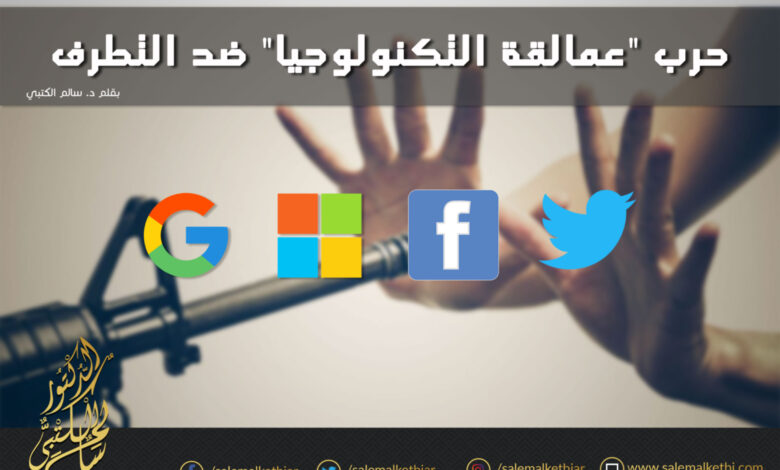
Google, Microsoft, Facebook and Twitter companies recently agreed to step up efforts to remove extremist content from their online platforms within hours after they get posted.
The agreement between technology giants came after a two-day meeting with representatives of the Group of Seven (G-7) countries. Officials said the goal was to delete “jihadist” content from Web sites within two hours of publication.
Twitter called these results “important”. Indeed, they are very important in the fight against radicalization and terrorism.
Extremism is a prelude to violence and terrorism. Technically, there is extremism and there is violent extremism. The fight against violence and terrorism should start by addressing the root causes of extremist ideology before dealing with the consequences.
If they take the matter seriously, the tech giants could engage in counter-extremism more effectively than most international decisions and strategies do.
The virtual world became the new space for extremists to recruit and train people. The Daesh terror organization has made propaganda and recruited members over the Internet, especially through social networks. They attracted thousands of young people from different nationalities and regions. This is a key difference between them and previous generations of terrorist organizations such as al-Qaeda.
Following the meeting that he called “historic,” Italian Interior Minister Marco Minetti said that the agreement constitutes “an important first steps”. In a statement, the G7 said “we underscore the challenge to industry and we urge it… to develop solutions to identify and remove terrorist content within one to two hours of upload, to the extent it is technically feasible, without compromising human rights and fundamental freedoms.”
This meeting culminates ongoing efforts to counter extremism, incitement and hatred across the virtual world without harming those companies whose market value is hundreds of billions of dollars. The market value of Alphabet, The parent company of Google, amounted early this year to nearly $544 billion.
Last September, British Prime Minister Theresa May said that technology companies “must go ‘further and faster’ in removing extremist content” within two hours. MI5’s officer Andrew Parker explained how extremists can exploit ‘safe spaces’ online areas, making it difficult to detect them.
The meeting with technology companies opened the way for cooperation with governments on maintaining security without prejudice to the economic rights of these companies that are the mainstay of Western economies. It is no surprise that the four major technology companies met with G7 officials {Canada, France, Germany, Italy, Japan, The UK and the US} to agree on a road map for future action.
The extremist content censorship algorithms elaborated by technology companies will benefit everyone. Extremism has no place on the internet. Many countries would be reluctant to join the technology movement for security concerns if extremists are haunting the cyberspace. Freeing this cyber world from radical content is as important as fighting terrorists in the “meatspace”.