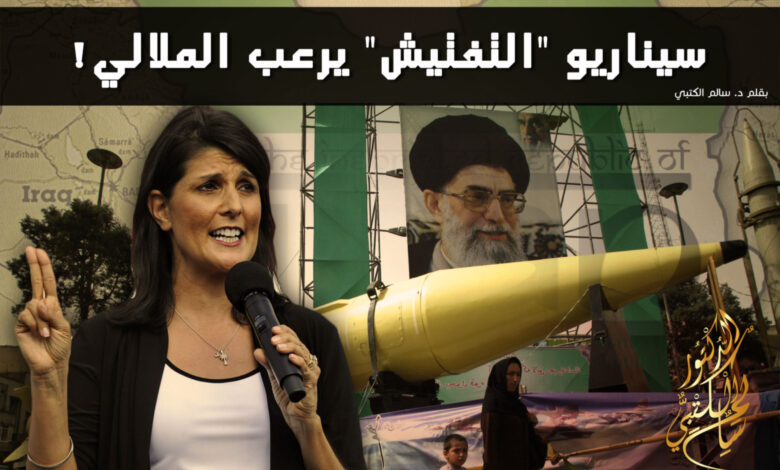
Many said she had little experience in US foreign policy and that her past experience is limited to being a former governor of an American state. But United States Ambassador to the United Nations Nicky Haley made strong statements on Iran.
She recently demanded that international inspectors be allowed to visit Iranian military bases, thus bringing back the Iranian nuclear file into discussion. The demand falls within the framework of the nuclear agreement signed with Tehran. The ambassador wants to ensure the commitment of the Iranians to the terms of the agreement through applying serious international mechanisms. She urged the International Atomic Energy Agency (IAEA) to use its authority to ensure Tehran’s compliance with the General Nuclear Agreement of 2015, including allowing IAEA inspectors to visit and inspect Iranian nuclear facilities.
The US Ambassador to the UN visited the IAEA headquarters in Vienna recently. “I have good confidence in the IAEA, but they are dealing with a country that has a clear history of lying and pursuing covert nuclear programs,” she stated. She urged the IAEA to pursue every angle possible “to verify compliance with the nuclear deal.”The visit came on the backdrop of the Trump administration’s periodic reviewing of Iran’s commitment to the deal. It seems clear that the White House will not withdraw from this agreement in a hasty manner, but seeks convincing legal grounds to prove to ally signatories Iran’s violations of the agreement.
Iran refused having nuclear facilities and sites inspected. Iranian Revolutionary Guard commanders who categorically rejected it look suspiciously at the US move, recalling the experiences of Iraq and Libya with UN inspectors. The commander of the Revolutionary Guards’ missile unit, Amir Ali Hajizadeh, stressed that his country will not allow the agency’s inspectors to visit the Iranian military centers. He accused Western countries of trying to disarm Iran through “sanctions and psychological warfare […] just as they did in Libya.”The Iranian response was clear according to him, “we will never allow this.”In his speech at the ceremony of Rouhani’s presidential inauguration, the Iranian leader Ali Khamenei called on the government to stand against the policy of the new US administration. This warns of an impending clash between Iran and the International Atomic Energy Agency, which found it hard to issue a report that would confirm Iran’s commitment to the agreement.
The Joint Comprehensive Plan of Action does not distinguish between military and non-military sites. Haley wanted to activate the terms of the agreement that allow the IAEA to request access to any Iranian site. If IAEA cannot do that, Iran would be accused of not complying with the deal and any party would have the right to dispose of this agreement without facing charges of not meeting their obligations.
Chairman of the United States Senate Committee on Foreign Relations Bob Corker told the Washington Post that the United States will test Iran with more inspections to various sites and facilities there. “If they don’t let us in, boom,” Corker said.””You want the breakup of this deal to be about Iran. But we do not want the United States to bear the consequences of that, because we want to support our allies in this game as well.”
The United States will not unilaterally withdraw from the deal as some analysts have predicted. The US will proceed with a clear and more mature strategy to ensure Iran’s compliance with its provisions through IAEA procedures. A new confrontation over the deal can completely break it up or reopen negotiations to amend it as Washington said a while ago. Its position may be supported by other parties and partners like France. In any case, the mullahs of Iran are in a difficult situation. As a consequence, they might get adventurous and want to use their influence in Syria and Iraq as a pressure card on international powers to ease off measures they might take vis-à-vis the nuclear deal.