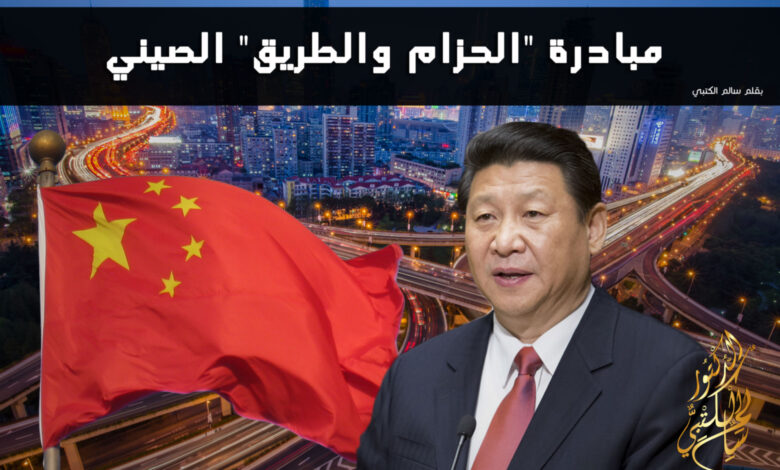
Amidst the vast media coverage of the visit of President Donald Trump to the Middle East and the American Islamic Summit, the Chinese dragon hosted on Saturday, May 14, a summit dedicated to celebrating the launch of the Belt and Road Initiative, which strongly reflects the aspirations of Chinese President Xi Jinping to promote Chinese influence globally. About 29 presidents and leaders from around the world as well as 1500 delegates from 130 countries and 70 international organizations and the Secretary-General of the United Nations participated. Representatives from several Arab countries, including the United Arab Emirates, also participated in the largest gathering in Beijing since the Olympic Games in 2008.
The talk about a new Silk Road began in 2013 through an initiative called One Belt and One Way, where China spent billions of dollars on investments in infrastructure and roads to establish the Silk Road linking China to Europe.
The Silk Road has two branches, one on the land and the other on the sea. China invested $ 150 billion in some 68 countries that have agreed to participate in this ecopolitical initiative.
Wang Xiaotao, vice president of China’s National Development and Reform Commission, said that the purpose of the summit is to establish a more open and efficient base for international cooperation and a stronger network of partnerships with different countries, and to establish a more just, rational and balanced international order. The Chinese president sought to reassure the West in a speech to the summit participants that the project is not only a means of boosting China’s influence on the international stage. However, everyone is aware that the growing economic power of China will someday have a global strategic influence.
Western observers believe that China’s industrial production surpluses are one of the main reasons behind the initiative. A producer of huge quantities of raw and processed materials, Beijinh needs huge markets to export these products. For example, China produces about 1.1 billion tons of steel per year, which is equal to the production in all other countries, but it does consume internally only 800 million tons. The search for markets is a very important strategic task to the Chinese as they want to build an alternative model of global supremacy to avoid entering into conflicts and wars for hegemony and influence. It seeks to enshrine a new paradigm of Soft Power through cooperation, building bridges and common interests. This does not end the fears of large regional powers such as India and Japan, which were absent from the summit and expressed their doubts that the Chinese project hides geopolitical ambitions and intentions to dominate strategic resources. Some experts also believe that the ambition is unrealistic. However, this ambitious Chinese vision involves nearly 70 countries representing 60% of the world’s population and one-third of the world’s GDP. In fact, the signs of the project have already appeared with the first cargo train linking China to the UK in early 2017, which arrived in London after an 18-day journey of 12,000 km.
The summit participants confirmed their common commitment to building an open economy, ensuring freedom of business and confronting any form of protectionism within the framework of the Belt and Road project, with the aim of promoting an inclusive, open, non-discriminatory, fair and law-based system, where the World Trade Organization is the center. This vision is described as ideal, and the chances of achieving it on the ground are still being calculated.
The entire project is a Chinese ambition, in which Beijing seeks to create a favorable opportunity for a business worth more than $ 2.5 trillion in one decade. The project represents a huge strategic lever for the Chinese economy in the coming years, providing important incentive plans that can ensure further global economic superiority to China. The project includes the development of networks of roads, railways, oil and gas pipelines, power lines, the Internet and various maritime infrastructure in the regions of West and South Asia towards Greece, Russia and Oman, enhancing China’s contact with Europe and Africa. The project is China’s biggest challenge in the 21st century. China set up a committee to oversee the implementation of the project. The committee includes advisers trusted by the Chinese president, led by the Communist Party Research Office chief Wang Huning, one of the main advisers to President Xi Jinping.
The Chinese president’s meeting with leaders of many countries including Bangladesh, Cambodia, Laos, Mongolia, Myanmar, Tajikistan and Pakistan at the Silk Road Summit made it clear that there is a strong Chinese approach to building a strong business network with Asian partners.
For the Arab countries, there are two routes in the new Silk Road – a land line passing through Iraq and a sea line running through Bab al-Mandab strait and crossing the Suez Canal, which are one of the six economic corridors of the Silk Road linking to Europe. So we have to consider opportunities and challenges of this ambitious project, in which regional countries such as Turkey will have an active role.