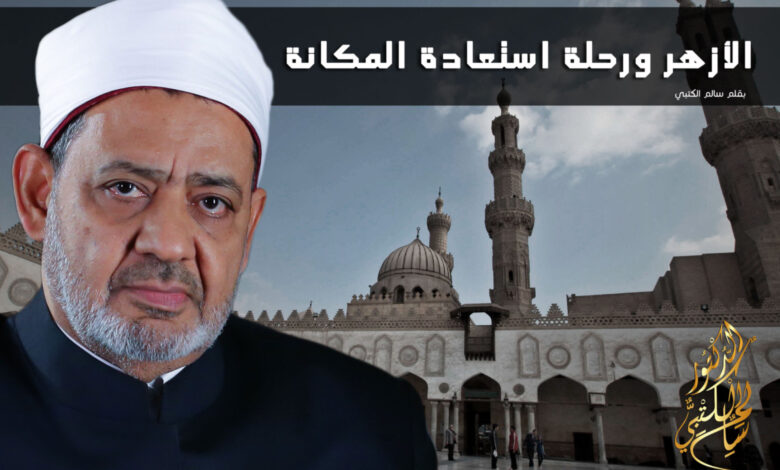
On a historic day, not only for Egypt and Al-Azhar but for the entire Arab and Islamic world, the World Peace Conference was held at Al-Azhar in the presence of Pope Francis and Pope Twadros II, Pope of Alexandria and Patriarch of St. Mark.
On April 27 and 28, the world saw Egypt’s peaceful and civilized image, gradually regaining its stature and cultural influence.
In this world conference, Al-Azhar has regained its status and leading role in bringing religions, cultures and civilizations together and in leading the Islamic world. Sheikh Ahmed Al-Tayeb proved to be an exceptional man over the past years through efforts made in his high position in Al-Azhar and as president of the Muslim Council Of Elders, where he worked to bring religions together and spread moderation and tolerance, seeking to enshrine the principles of citizenship in Egypt and abroad. Sheikh Al-Tayeb’s efforts reflect genuine values and principles rooted in his consciousness.
In his historic speech during the opening session of the conference, the respectful Sheikh emphasized important points which entirely represent bright lights that frame the relationship between Islam and the world in the coming years. The first point is that he has expressed the relevance of peace and that it should be fulfilled through serious work, not only through slogans. Al-Tayeb stressed that the world peace seems to need further efforts, analysis and research. The Sheikh, as a scholar and researcher, did not resort to the courtesy and protocol that is usual in such circumstances, rather he was clear and direct. He considered that the concept of world peace is one of the most complex and intractable mysteries to any mind that adopts logic. Not only did he refer to the magnitude of the ambiguities and complications surrounding peace at the level of theory and practice, he went on to analyze their reasons based on a historical logical philosophy. The Sheikh started talking from the view of Western philosophers and thinkers about the cause of peace to stress his ability to build bridges of dialogue with other cultures and civilizations.
Al-Tayeb said that Islam is suffering from distortion and injustice, just like Christianity and Judaism. The Sheikh said that all that is said about Islam concerning peace is said about Christianity and Judaism. He highlighted the rapprochement between religions, stressing that Islam is complementary to all the divine religions and not separate. Islam is a final link in the chain of the one divine religion that began with Adam and ended with the Prophet of Islam. These messages, from the beginning to the end, correspond in content and differ only in the changing practical legislation. Each religion has a practical law that suits according to periods, places and believers, said Al-Tayeb.
The Grand Sheikh stressed the integration and communication between religions and their unified and noble objectives. He gave a convincing explanation about his vision of moderation and tolerance, where ideas were presented in a coherent methodology. He said that freedom of belief and difference in religion are two sides of one coin and that freedom of belief necessitates the denial of coercion in religion. A religion that allows freedom of belief cannot force others to follow it. This is the logical argument that Muslims should use while addressing others, not yell or scream.
Al-Tayeb addressed sensitive issues such as fighting non-Muslims, where he explained its historic and doctrinal circumstances. Then he dealt with the alleged link between Islam and terrorism, stressing the need for a separation between Islam as a religion and Muslims as human beings, where some can be mistaken or right, and few of them practice terrorism and extremism. The Sheikh put forth a logical question: “if it is said, do not pass judgment on religion because of some crimes of its believers, why not say so about Islam? And why unjustly and falsely insisting on Islamophobia?
The Sheikh of Al-Azhar called on to discharge all religions from terrorism, as well as he explicitly linked terrorism to international policies, which are based on hegemony and double-standards.
From a political analytical perspective, I think that the speech was a historical trial of the world order and its unjust rules, which play a prominent role in fueling conflicts and spewing terrorism and other phenomena that undermine global security and stability.
Al-Azhar has succeeded through this conference to regain much of its influence and prestige. There is a global environment conducive to achieving a historic rapprochement between religions, given Al-Tayeb and Pope Francis’ historical attitudes that reveal a tremendous cultural awareness and a deep religious tolerance.