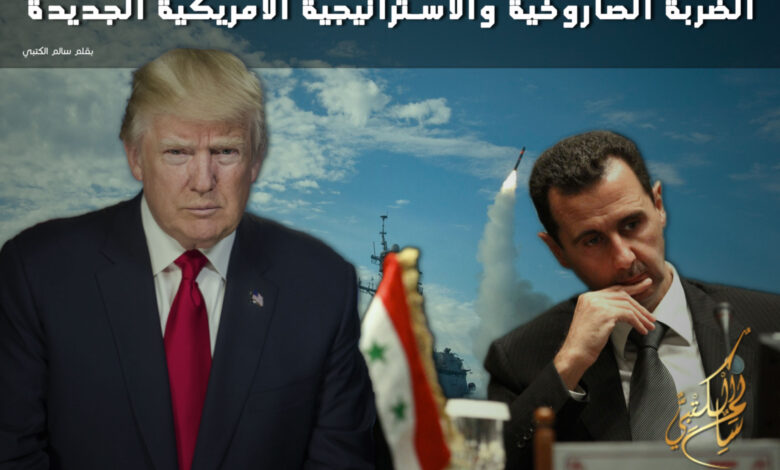
The Trump administration is reshaping the US mental image under what it believes to be an unprecedented phase of weakness that marked the administration of President Obama. The US administration is representing what some call Trump’s recklessness, since it considers that such an image can restore the prestige of the US. The US missile strike against the Syrian Air Force Base has revealed that it is not about recklessness but very accurate strategic calculations.
The Trump administration is deliberately making it difficult for the world, including its allies and rivals, to anticipate US reactions. This is a strategy that Western experts associate with the influence of Kissinger, former Secretary of State and the most famous political theoretician in US history, on Trump administration. Kissinger put forward the principle of unanticipated actions in foreign policy, and believes that this principle can establish the prestige of the major force in the world system.
Kissinger and some American experts believe that the United States should abandon excessive caution and calculations in its reactions, and that it must sometimes act with a calculated degree of recklessness in order to induce others to fear its reactions. This type of behaviour corresponds to the prestige of the unipolar force, as it puts strategic pressure on opponents and competitors and makes them constantly worrying to the point of not taking any step that could harm US interests.
This approach, which is random in the eyes of some, is yet well calculated. It is subject to more accurate strategic calculations than conventional diplomacy. It puts US policy strategists in constant study, recalculation of attitudes, building unconventional scenarios and thinking outside the box to look for decisions and alternatives which are consistent with this type of strategic thinking.
The strategic confusion pattern vis à vis the decision-makers provides the margin of a massive maneuver in the US foreign policy, and allows the US to move flexibly between positions without being accused of switching positions. This strategic pattern also prevents US politicians from being blamed because of their stated statements and opinions, dealing with each case differently without a permanent political commitment. This explains the statement of the US Secretary of State, Rex Tillerson, who said he was not expecting a policy or position change concerning US military activities in Syria for now. It is clear that it is simply about working freely according to the situation and self-interest.
There are principles that can be drawn from this new seemingly random policy. The United States is no longer committed to the idea of non-military intervention in other countries as long as there are circumstances that threaten its strategic interests. In addition, the United States is no longer bound to calculations of military confrontation with others, and does not fear this, to remind it is a superpower. These are the grounds on which the Trump administration seeks to restore the US prestige.
According to Trump’s advisers, from now on, the world must co-exist with a new US foreign policy that is based on the absence of constants and on the changing priorities, where the only criterion is the interest of the United States.
It is hard to state that the American missile strike was aimed at overthrowing the Assad regime. The decision makers know where the head of state lives, but the aim of the missile strike was to raise Assad’s fear and concern about his personal life and the future of his regime. In fact, there are reports that talk about the possibility of Assad moving to stay in hideouts like Hassan Nasrallah.
US and Russian strategic interests often converge on the idea of keeping Assad a weak ruler of a small portion of the Syrian territory, and have him recognize the de facto Israeli occupation of the Golan Heights. Only Assad can accept such option at the moment.
As a matter of fact, the Trump administration does not want Iranian influence in Syria. Preventing Iranian intervention must be done by redistributing the roles in the Syrian scene. This has been done very effectively through 59 Tomahawk missiles, which the Iranian and Russian allies in Syria have stood still watching.
This missile strike will contribute to the “domestication” of Russian influence and the return of Putin to reality after years of strategic dreams. The Trump administration will not fall into the trap of humiliating Russia, but it will proceed according to the logic of a purely business bargain. The missile strike was aimed to give an important lesson to the Kremlin in order to negotiate sharing influence and roles in Syria. Russia will get a large part of what it wants especially with regard to the Crimean Peninsula, provided that it implements the US conditions. First, Russia must disband the alliance with Iran in Syria. This is a clear lesson for anyone who has positive expectations about Trump’s relationships with his Russian counterpart.
It is clear that the United States does not want to end the conflict in Syria now. Rather, the US wants the conflict to continue so that all parties will be exhausted. Then, US can intervene in the right time to impose what it is appropriate for its interests and the interests of Israel, and may give some other parties small gains.
There is a belief that Trump’s strategy is consistent with the interests of Daesh and other terrorist organizations in Syria. This conclusion is based on a certain understanding about the missile strike which does not take into account the entire matter.
The strike was not aimed at creating military balance between the parties in the Syrian conflict, but at deterring Assad from using chemical weapons against civilians and also restoring some international confidence in the United States. So, the missile strike has nothing to do with the military balance of power on the ground, and it may perhaps frighten Daesh as it did to Assad’s regime.