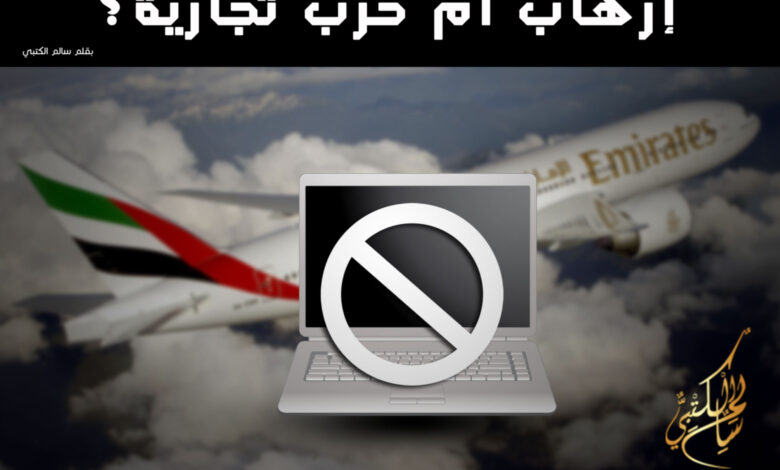
There are many justifiable doubts about the ban on carrying laptops on flights from 10 airports in Middle Eastern countries, including Abu Dhabi and Dubai airports, which are known for their high security measures. The Abu Dhabi airport, in particular, has a US passport and immigration unit responsible for such inspection procedures.
The UK has also imposed a similar ban involving 14 airlines operating direct flights from Turkey, Lebanon, Jordan, Egypt, Tunisia and Saudi Arabia.
The issue of invoking terrorism in the ban on computers seems unreasonable for many reasons. I am not convinced that the ban is a preventive measure, or the claims that UAE and Gulf airports have weak security measures, as many passengers go to the United States without being subject to inspection procedures. I cannot be convinced that a terrorist, who plans to attack a plane, will cancel his plan once he realizes that there is a ban on certain airports in the Middle East, rather he could try doing so from other airports located in some banana republic.
Doubts also surround the idea that the ban includes only the passenger compartment. There is an obvious question in this regard: how come it is risky to have a computer in the places reserved for travelers, while there are no concerns about smuggling it in the luggage? Wouldn’t that be dangerous too?
Experts say that luggage is less dangerous when the plan takes off, because the bomb needs a sophisticated time-control device. The bomb could also explode before the plane takes off or if luggage workers inadvertently cause the bomb to explode somehow. This explanation seems unconvincing because the difference lies only in the margin of error and the level of technical sophistication of the crime. Detonating a bomb on the plane before it takes off is very dangerous; especially that terrorists want not only to kill but also to terrorize through raising suspicion about a bomb.
Suspicions are not limited to the countries involved in the ban. IATA announced that the ban imposed by the US and the UK would not be effective as a security measure. Alexandre de Juniac, IATA’s chief executive, said in a “strong-worded” report that the ban can cause “commercial distortions”. De Juniac questioned these procedures saying the bans aren’t acceptable long-term solutions. Travelers are asking valid questions such as why the U.S. and Britain don’t have the same list of targeted countries and airlines, he said. And he suggested better screening equipment for electronics must be available. “The current situation is not acceptable and will not maintain the all-important confidence of the industry or of travelers.” De Juniac said. “We must find a better way.”
This confirms my doubts, especially that he has pointed out the relationship between what he described as political developments, limitation of borders and protectionist measures, and did not address the terrorist threat.
The story of the computer that was smuggled by the Somali terrorist group, Al-Shabab, on a civilian plane last year increases doubt. The plane took off from a Somali airport that was not covered by the ban.
I do not question the intelligence information that some American newspapers have reported, and that terrorist groups intend to manufacture explosive devices and put them into electronic means in a way that has been described as undetectable. But the question is whether terrorist organizations have canceled their plans since the application of the ban on the airlines covered by the US decision, or not.
This decision is the same as the decision that bans holders of passports of certain countries from entering the US, although it is obvious that terrorists are not coming only from certain countries and that terrorist crime has become a source of security concern that requires special measures. The latest example is the recent terrorist crime in Britain, where the British police confirmed that there is no conclusive evidence linking the criminal, who was killed in the attack, to terrorist organizations. The British police also said that the assumption that the criminal has developed his terrorist mindset inside prison is just an allegation. However, this does not deny the existence of a relationship between criminality and terrorism. In fact, the terrorist crime has become more sophisticated and no longer easy to track through conventional communication and security controls.
That the US ban does not have clear reasons raises doubts, and it seems that there is an evasion of investigating the credibility of related justifications. In addition, most of the targeted airlines are Gulf companies that compete with US and Western airline companies, and there were already concerns about protectionist measures that the Trump administration might undertake in this context.
According to reports by some US institutions, media reports confirm that President Trump met CEOs of major US airlines last February and vowed to help them fight against foreign competitors. This measure could lead to devastating business wars. The European Union may follow the example of the United States. The EU is expected to pass a bill that would charge foreign airlines or suspend their rights to carry out flights to European airports if they prove to harm European airlines.
One of the problems in addressing this issue is that WTO rules do not apply to airlines, as well as that the organization is not concerned with any negative practices in this context, even if they are proven to be protective measures against the principles of free trade.
To be frank, we are in the midst of a new brand of business protectionism, harmful to globalization and free market, where terrorism is only an excuse. The issue of the ban harms business but also questions the seriousness of the West in combating terrorism.