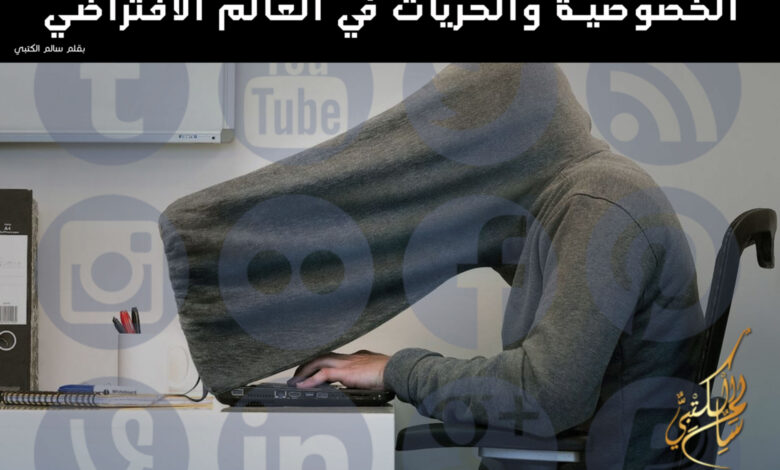
There is a political and legal debate about the limits of the relationship between privacy and individual freedom on the one hand, and the laws on the other hand, especially concerning the limits of freedom in the virtual world and the internet.
Privacy and individual freedom are preserved by international laws and conventions, as well as constitutions and regulations which are applied by most countries that seek to maintain the global advanced competitive ranks of human development, human rights, welfare, happiness, and so on.
Right after the terrorist attack in Britain, the relationship between freedom and laws jumped to the forefront of global debate. The security authorities in all countries are seeking to obtain information that can help in providing the necessary security and safety for citizens. However, much concern rises whenever the security authorities miss some areas, even in the virtual world.
That terrorists hide in caves, mountains and forests or on the Internet and social media, is may be related to freedom and individual privacy and the limits of its practices, which requires the precise identification of the right of communities and nations to live in peace and security and protect themselves from any criminal thought that may hide behind physical or virtual walls.
I am personally surprised that some human rights organizations object the fact that some countries ask from companies that manage or own famous web sites and social media, the access to personal accounts of people suspected to have links to terrorist organizations. In fact, the proportion of suspicion in such cases is negligible compared to the number of users of popular social media like Facebook, Twitter and others.
In the recent terrorist attack in London, investigation authorities were unable to access the electronic encrypted messages sent by the terrorist on WhatsApp. So, there were serious discussions about the right of specialized authorities to access information so as to provide protection for people, and also about the right of privacy and individual freedom of the users of the social media.
I am aware that it is difficult to draw precise legal and procedural limits to these rights, but the seriousness of terrorism requires hard work on this task, especially that it does not target freedom itself. Note also that granting powers to access information may be misused sometimes in some countries, but this is an exception that should not prevent everyone from getting the maximum level of security and protection.
Controversy between the owner of the famous web site and official authorities in Britain and other countries about this matter has a significant economic and commercial dimension. In fact, Facebook paid 19 billion $ to purchase WhatsApp in 2014, in a deal that was the greatest in the world of technology, which is a price that exceeds the estimated value of Facebook at that time. Some experts questioned the economic viability of the deal, because WhatsApp was annually generating revenues of no more than 20 million $, which were lower than the revenues of other programs. Moreover, the current and estimated revenues of Whatsapp outweigh the value of the deal. Although some specialists described the deal as a crazy deal (Google had offered only about two billion dollars to buy WhatsApp in 2013), the rise and spread of WhatsApp indicates that it was a successful deal. Indeed, WhatsApp contributed to the preservation of Facebook in face of its challengers, such as Google and others, and guaranteed its control over the social media.
Consequently, this matter is related to the competition between the giants of the world of Internet and to massive investments of tens of billions dollars, which are closely linked to vital matters such as levels of confidentiality and privacy in calls and chats across these programs and so on.
Despite the above, the risk of terrorism and its elements that can hide among millions of users of these programs is serious. So, how can we balance between the rights of these economic and commercial companies and the free economic competition on the one hand, and the requirements of security on the other hand? It is a perplexing question, but the evidence confirms that there is a way out of these discussions in order to preserve the rights of these companies and the security and safety of individuals and peoples.