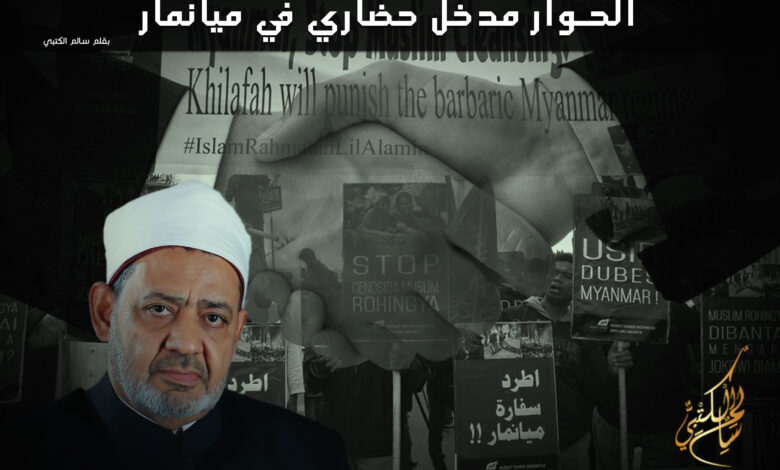
Recently, I took interest in dialogue sessions to be held in Cairo, between young people representing the parties involved in the conflict in Rakhine State, Burma, under the beautiful title “Towards civilized humanitarian dialogue for Myanmar (Burma) citizens”. These meetings are organized by the Muslim Council of Elders, based on the Council’s role in working to spread a culture of peace and coexistence throughout the world.
I was also interested in the fact that these sessions include intellectual and cultural elite, and start from purposeful axes about ways of co-existence, the roots of the conflict in this country, trying to put an end to it and consolidate the foundations of citizenship and coexistence between the citizens of Myanmar.
There is no doubt that such sessions involve constructive action seeking effective solutions to the status quo. Condemnation statements were made by official and other Arab and Muslim institutions, and that is an easy thing to do. What is difficult is to direct efforts to break the wall of silence and exclusion around such crises.
Al-Azhar’s position about the sessions is clear and strong, and stems from condemning murder and fighting in the name of religion or ethnicity. His Eminence Dr. Ahmed Al-Tayeb, Grand Imam of Al-Azhar, warned that killing or fighting on ethno-religious grounds is serious, very harmful and highly destructive to people, stressing that the prophets and messengers never stood for murder, persecution or displacement.
There is no doubt that the speech of the Grand Imam of Al-Azhar at the opening of these sessions is an important historical document to look at what is going around us regionally and internationally of disastrous strives, plots and crimes perpetrated by terrorist organizations; which give rise to discord, wars and intrigues in the name of Islam. He stressed that “The wisdom of Buddhism, Hinduism, Christianity and Islam calls you all not to kill, steal or lie, abide by chastity and not drink alcohol.”
There is no doubt that we in the Muslim world need many people like Dr. Ahmed Al-Tayeb and his enlightened knowledge, to address everyone and seek to build bridges, bring together not divide, build rather than destroy. One solution to the current crises in the world today lies in the dialogue that the Grand Imam has encouraged us to adopt.
While His Eminence the Grand Imam of Al-Azhar talks about other religions, we see the tolerance and greatness of Islam, as no one can deny the religious knowledge the Grand Imam has. When His Eminence calls on the youth of Myanmar to instill and spread the culture of peace, he represents Islam as the religion of civilization and tolerance. This image, however, is being deformed by practices of ignorance, along with vanity, recklessness and absurdity, and that cannot represent Islam in any way.
We say we need to develop religious discourse, and the speech of the Grand Imam of Al-Azhar touched that point. On behalf of the Muslim Council of Elders, the man spoke to the people of Myanmar and called on them to act in a human way to protect the Muslims of Myanmar. As I said, there is nothing easier than igniting sedition and add fuel onto the fire, but what is difficult is to be wise and not impulsive or absurd. The Muslim Council is treating the Myanmar Muslims crisis with wisdom and we hope the Council would treat many crises in the same way.
There is no doubt that the easiest ways to build commonalities, bridge the gaps and reduce disagreement is through understanding and dialogue about the causes of disagreement. This should be done through people who are aware of the significance of dialogue, not as an end in itself but as a means for people to overcome their differences and agree on what unites them.
Dialogue with the youth of Myanmar might be a new approach in this serious crisis that could worsen if left alone without such rational interventions. Some might underestimate this approach but I am confident that such efforts are the possible rational alternative in the long term for the future of millions of Muslims in this country and elsewhere. The wise Muslim Council of Elders and other institutions that adopt a moderate mindset and civilized positions that represent Islamic tolerance, have a huge responsibility because they are working amid conditions dominated by violence and ignorance, disseminated by terrorist organizations and extremist ideologies. But their role to promote humanitarian and civilizational ideals is significant. They illuminate the paths of people and help us protect the true image of the Islamic faith that the practices of terrorism and extremist thinking damaged in recent years.