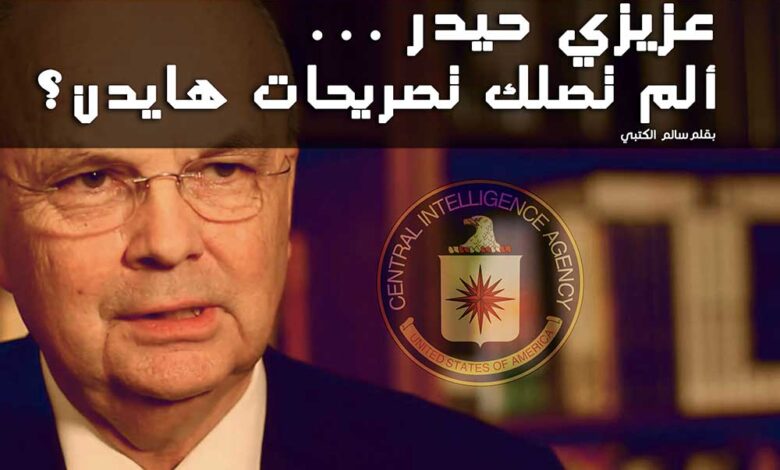
“Current times are witnessing tectonic changes, especially in the Middle East” (relative to the movement of the earth’s tectonic layers that cause earthquakes and movements of continents and change terrain)”. This is the view of Michael Hayden, the former head of US intelligence, according to an interview with CNN.
His statements have attracted the attention of many experts and observers in the world, but I did not notice any impact of them in the Arab world, in spite of the meanings and implications they hold for the future of the region and its countries; especially as Hayden went on in his statement, saying that “What we are seeing is a fundamental breakdown to international law, we are seeing the collapse of the agreements that followed World War II, we are also seeing a collapse in the borders that were demarcated in the treaties of Versailles and Sykes-Picot, and I can say that Syria no longer exists and Iraq no longer exists and will both never return, and Lebanon is losing its cohesion and Libya went long ago”.
What concerns me in the beginning is to try to read Hayden’s remarkably direct and explicit statements, in which he did not try to send hints or signs open to interpretation nor did he leave meanings between the lines, he was surprisingly direct and clear. His talk about “tectonic” changes means for me that the scenario of re-establishing the geographical boundaries’ architecture of many countries in the region is going on apace.
Hayden, a former high caliber official, realizes the significance of what he says, and we realize that such “geological moves” result in changes in the political terrain and geography.
There is no doubt that Michael Hayden’s statements on the disappearance of Iraq and Syria are not new. He has already talked about a similar scenario, last July, in an interview with the French newspaper Le Figaro, and only few took notice of that. Hayden talked in that dialogue about a darker and more pessimistic scenario when he referred to the fact that the situation of regional instability will take about twenty or thirty years.
It may not be a big paradox for experts in international relations that the secret understandings in 1916 between the British Mark Sykes and the French François Georges-Picot, could be reconsidered after one hundred years of their occurrence, and their consequences reflected in sharing influence in the Levant and Iraq between England and France.
Evidence is clear that there is a relationship between Hayden’s statements and those understandings, especially because he considered that Iraq and Syria have already disappeared, from his point of view, and no longer have a presence on the map. He was confident when saying, “I can say they will absolutely not return as they were.” It is a very dangerous sign in the light of the historical link of these two Arab States to that Convention, and what also confirms that is that Hayden talked in the interview about a similar fate to Libya, which is also a country associated with the understandings of Sykes-Picot.
It is no secret that the division plans take place in official American corridors, and are not limited to televised statements. In the US House of Representatives, a plan to divide Iraq into three states, was introduced, according to what was published in the end of April last year in Time magazine, known for its proximity to the US decision-making circles. The plan is comparable to the famous Bernard Lewis plan, which was published nearly three decades ago, and is based on re-architecting the Arab region according to ethnic, sectarian and tribal standards.
What is happening in the region was not at random. The flame ball has been rolling since 2003, with the American invasion of Iraq, then the launch by former US National Security Adviser, Condoleezza Rice, of the “creative chaos” balloon, and the subsequent outbreak of the so-called “Arab Spring”, which inaugurated chaos and translated it on the ground. Then the emergence of the organization of the Islamic State and its announcing of the fall of the Sykes-Picot convention.
These developments, in turn, resulted in the ignition of the regional conflict about what is described in the research literature as “blood borders”, and competition intensified between regional and international powers over influence and interests, and all entered the danger circle, including Turkey, which is aware from the outset about the imaginary scenario for the area, and wanted to control its tracks.
But the thread of control is cut off and it escaped from its grasp after the overthrow of the Muslim Brotherhood regime in Egypt, and the American bias to the Kurds and the help America clearly gives them in achieving their historic dream of building an independent State. And so the scenario goes on the bodies of millions, under sectarian and ethnic covers, and through proxy wars between militias, organizations and minorities.
Some may be surprised at the statements of the Turkish Prime Minister Davutoğlu, who said that his country rejects the existence of a new Sykes-Picot in the region, but previous statements by Hayden explain this Turkish position. The former president of the American intelligence talked in published statements about the US absolute support to Kurds and called them friends of the United States, and promised not to abandon them, which is what we are really seeing now, which is something that certainly angers the Turkish side, which is aware of the seriousness of the US support for the Kurds and the arrangements it implies that threaten Turkish national security, and may put an end to long years of honey between Ankara and Washington.
Some might think that Turkey will not accept a strategic defeat for the second time in two hundred years, and will rush into the arms of Washington and take refuge in them, not realizing that the matter exceeds Turkey’s strategic capabilities, and is primarily subject to the calculations of the great powers, which can reach new understandings with the Turkish side, which would inevitably agree and get a “little” for fear of going out empty-handed from the game of “sharing the cake.”
It also caught my attention that Haidar al-Abbadi, the “Baghdadi”! Prime Minister of Iraq, who rose up because of Sheikh Abdullah bin Zayed Al Nahyan’, UAE Foreign Minister’s statements, which are in the interest of Iraq and are aimed at protecting his people, did not take the initiative to comment on the statements of Michael Hayden, although he realizes the seriousness of their content, as they directly dealt with a formal absence of the Iraqi State from the map. So did Hayden’s statements reach Al-Abbadi and he ignored them, or does the man not read or hear?
In any case, it is my right as an observer to ask Haider Abadi, “al-Baghdadi”: are you really interested in what is said about the fate of your sister country? Or do only pay attention to what hurts the feelings of your leaders in the Iranian Revolutionary Guard?