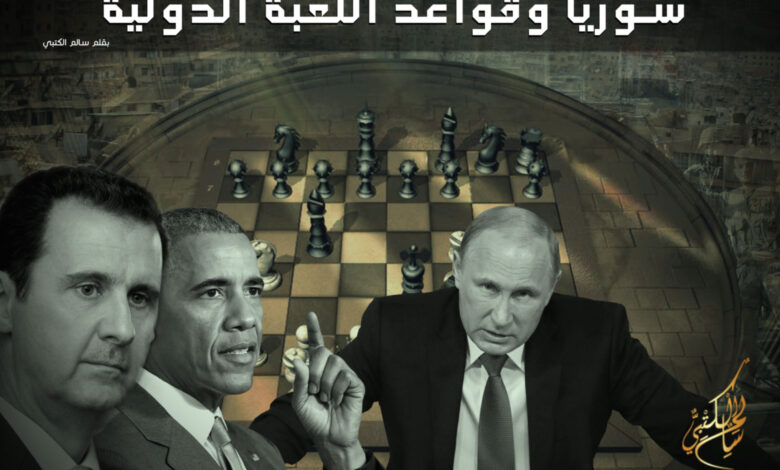
Through their vision of the rapid developments in the Syrian crisis, recently many observers said that the world is heading into a new polarity with Russia on the top, and that the United States’ control over the existing world order has become one of the past, and I believe, firmly, that this opinion needs to be read carefully because it ignores a number of points.
This viewpoint stems from the analysis of Russian individual management of the situation in Syria, in coordination with Turkey and Iran. The three parties succeeded in reaching a cease-fire between the Syrian regime forces and terrorist organizations. I think that the crisis is bigger and more complicated than just agreeing to a cease-fire. Prospects for peace need more than the absence of military confrontations, said German Foreign Minister Frank-Walter Steinmeier.
It is true that a ceasefire could be a prelude to the launch of political negotiations between the conflicting parties in Syria. This is the plan for the meeting in the Kazakh capital of Astana in late January, but we have to see beyond the events in this crisis, and there is much to be said in this regard.
Russia was stroke by terrorism in the month of December last year, and it is not logical that it seeks to accelerate mediation between the Syrian regime and terrorist organizations unless it sees that the time is not in its favor. The Trump administration may come up with a new strategy not in Moscow’s interest, in the sense that it is normal that Russia would take its time until President Trump takes office on the twentieth of January in order to benefit from agreeing with him to execute a Russian–US mutually beneficial deal, but the desire to speed up the resolution of the crisis and to reach a compromise in haste reflects the concern of the parties that are now racing against time in the Syrian scene regarding the intentions of the new US administration.
Clearly, the agreement, which was backed by Russia and Turkey, did not have the ingredients to solve the crisis once and for all, for various reasons and considerations. First, the agreement ignores the role of the important parties in Syria, and even ignores Iran, which is the party that runs the military scene on the ground, and does not include all terrorist organizations in Syria. The second reason is that the fact that the US delegate to the UN Security Council praised the last Russian draft resolution on Syria, which had collective approval of the Council, does not necessarily mean the recognition of the US of a Russian individual management of the crisis in Syria, and we should not ignore the hypothesis that the Obama administration has been recently putting mines on the way of the next US administration. This is evidenced by refraining from voting on the draft resolution on Israeli settlement or supporting the Russian position on Syria in the Security Council.
It is unlikely that the Obama administration or President Trump would accept a Russian individual management of the world. Washington would not agree that Russia would have a free hand in the conflicts and crises that matter to US strategic interests. That would simply mean the collapse of the era of American supremacy and domination of the new world order, not to mention that Russia does not have the elements of the management of this system in all its details and its complexity. But I do not even think that the Russians aspire to this role. All they want in Syria is a foothold on the Mediterranean Sea, and a deal of exchange of interests between Russia and Ukraine, and some recognition, and to match the American power in search of sharing influence for the benefit of Russia’s strategic interests in the Middle East in particular.
Other signs no observer’s eye should miss include the lack of response of President Putin to President Obama’s decision to expel Russian diplomats, and even acting promptly to correct a statement said to have been misrepresented by the US media, in which he talked about the Russian military power as the world’s most superior, but he returned to confirm that the United States is the most advanced in military terms. This means a strong desire on the part of the Kremlin to avoid angering the next man in the White House. The Russians are very keen to build spaces of agreement with him, and even to avoid any decisions that may cause the loss of positive signals exchange between Putin and Trump.
It is true that the Russian attitude towards the next US administration is a diplomatic and clever one, but it also reflects the actual balance of power. Otherwise, Moscow would not take the next US administration into account, and instead would have responded to the expulsion of its diplomats similarly, just like in the Cold War. Rather, it acted differently, confirming that Putin’s Russia is not Soviet Russia—at least in terms of the strategic management of the competition with the United States—and that it is not about a conflict of poles and a new cold war, as they say, but conflicts of interests, and a Russian strong desire to prove itself and push the US into respecting Russia’s interests and influence in the Middle East.