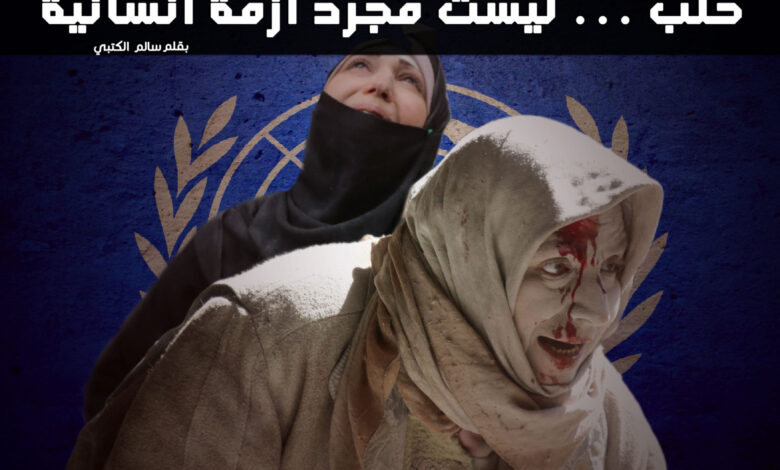
In the Syrian city of Aleppo, the humanitarian, political and military crisis ongoing for weeks at the humanitarian, military and political levels is threatening the present world order. The battle for the city culminates years of suffering of the Syrian people. The present situation did not emerge unexpectedly, but was portended by events that have been widely disregarded.
The Syrian crisis draws attention in many ways. First, the world has become strangely and reprehensibly apathetic to the Syrian crisis. The international community no longer responds strongly to terrorist and extremist operations undertaken for years, only to issue statements to condemn, and criticize and denounce the acts. For now, all the international community works on, it seems, is sending humanitarian aids to the Syrians and control the flow of refugees and displaced populations. Their crisis was not perceived as a crisis of a State that has been ravished by terror and extremism, which led to where things are at the moment.
Second, the erosion and the collapse of the principles about international security and stability dating back centuries and making up the foundation of the present world order. The notions of State sovereignty and the national State (derived from the Peace of Westphalia in 1648, this concept has been central to international security and stability).
On top of the crisis in Syria and other Arab countries, national sovereignty, enshrined by the United Nations Charter, was again violated in Saudi Arabia. Given the present circumstances, one might wonder how national sovereignty and immunity became a thing of the past.
Are major powers turning the page on the principles and basics of international legitimacy governing interstate relations since the inception of the UN?
Has the United Nations changed from an international law enforcer and peace preserver into a silenced institution that holds futile meetings that are remindful of regional organizations whose leaders meet annually to greet, smile to and take pictures with each other?
How could the international community be silent on Iran’s interventions in the affairs of regional Arab countries, as an agent of tensions and crises in the Middle East?
What about the Iran’s sectarian Shia army, whose sole mission is to intervene in other countries and serve Tehran’s interests?
Isn’t it an international law violation?
Are we witnessing the collapse of the present world order due to changing strategies of the leading state (the United States) on the one hand, and the rise of strong competitors for the global leadership, such as Russia and China, on the other?
Will Aleppo turn into a crossroad in the process of international relations as tensions between Moscow and Western capitals escalate?
The idea of a third world war because of what is happening in Aleppo is exaggerated. There were historical crises and unprecedented tensions in the relations between the USA and the former USSR—notably the Cuban missile crisis—but, back then, the red lines were drawn and crises were managed through an ‘edge of the abyss’ strategy, which is what is currently happening now between the United States and Russia, heir to the Soviet Union.
The mix between religion, politics and interests in the Syrian crisis caused large confusion. Identifying the motives for such and such party’s involvement in Syria proved increasingly difficult.
Day after day, it is becoming clearer how that the Syrian logjam is not the product of a popular freedom revolution as much as planned regional and international agendas that were compromised by new-coming actors having interests to protect.
Whether or not a world war will break out because of Aleppo is not the real question. The true question is how to overcome the impasse: Western countries criticize Russia over human rights violations in Aleppo, although they remained in silent mode since the beginning of tragedies and humanitarian disasters throughout the crisis.
Clearly, everyone makes use of the humanitarian cover to advance their strategic interests in Syria and elsewhere. Flashy words conceal interests and ambitions, history taught us.
Not to appear as pro-Russian or in favor of any other party involved, I say all parties are somewhat responsible for the violations, violence, terror and bloodshed our Syria is suffering from. Foreign powers use fighting terrorist organizations, like Daesh, as an excuse to further their interests; terrorist groups in Syria do not even have the organizational, operational and fighting capabilities to face the strikes of two international alliances encompassing almost all world countries!
Not just a human tragedy, what is happening in the Syrian city announces, discreetly, the death of the so-called new world order. We are about to enter a new era, yet we still do not know whether it will be characterized by multipolarity, bipolarity (again), ‘collective leadership’ of the world, or devolution of the polarity theory and, as European international policy experiments have suggested for years, the emergence of a ‘world government'(!)