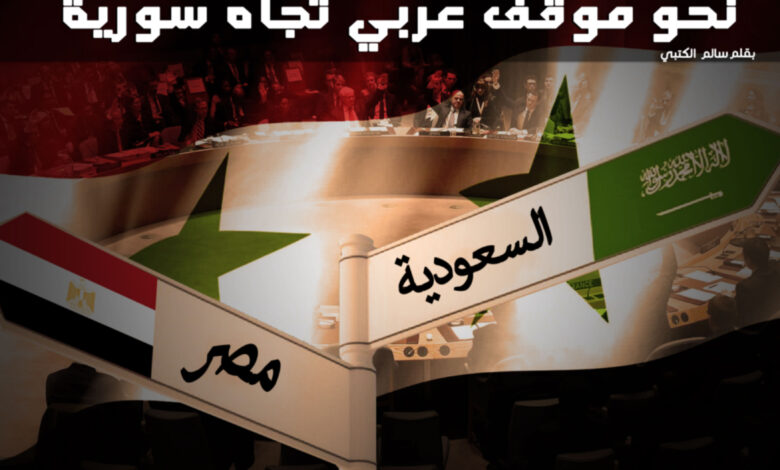
The contrasting Arab attitudes toward what is happening in Syria are no longer a secret. The latest manifestation of this is Egypt’s vote yesterday in favor of the Russian draft resolution at the UN Security Council on the crisis in Syria. This position was met with obvious irritation from the Saudi ambassador to the United Nations, Abdullah Al Muallimi, who described Egypt’s delegate vote in favor of the Russian draft resolution as painful.
The Problematic here is not in Egypt’s position and vision stemming from its pan-Arab role and historical responsibilities, nor in the resentment of Saudi Arabia, which also has a strategic vision and pan-Arab responsibilities, but in the contrasting Arab stances that put the two largest influential countries in the Arab world at the moment in opposite positions, which makes a common collective Arab role in resolving the Syrian crisis difficult to achieve, at least in light of the current data.
I realize that the complexities of the Arab scene with its severe crises, have contributed to the existence of a deep contrast between the strategic interests of Arab countries, and I also realize that there is a state of international and regional polarization that makes it difficult for the influential Arab capitals to have common views about these crises. I also understand that there is great difficulty in the convergence of views on specific issues such as the future of the Syrian regime, and so on. But I am absolutely certain that the preservation of the gains of the Arab peoples and the lead in resolving regional crises is certainly a priority to the leaderships of the two brotherly countries.
In my opinion, the matter requires first and foremost, bridging the existing gaps in the positions and views among major Arab capitals. In international and regional relations, strategic interests of nations may converge for a certain time on a particular issue, but it is difficult to guarantee this convergence all the time. In fact, priorities and profit and loss calculations come to the surface, so that a point of diplomatic equilibrium can be reached, in such a way that there are neither winners nor losers in the political game.
In such crucial situations, it does not seem politically prudent nor rational to back any of these views. We are talking about two sister countries that are the mainstay of our Arab region. It is not in our interest to engage in any debate about this contrast for the simple reason that the two leaderships, in Egypt and Saudi Arabia, are able to address such a temporary gap in the relations of the two brotherly countries. Those who talk about clashes on new axes and other analyzes are solely making meaningless wishes. A deep consideration of the positions of the two countries easily makes us realize that both have the same strategic single goal, which is to preserve the interests of the Syrian people, and the unity and cohesion of the territory of the Syrian state, but the disparity remains at the tactical level, according to the calculations and perceptions of each party.
I think that whatever the Egyptian-Saudi difference on the Syrian issue, the two brotherly countries’ relations are much deeper than this issue, and the areas of compatibility remain larger than the areas of differences. But the hot character of the Syrian issue and its accelerated developments make media specialists discuss the details of the issue including the Egyptian and the Saudi Arabian positions. In addition, terrorist organizations, specifically the Muslim Brotherhood, which owns a media machine whose main priority in the recent period is to stir up conflict on the basis of any developments regarding the positions of Egypt and Saudi Arabia about regional crises, are eager to ignite any spark of discord that would perhaps widen and help these terrorists full of hatred achieve their goals.
Regardless of the visions of researchers, specialists and observers over Egyptian and Saudi officials’ statements about the existence of differences in the positions of the two countries towards the Syrian crisis or not, what I am interested in anyway is that the level of coordination and cooperation and consultation between the two Arab capitals has not changed, and this in itself is a sufficient guarantee to overcome any missteps and to address any lapses or differences in views.
Egyptian-Saudi relations are deep and cannot be affected by different views about a particular crisis. It hurts both Arab powers to believe that one party is subordinated to the other, or that one party is engaged in a regional or international hub in a way that harms the interests of the other party. It is hoped, that both leaderships succeed in making their views converge about the Syrian crisis, because our Arab peoples are in an urgent need for a unified and cohesive Arab front to get out of the cycle of complex crises, and to escape from the trap of conspiracies and conspirators, who plot against some of our states, from inside and outside.