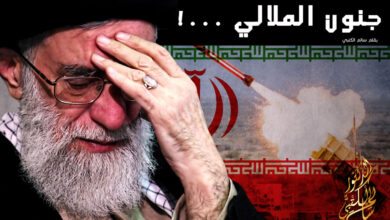
Iran’s possession of military nuclear capabilities was, and still is, a certainly serious risk to the national security of the Gulf Cooperation Council (GCC).This risk has not disappeared following the signing of the nuclear deal with the 5 + 1 group last year, but we can say the danger has only been delayed.
For years, experts and specialists were convinced that the Iranian nuclear bomb is a nightmare for security planners at the regional and international levels. The reason for this is not only the spread of nuclear arms, but because nuclear weapons are in the hands of the reckless theocratic regime of Iranian mullahs which represents a major strategic threat to any country, especially neighboring ones.
Iran seems to realize that it cannot get away with a nuclear bomb unless it concludes an understanding with the West on some strategic rules of the game. So it decided to make a bomb of a different kind—a sectarian one. Iran recently accumulated a sectarian arsenal with an explosive power perhaps no less dangerous than a nuclear or hydrogen bomb in terms of strategic impact and the degree of potential threat.
Iran’s sectarian bomb is not new in its external agenda. The regime of the mullahs plays the sectarian card since they came to power after the 1979 Iranian revolution. The mullahs were keen to use sectarianism to expand the Iranian influence in several Arab countries, starting by promoting the ‘export of revolution’, then interfering in Lebanon, and ultimately taking pride in ‘occupying’ four Arab capitals.
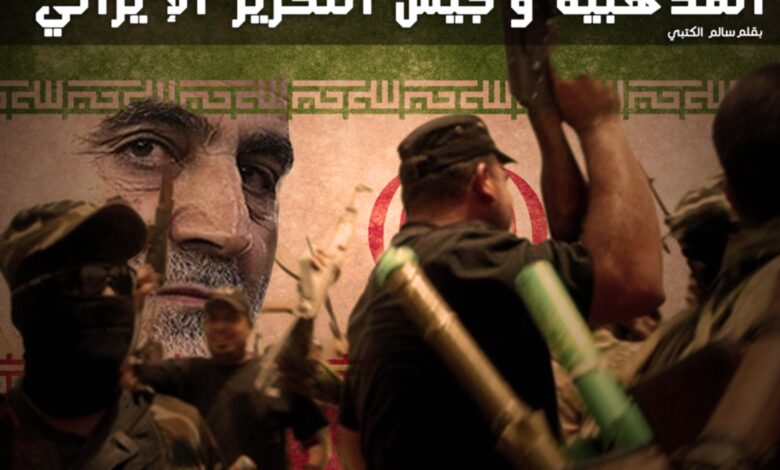
The latest step in Iran’s ideological path is to build the so-called ‘Liberation Army’, which was established by Iran on purely Shiite sectarian grounds, and works under the command of ‘TV Gen.’ Qassem Soleimani and the leadership of the Iranian Revolutionary Guards, and is administrated by Supreme Leader Ali Khamenei. The army consists of Shiite elements gathered from several countries, including Pakistan, Afghanistan, Iraq and Lebanon, in addition to Iran of course.
In years past, Iran had political, security and military arms claiming to work under national slogans, such as what was claimed by ‘Hezbollah,’ the group that caused destruction and sabotage in Lebanon with its failed military adventures in exchange for preserving the lives of its ‘leader’ Nasrallah.
Iranian officials did not deny the establishment of a Shiite sectarian army, and admitted doing so openly and without equivocation. They seem to stand on common ground with international and regional forces that also use the sectarian card to compromise the security and stability of countries in the region, especially those involving significant Shiite minorities in the demographic composition.
The so-called Shiite Liberation Army will surely be an important player in the next phase in countries such as Iraq, Syria and Yemen, according to official statements by Iranian officials. The Iranian regime wants to rely on the military to achieve its strategic objectives during the next phase.
There are concerns about Iran’s regional plans on the foreseeable future. Tehran granted Russia access to the Hamedan military base, although it recognizes that the maximal increase of the Russian influence in Syria does not serve the Iranian interest. But it appears that Iran received in return a promised silence about its regional strategic ambitions.
Once again, the mullahs try to deceive the Arabs and Muslims by claiming that the objective of the Shiite Liberation Army is to ‘wipe Israel after 23 years’ in another misleading attempt to trade the Palestinian cause, even though everyone knows that the leaders, advisers and members of the Revolutionary Guard fight in various parts of Syria away from Israel’s borders.
Remarkably, Gen. Mohammad Ali Falaki, a leader of the Revolutionary Guards and the Iranian forces in Syria, has implied in his talk about the Shiite Liberation Army that Iran will use the children of nearly two million Shi’ite Afghan refugees residing in Iran in the formation of this army, and that huge numbers of Afghan Shiites, who are fighting with the Iranian Revolutionary Guards in Syria, are fighting out of religious commitment rather than nationally.
The meaning of this is that Iran does the same as terrorist organizations such as al Qaeda and Daesh. It relies on religious and ideological mobilization to push people to fight. So when we say that Iran is a state sponsor of terrorism, there is no doubt on that.
Gen. Falaki also revealed shocking facts to the defenders of leader Nasrallah, who claims to defend Lebanese and Arab nationalism. The Iranian general said that ‘Iran “created” Hassan Nasrallah’ and made him leader of the Hezbollah militias.’ so the party was not a Lebanese national product as alleged by supporters and sympathizers of the group in Arab countries.
Personally, I do not know the position of the UN and the UN Security Council about the establishment of the sectarian ideological army to fight in other countries. If Israel announced the formation of a Jewish army to fight the Muslims, the world would turn upside down. How can Iran be allowed to form an army of Shiite mercenaries to fight in three countries that are members of the United Nations General Assembly?
It seems the international organization and major powers do not realize the danger of letting Iran have the free hand in the Middle East. Not everyone has learned the lesson of the danger of violating the international law even if the goal was to get rid of the strategic threat of terrorist organizations.
Iran is not fighting terrorism. It did not form a Shiite Liberation Army to eradicate terrorism from the region and the world. On the contrary, it has provided the necessary ground for terrorism to expand in Iraq, in particular through the flames of sectarian strife between Iraqi brothers, Shiites and Sunnites. It sponsored ethnic cleansing in several Iraqi cities under many pretenses.
The formation of the Popular Liberation Army is compelling evidence of Iran’s interventionism in regional crises. Extremist Sunni militias are expected, consequently, to mobilize against Tehran, which perniciously tries to evoke the danger of extremist and terrorist organizations to ensure its continuity, until the achievement of the division and fragmentation plans in the targeted countries.